National committee recommends ₹68,816 crore plan for India's first 1,150 kV transmission corridor
Phase I would carry renewable power from Rajasthan by HVDC to Chhattisgarh, then over about 1,056 km of 1,150 kV lines to Odisha and West Bengal. The record is a committee recommendation; we have not yet seen the Ministry of Power's approval or a bid notice.
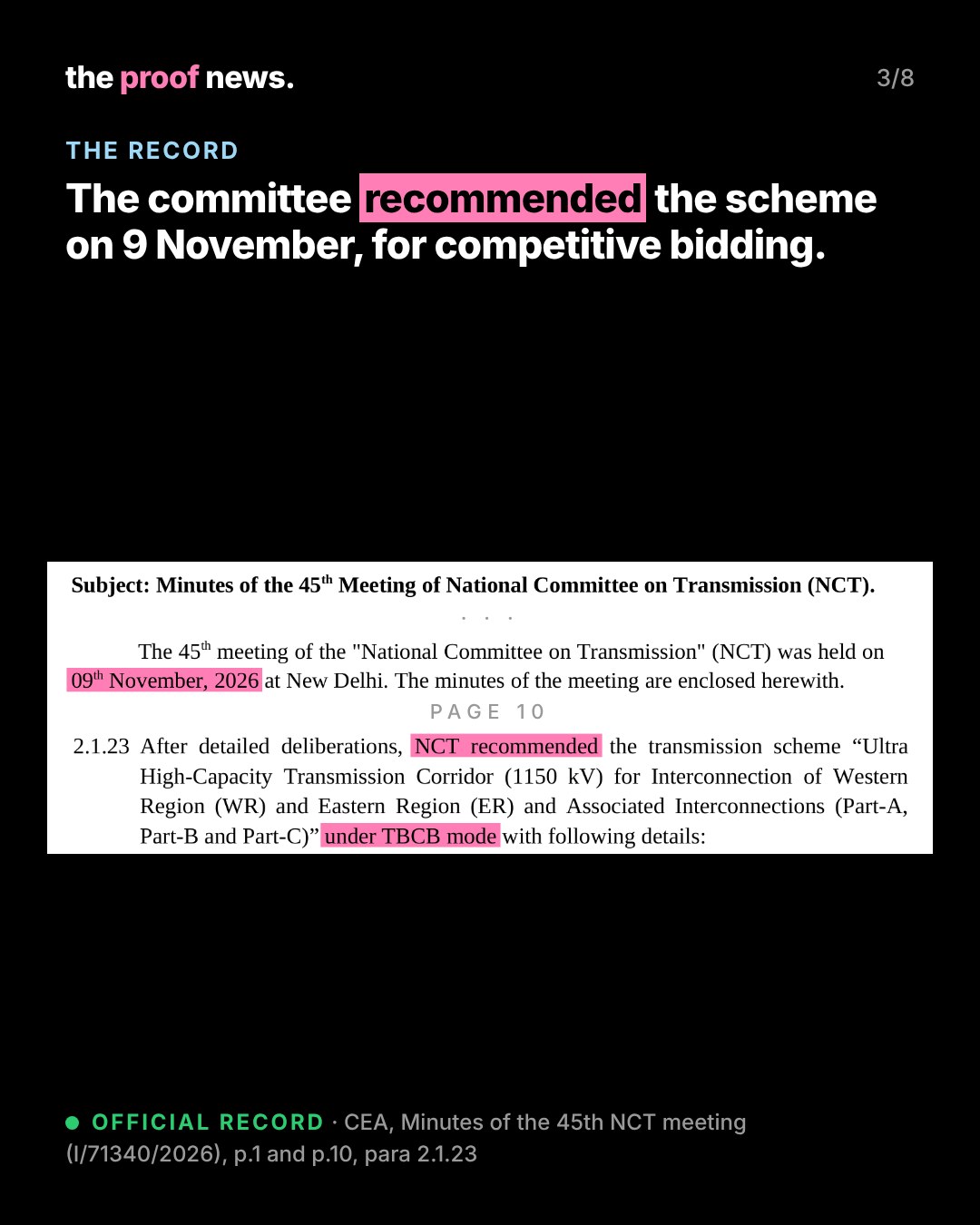
Official recordThe National Committee on Transmission (NCT) recommended the "Ultra High-Capacity Transmission Corridor (1150 kV) for Interconnection of Western Region (WR) and Eastern Region (ER) and Associated Interconnections" in three parts under tariff-based competitive bidding (TBCB) at its 45th meeting in New Delhi on 9 November 2026, according to the minutes published by the Central Electricity Authority (para 2.1.23). The minutes describe the 1150 kV system as "being introduced for first time in the country" (para 2.1.25).
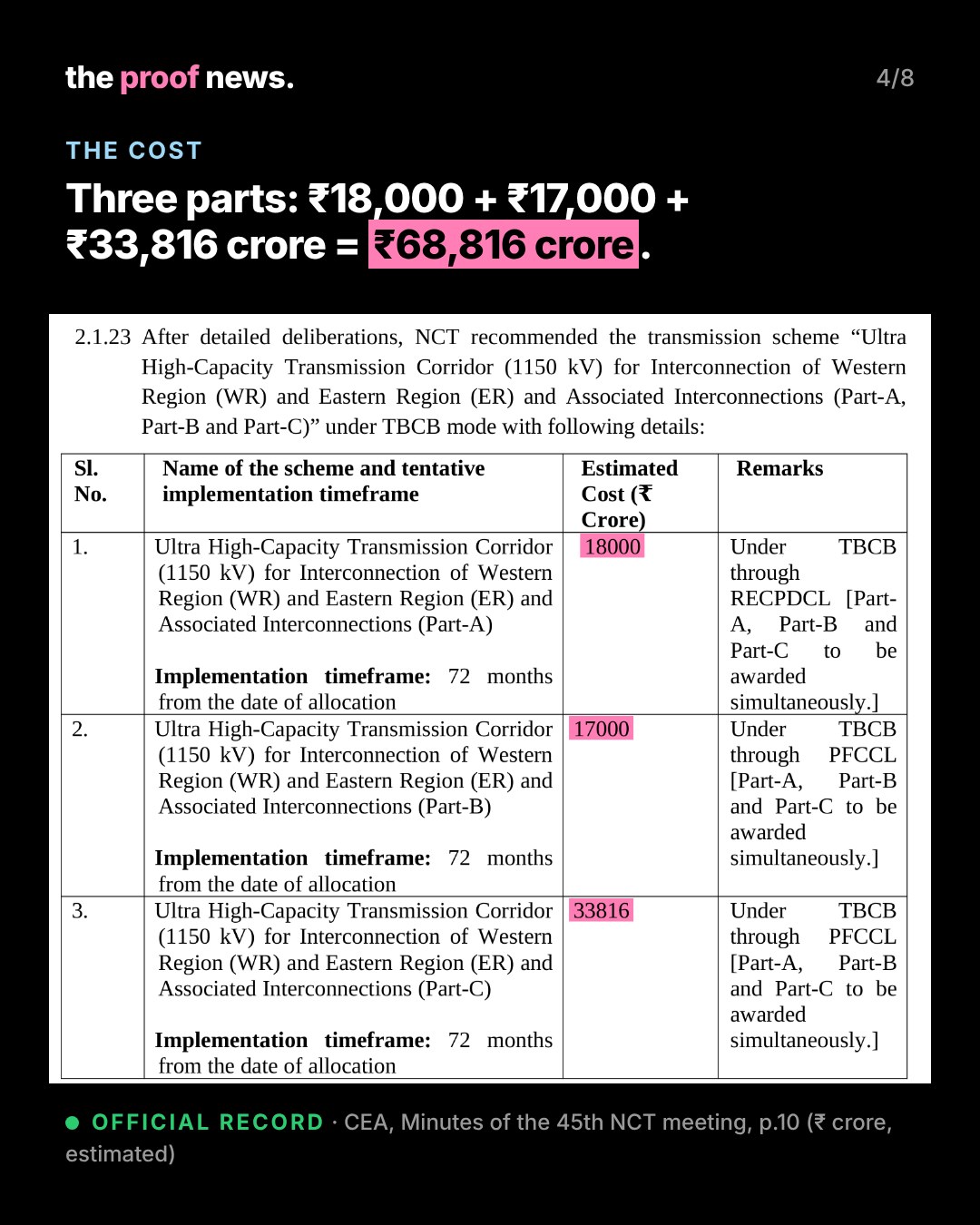
Official recordEstimated cost: Part-A ₹18,000 crore, with RECPDCL as bid process coordinator; Part-B ₹17,000 crore and Part-C ₹33,816 crore, both with PFCCL. The three parts are to be awarded simultaneously, each with an implementation timeframe of 72 months from the date of allocation (p.10).
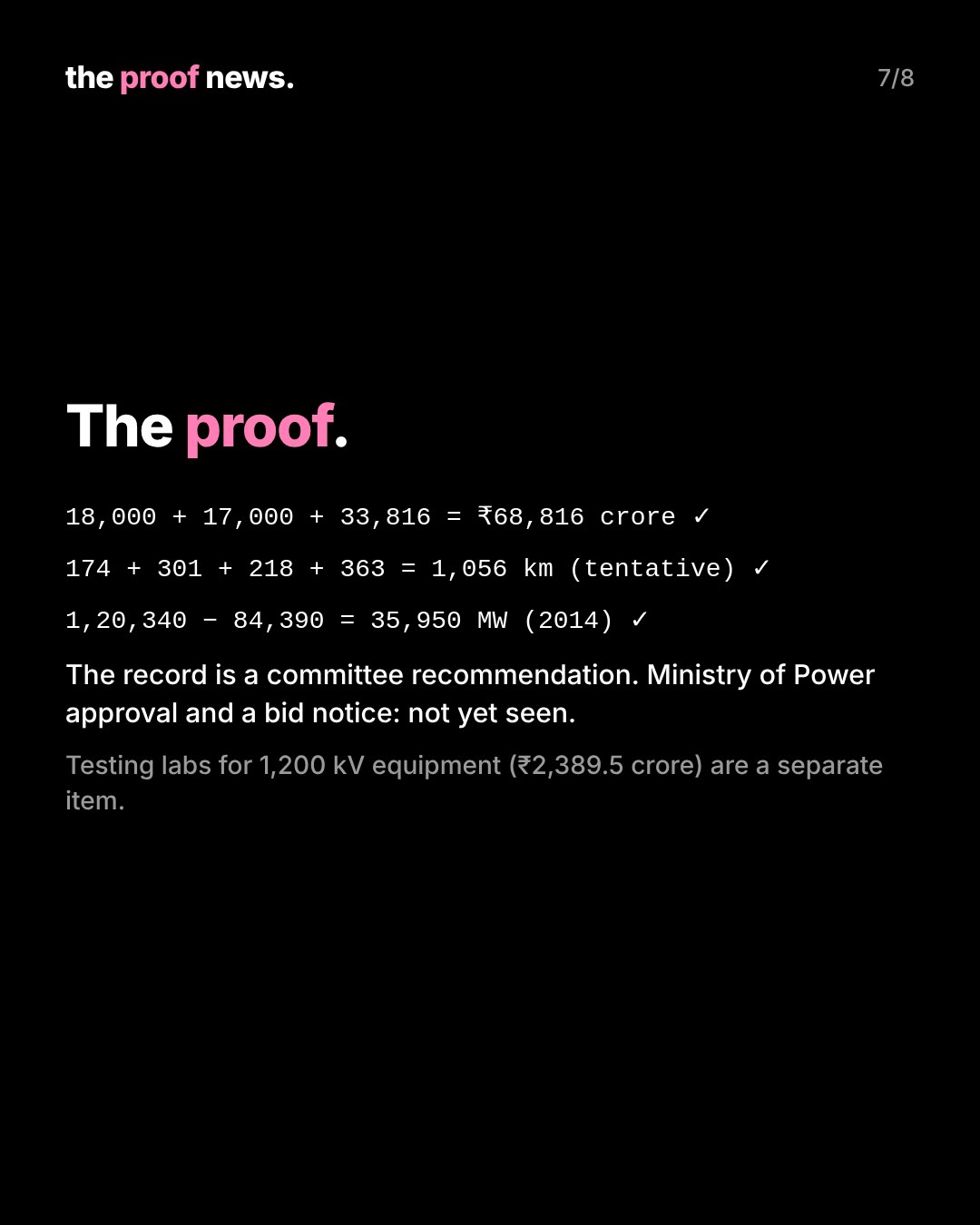
Verified factTotal: ₹68,816 crore (our sum of the three parts). Separately, the committee recommended testing facilities for 1,200 kV equipment at CPRI in Bengaluru, Hyderabad and Nagpur, estimated at ₹2,389.5 crore, to be built by POWERGRID under the regulated tariff mechanism (paras 2.1.26–2.1.30); that is not part of the ₹68,816 crore.
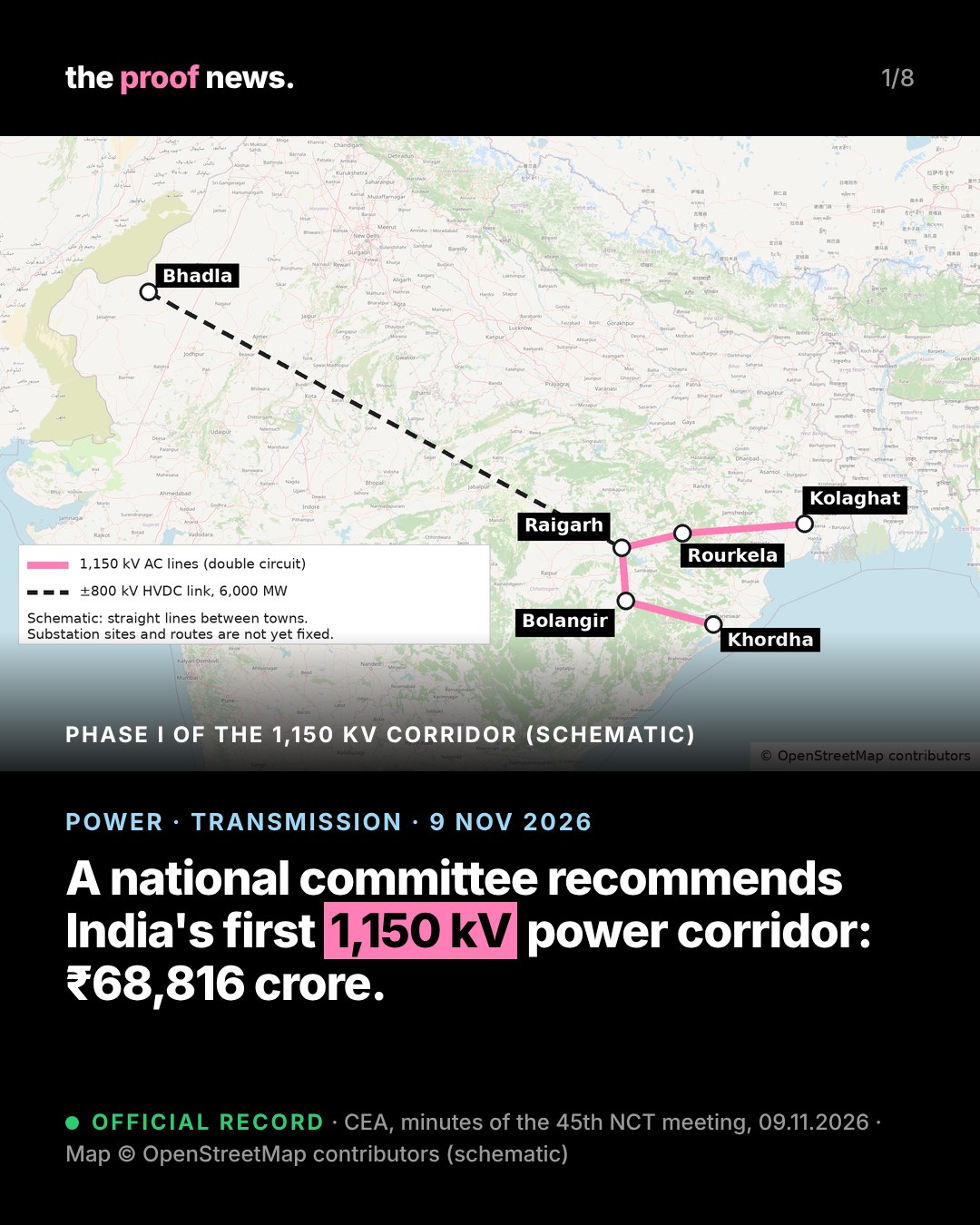
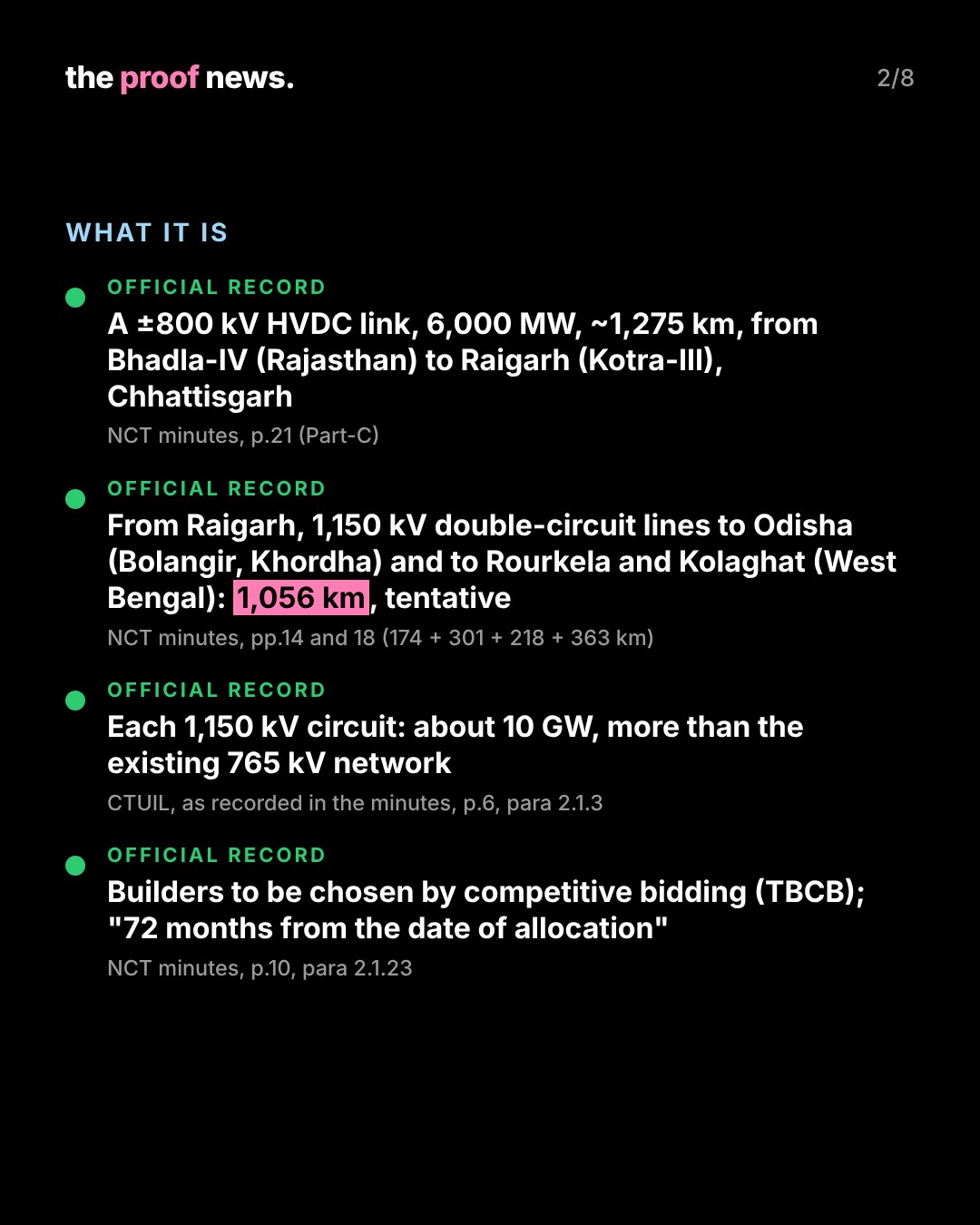
Official recordWhat it is. Phase I would bring renewable power from Bhadla-IV in Rajasthan to the Eastern Region states, including Odisha, Jharkhand and West Bengal (para 2.1.6). A ±800 kV voltage-source-converter HVDC link of 6,000 MW, about 1,275 km long, would run from Bhadla-IV to a new substation at Raigarh (Kotra-III) in Chhattisgarh. From there, 1,150 kV double-circuit lines would run to Bolangir (New) (174 km) and on to Godipada (Khordha) (301 km) in Odisha, and to Rourkela (New) in Odisha (218 km) and on to Kolaghat (New) in West Bengal (363 km). The minutes say line lengths are tentative.
Verified factThe four 1,150 kV lines add up to 1,056 km (tentative).
Official recordCapacity. The Central Transmission Utility (CTUIL) told the committee that 1,150 kV offers a thermal transfer capability of about 14,000 MVA and, with presently feasible 5 kA bay equipment, "about 10GW per circuit", substantially more than the existing 765 kV network (para 2.1.3). Its studies for 2031-32 assumed 5.2 GW of thermal generation at Raigarh (Kotra-III), 12 GW of renewable generation at Bhadla-IV and Ramgarh-II, and around 124 GW of battery storage and 42 GW of pumped storage nationally (para 2.1.1). Only Phase I was put up for approval; Phase II was held back because of lower projected use (para 2.1.5).
Official recordThe regional power committees for the Western Region (24 October 2026) and the Eastern Region (26 October) agreed in principle, and the Northern Region committee (27 October) agreed; the Eastern committee noted the scheme would be classified as a national renewable-energy component for tariff recovery (para 2.1.7).
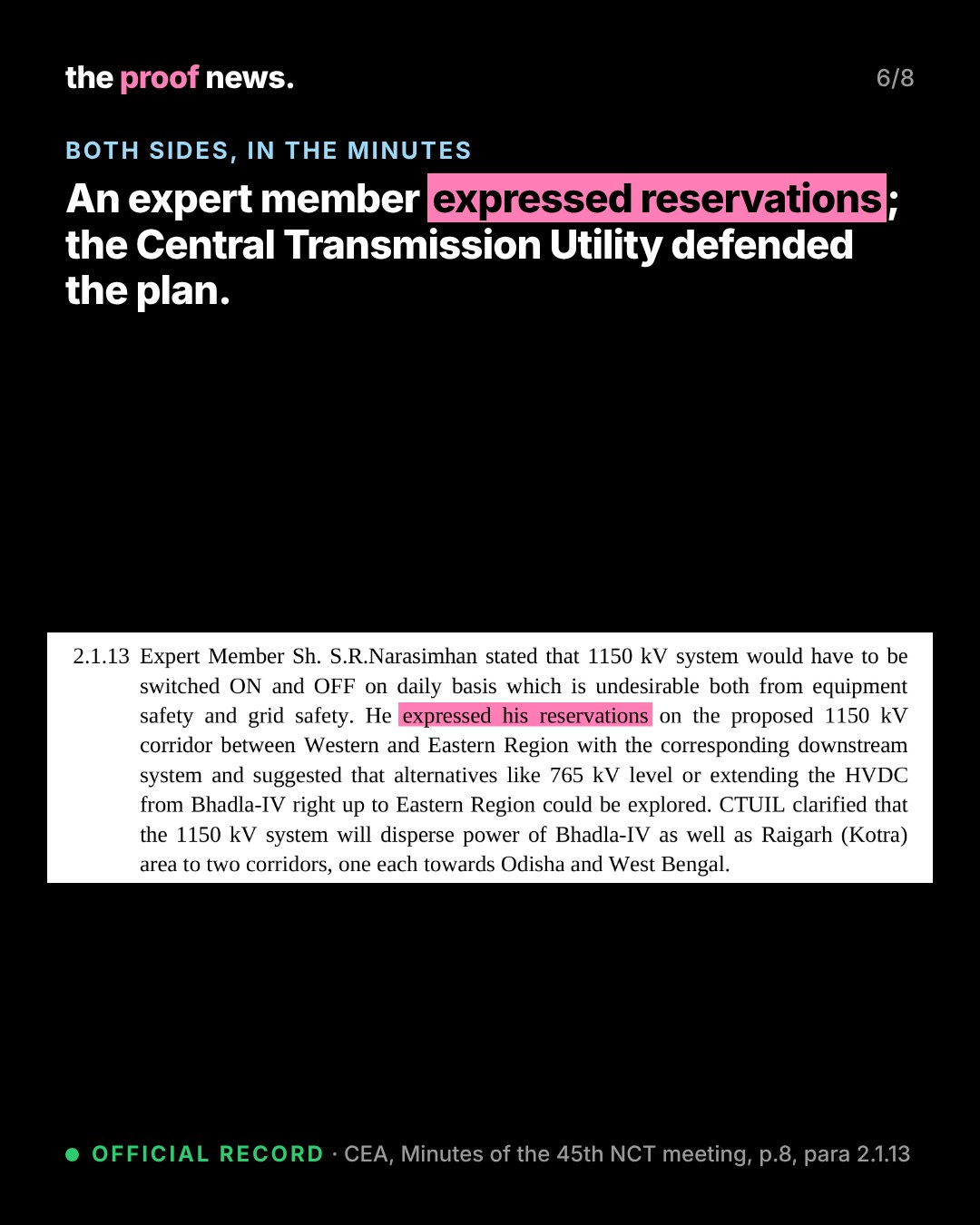
Official recordThe objection. Expert member S.R. Narasimhan said the projected Eastern Region peak demand for 2031-32 implied annual growth of 7.64% from 2026-27, which he called "quite high"; saw a "strong possibility of low loading" of the 1,150 kV lines outside solar hours; said the system would have to be switched on and off daily, which was undesirable for equipment and grid safety; and "expressed his reservations", suggesting a 765 kV option or extending the HVDC from Bhadla-IV to the Eastern Region (paras 2.1.8, 2.1.11, 2.1.13).
Official recordThe reply. CTUIL said demand was based on Electric Power Survey projections, state feedback and access applications, and that in its studies the corridor "remains effectively utilized" in both solar-maximum and evening-peak scenarios; it said the system would carry power from Bhadla-IV and Raigarh (Kotra) along two corridors, towards Odisha and West Bengal (paras 2.1.9, 2.1.12, 2.1.13). Expert member R.K. Tyagi noted that 1150/765 kV transformers have not yet been developed, and the committee kept this phase to 1150/400 kV (para 2.1.20).
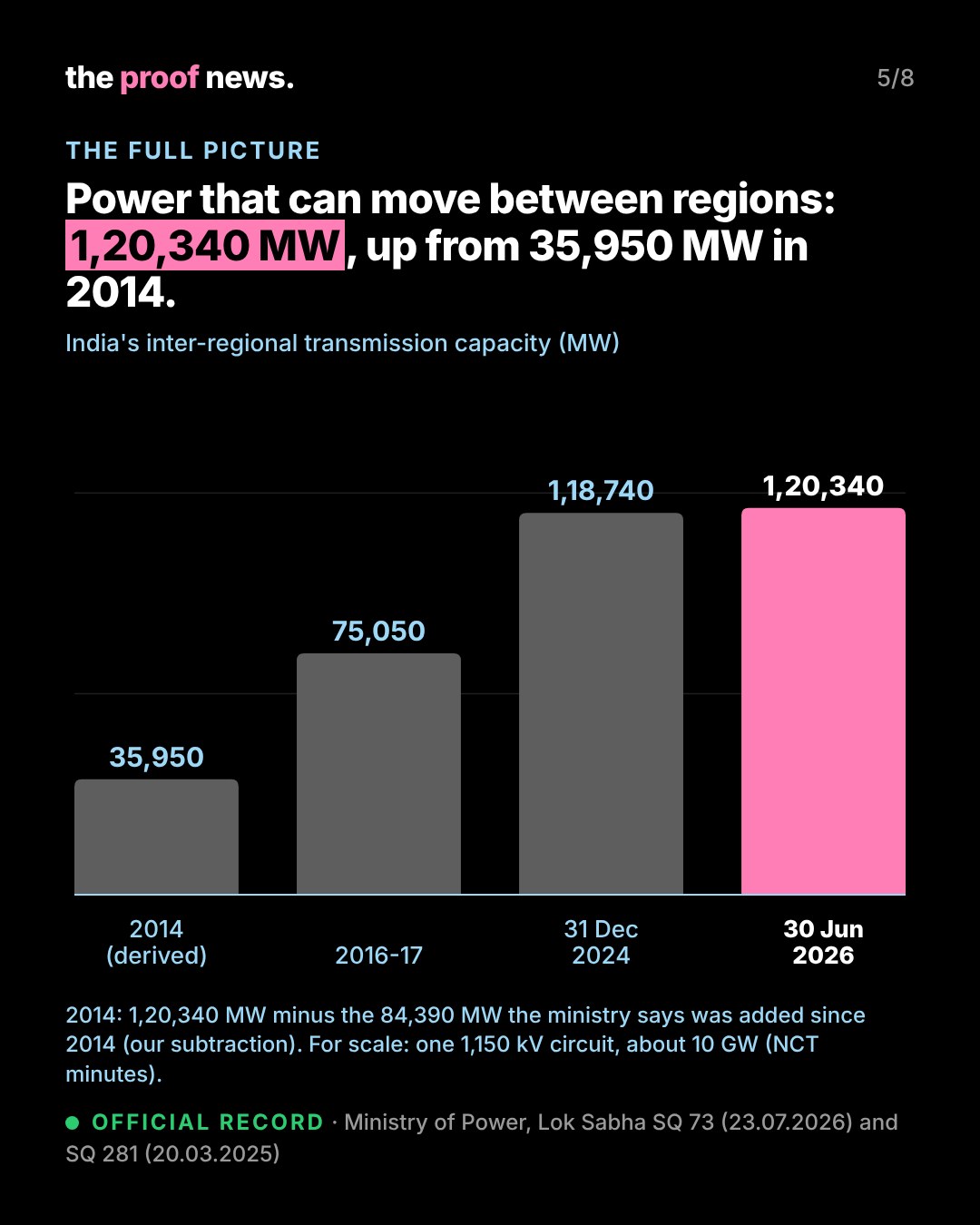
Official recordThe full picture. India's inter-regional transmission capacity, the power that can be moved between its five regional grids, was 1,20,340 MW as on 30 June 2026, with 84,390 MW added since 2014 (Ministry of Power, Lok Sabha Starred Question 73, 23 July 2026). It was 75,050 MW in 2016-17 and 1,18,740 MW on 31 December 2024 (Starred Question 281, 20 March 2025).
Verified factThat puts the 2014 level at 35,950 MW (1,20,340 minus 84,390; the 2025 answer gives the same figure). The ministry does not state the 2014 figure directly.
UnverifiedWe have not seen a Ministry of Power approval, a gazette notification or a request for bids for the scheme as of 14 November 2026. Who will build it will be decided by bidding.
CommentaryWhat to watch: the ministry's decision, the bid process run by RECPDCL and PFCCL, the final routes and costs after bidding, and whether the utilisation concerns raised in the committee are borne out.
The proof.
Every figure is read from the CEA's minutes of the 45th NCT meeting and recomputed: the three part costs add up to ₹68,816 crore and the four 1,150 kV line lengths to 1,056 km (tentative). The inter-regional capacity series is from two Ministry of Power answers in the Lok Sabha; the 2014 level is our subtraction from the ministry's own figures, and both answers give the same result. The map is a schematic between town centres, because substation sites and routes are not yet fixed.
- CEA, Minutes of the 45th Meeting of the National Committee on Transmission, 09.11.2026 (PDF)
- CEA, National Committee on Transmission: meetings and minutes
- Ministry of Power, Lok Sabha Starred Question 73, 23.07.2026 (PDF)
- Ministry of Power, Lok Sabha Starred Question 281, 20.03.2025 (PDF)
- PIB release 2217216, 22.01.2026: transmission network crosses 5 lakh circuit km
- Map data © OpenStreetMap contributors