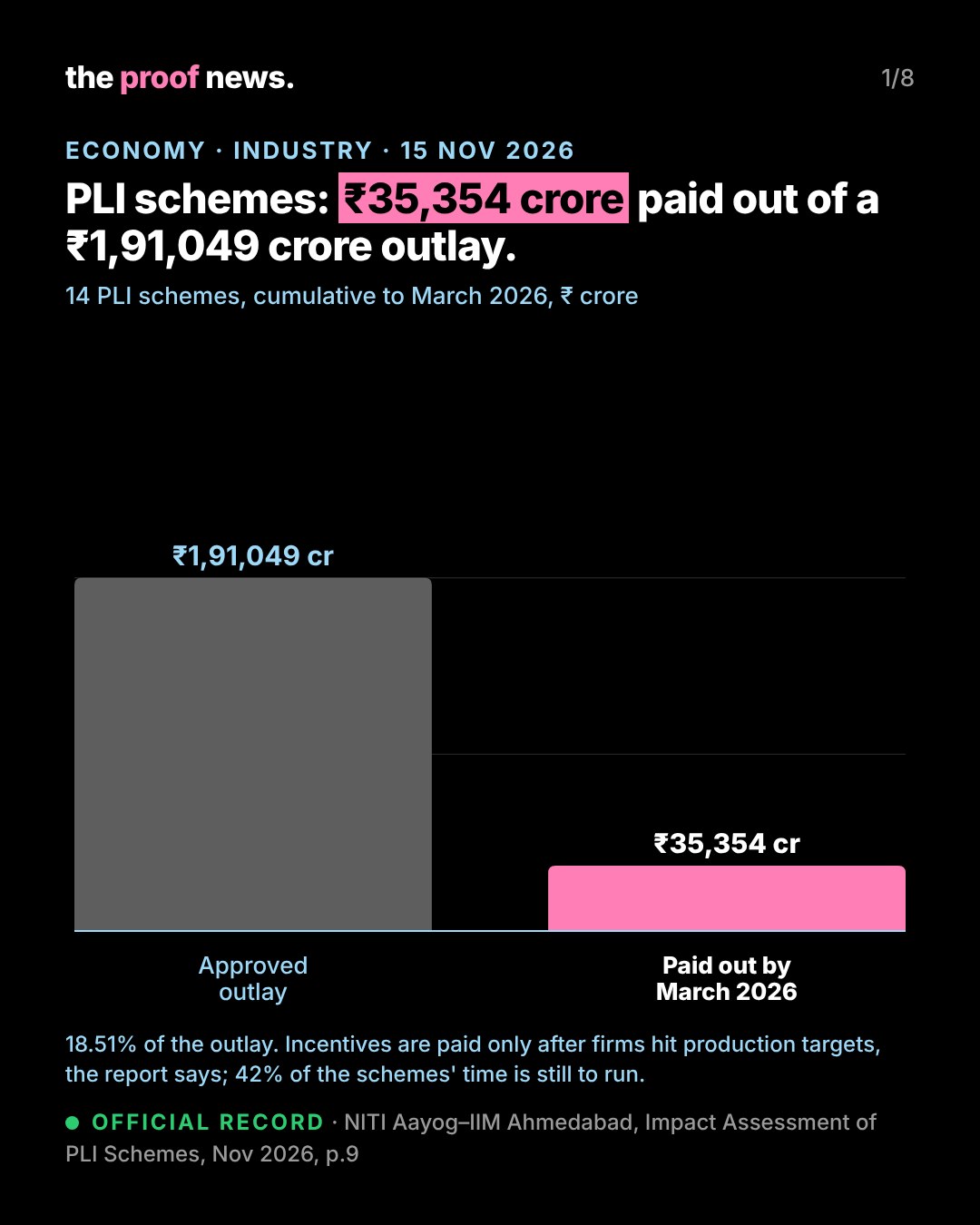
PLI schemes: ₹35,354 crore paid of a ₹1,91,049 crore outlay; jobs at 28% of target, investment at 76%, NITI Aayog report finds
A NITI Aayog assessment prepared with IIM Ahmedabad covers all 14 Production Linked Incentive schemes to March 2026. Payouts are rising and investment is ahead of schedule; jobs and some sectors, such as ACC batteries, are well behind.
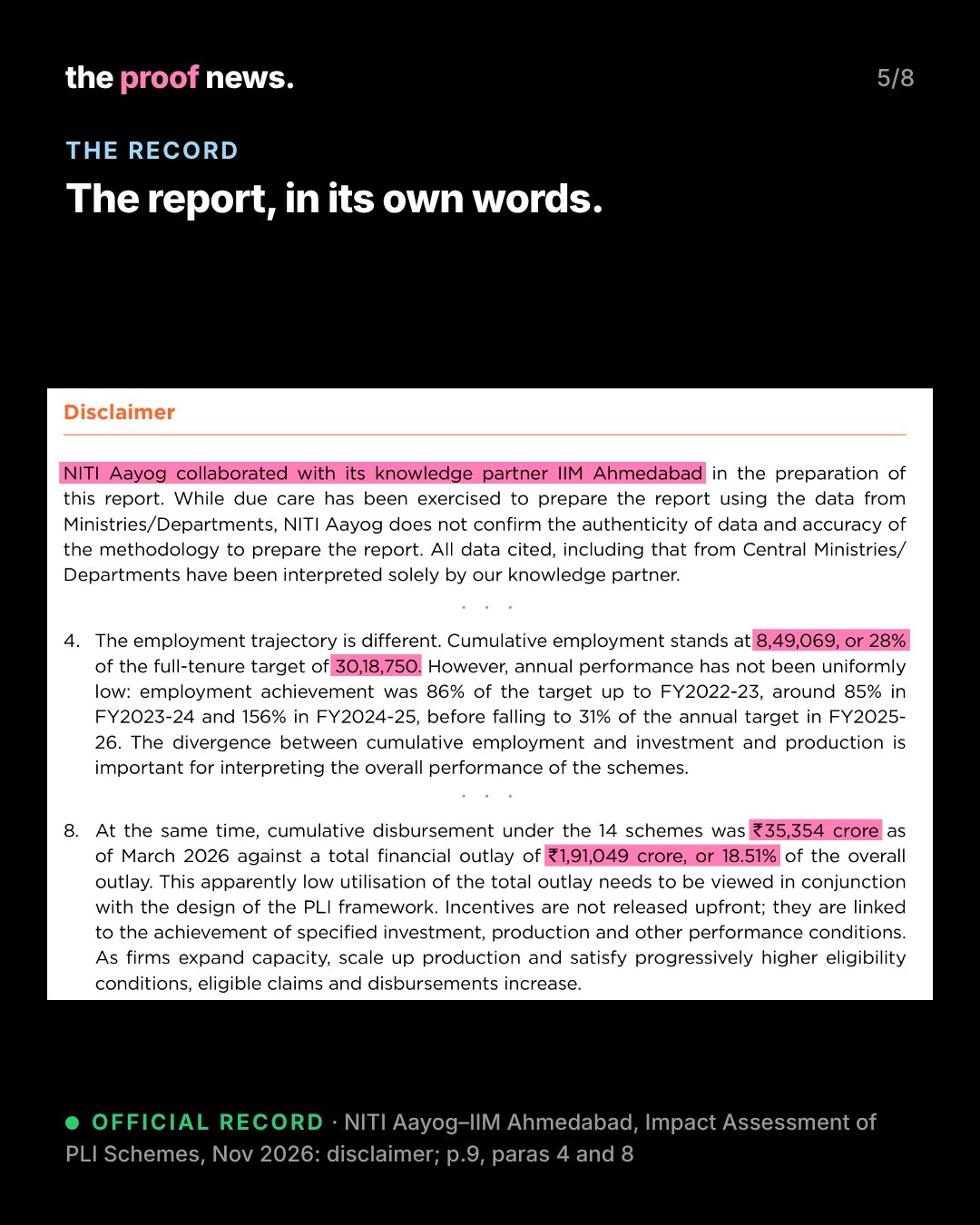
Official recordNITI Aayog has published "Impact Assessment of PLI Schemes" (November 2026), prepared with its knowledge partner IIM Ahmedabad. It assesses the 14 Production Linked Incentive schemes on investment, production, employment and exports, using ministry data to March 2026. The report's disclaimer says NITI Aayog "does not confirm the authenticity of data and accuracy of the methodology" and that the data "have been interpreted solely by our knowledge partner".
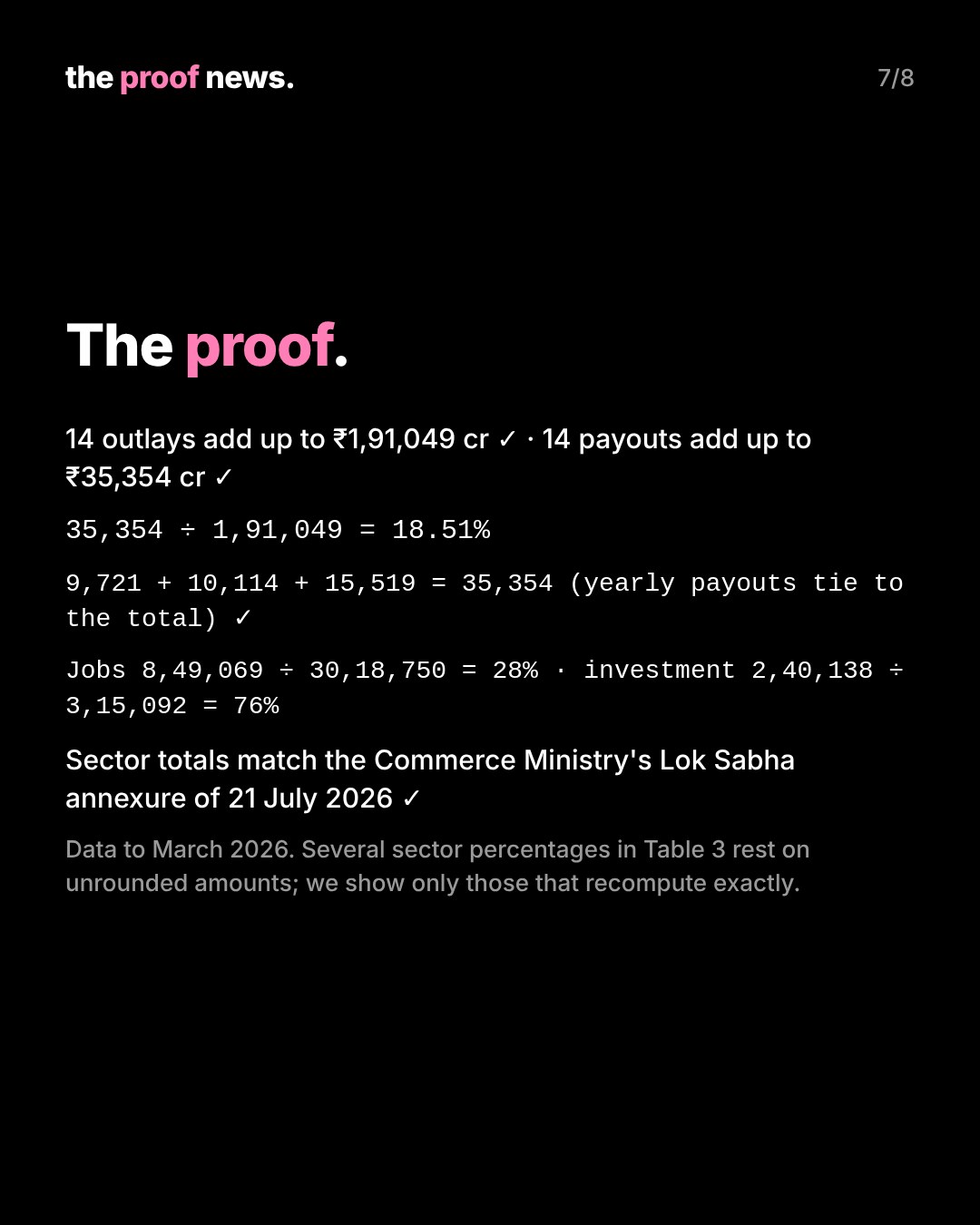
Official recordMoney: the 14 schemes have a combined outlay of ₹1,91,049 crore. Cumulative incentives paid to March 2026 were ₹35,354 crore, or 18.51% of the outlay (p.9, para 8; Table 3). The report says this "apparently low utilisation" reflects the design: incentives are released only after firms meet investment, production and other conditions.
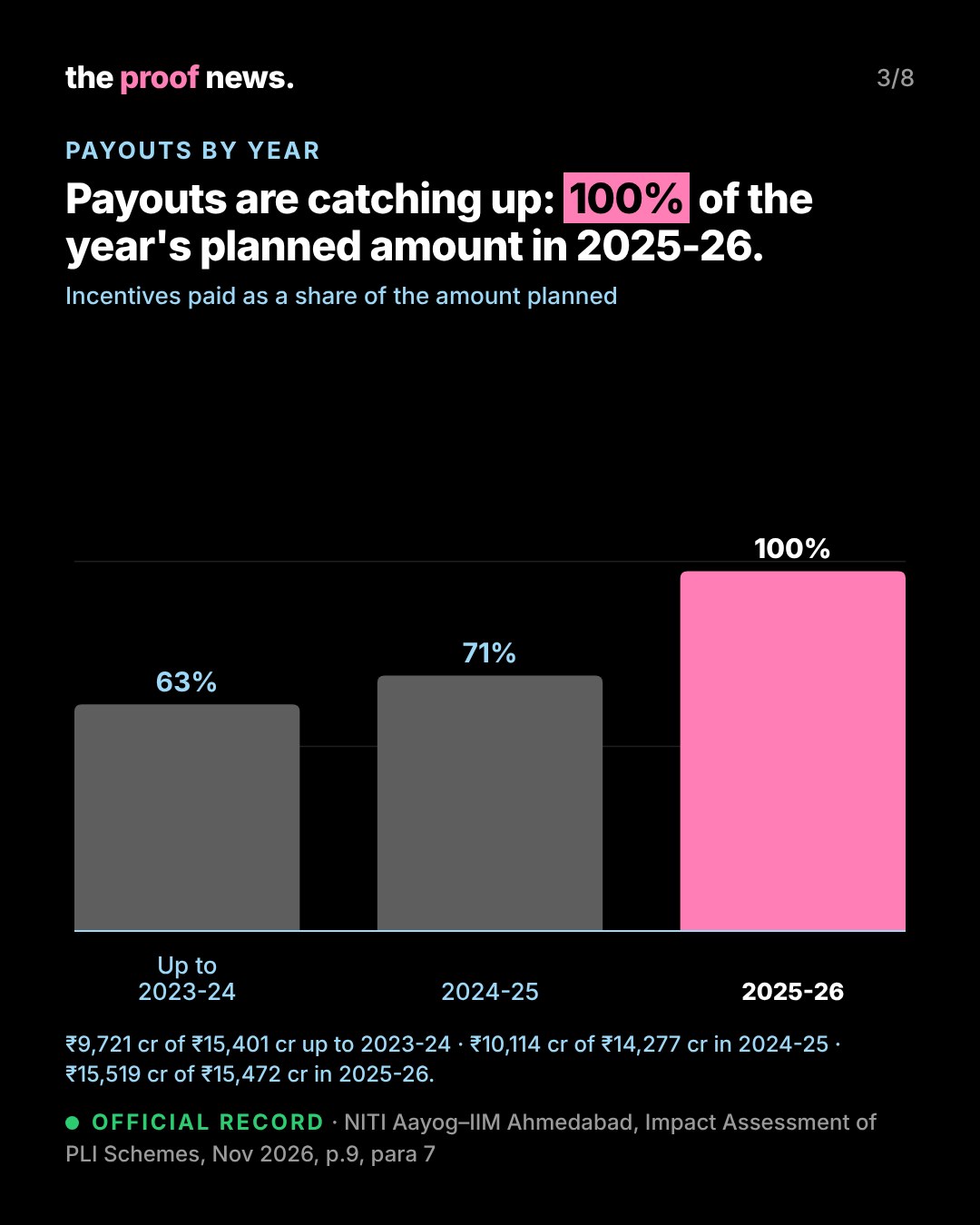
Official recordPayouts against plan, by year: ₹9,721 crore of a planned ₹15,401 crore up to 2023-24 (63%), ₹10,114 crore of ₹14,277 crore in 2024-25 (71%) and ₹15,519 crore of ₹15,472 crore in 2025-26 (100%); 78% of the planned amount overall (p.9, para 7).
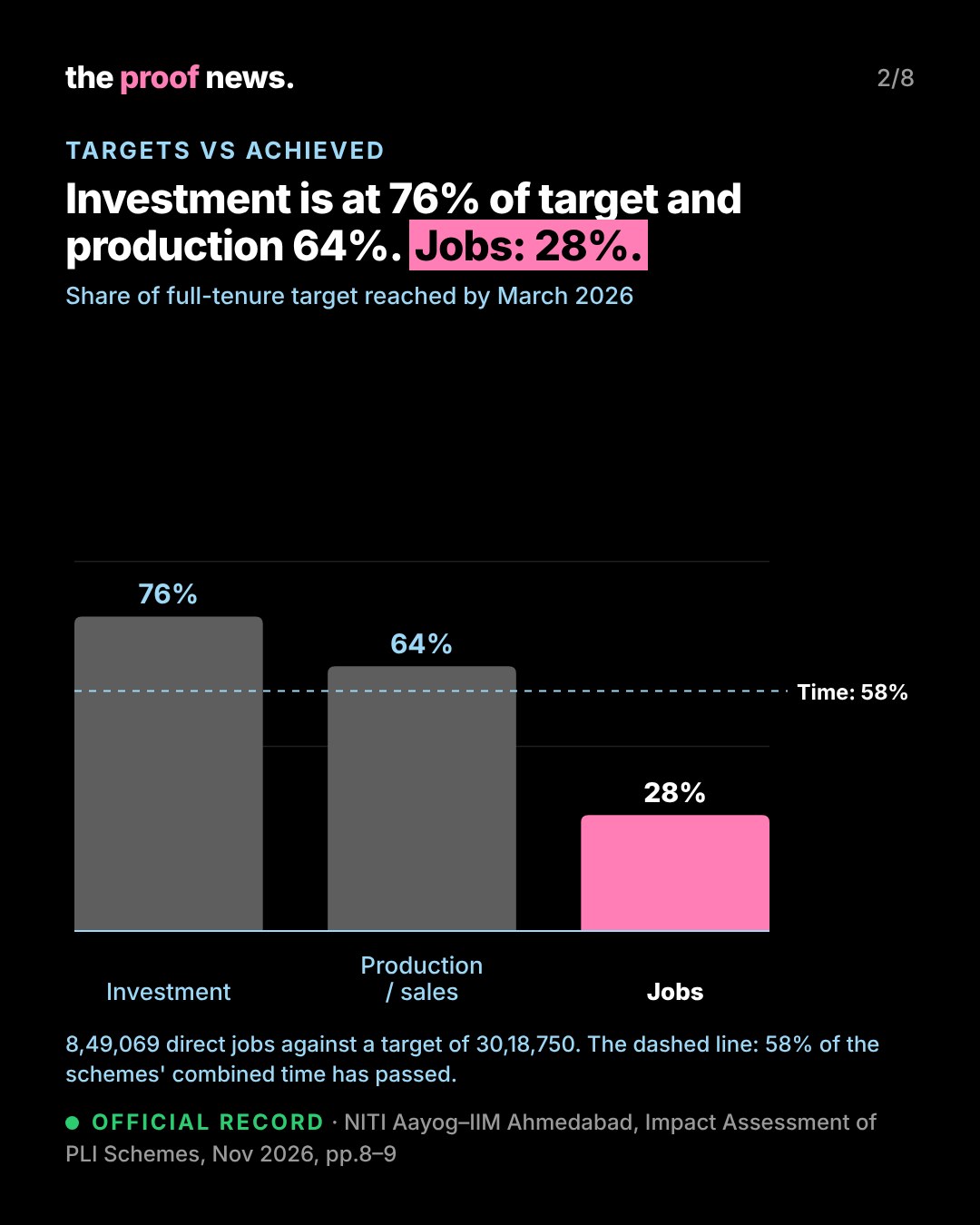
Official recordAgainst full-tenure targets: investment ₹2,40,138 crore, 76% of ₹3,15,092 crore; production and sales ₹22,66,412 crore, 64% of ₹35,37,863 crore; employment 8,49,069, 28% of 30,18,750. The schemes have used 58% of their combined implementation period (578 of 996 months). Yearly job achievement was 86% of target up to 2022-23, about 85% in 2023-24, 156% in 2024-25 and 31% in 2025-26 (pp.8–9).
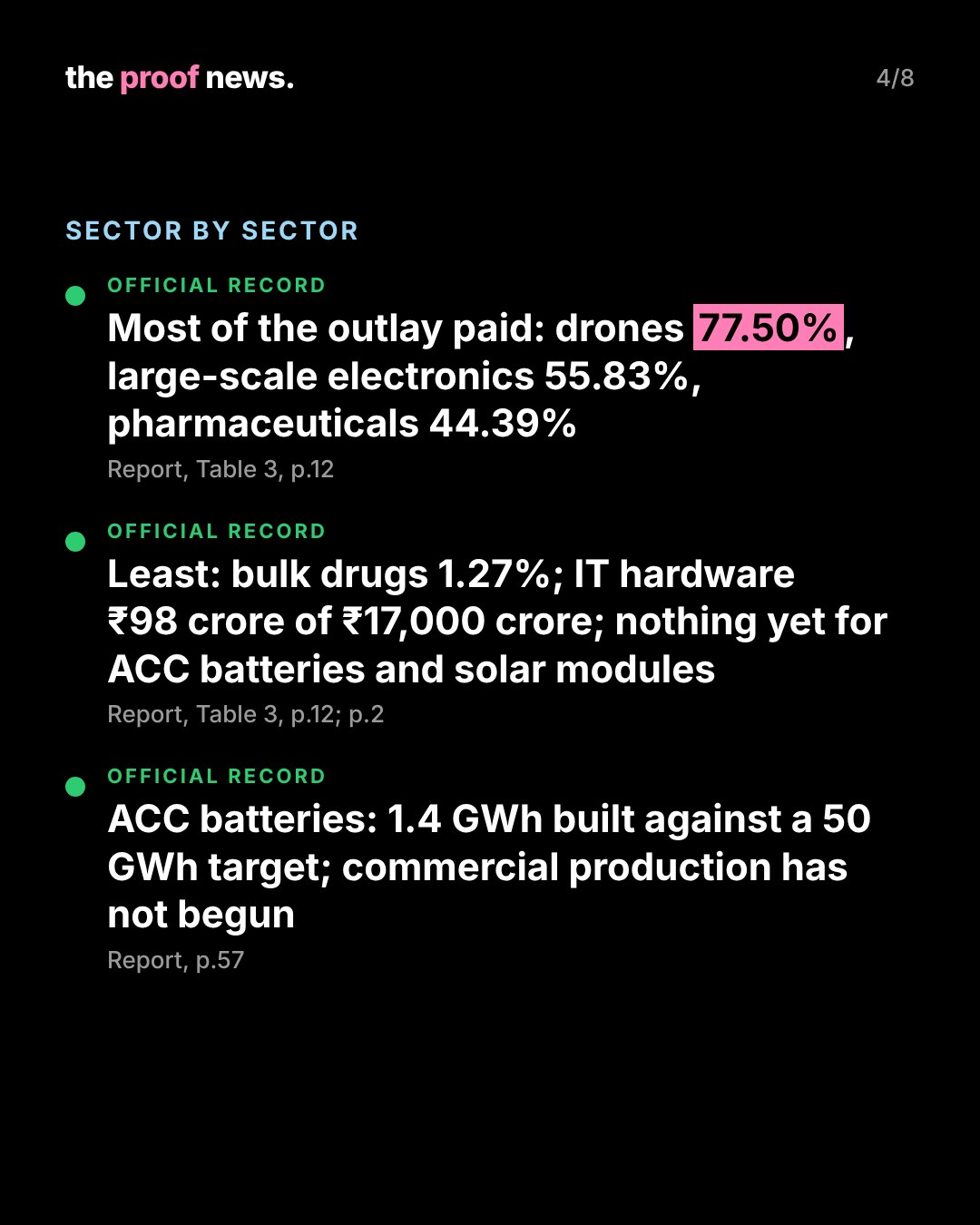
Official recordBy sector (Table 3): drones 77.50% of outlay paid, large-scale electronics 55.83% (₹19,091 crore), pharmaceuticals 44.39%, automobiles 9.20%, speciality steel 3.73%, textiles 3.61%, bulk drugs 1.27%. IT hardware received ₹98 crore of a ₹17,000 crore outlay. No disbursement is shown for ACC batteries or solar PV modules.
Official recordACC batteries: about 1.4 GWh of capacity has been developed against a 50 GWh target, and commercial production has not begun; the report cites limited domestic technology, imported machinery, execution delays and a shortage of skilled workers (pp.2–3, 57). Telecom: the scheme sets no domestic value-addition requirement, so a firm "may import up to 100% of the components, assemble them, and still qualify" (p.48).
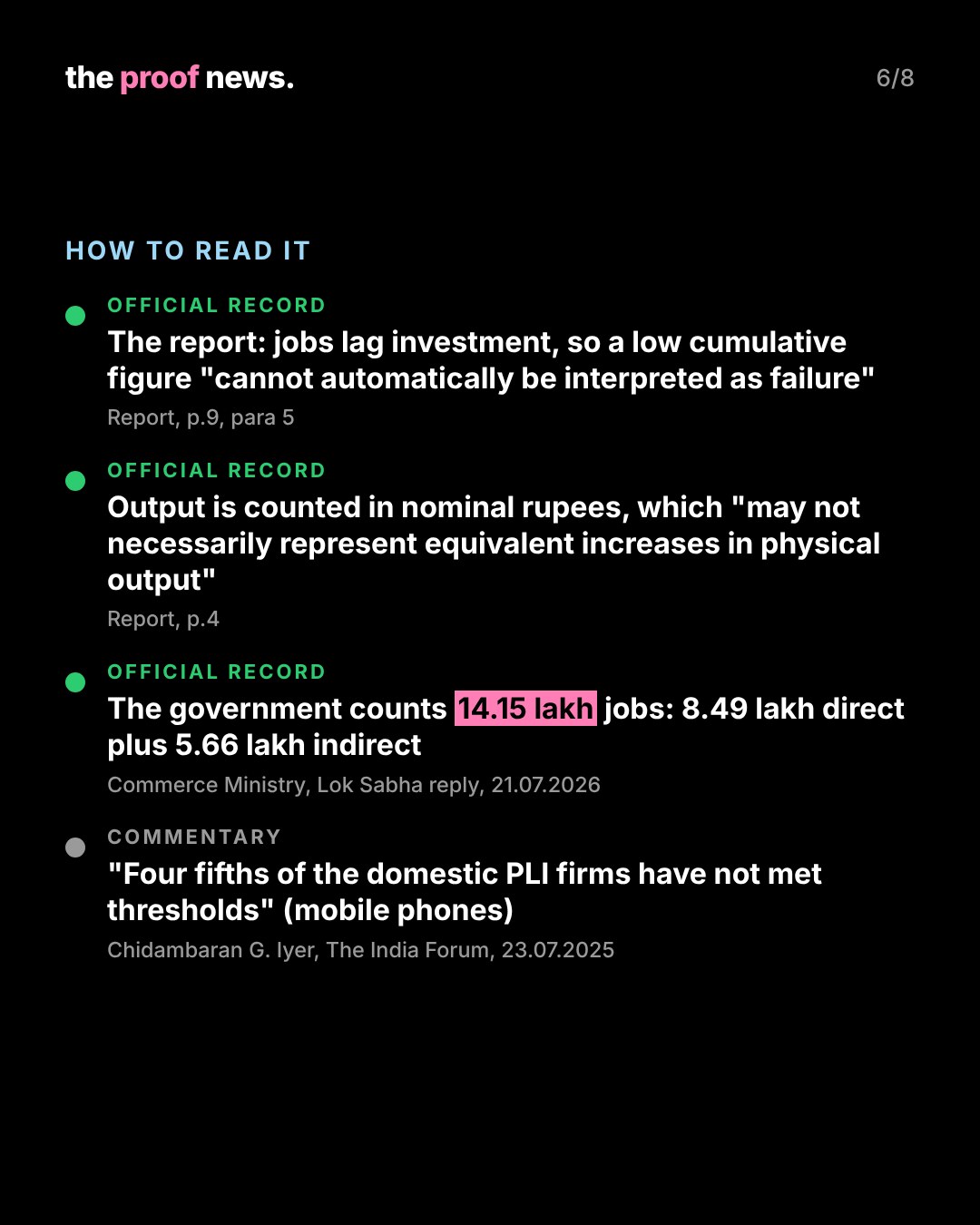
Official recordThe report's own caveats: employment lags investment, and a low cumulative figure "cannot automatically be interpreted as failure" (p.9); production and sales are in nominal values, which "may not necessarily represent equivalent increases in physical output" (p.4); and data reporting across ministries "need urgent standardisation" (p.96). Its overall view is that the scheme "is on track in achieving several of its intended objectives, while the full impact remains to emerge in a number of sectors" (p.4).
Official recordThe government's employment figure differs because it adds indirect jobs: in a Lok Sabha reply on 21 July 2026, the Commerce Ministry put PLI employment at over 14.15 lakh, made up of the same 8,49,069 direct jobs plus 5.66 lakh indirect jobs reported in three sectors (large-scale electronics, IT hardware and solar). Its sector-wise investment and direct-job figures match the report's Table 4.
CommentaryCritics have questioned the schemes' value. Economist Chidambaran G. Iyer, writing in The India Forum on 23 July 2025 about the mobile-phone scheme, said: "Four fifths of the domestic PLI firms have not met thresholds, bringing the value of PLI into question." We found no response from opposition parties to this report by the morning of 15 November.
Verified factNote on the data: in Table 4 the bulk-drugs investment is printed as "50,70"; the Lok Sabha annexure gives ₹5,070 crore, which is the figure that makes the column add up to ₹2,40,138 crore. Several sector percentages in Table 3 differ by 0.01–0.02 points from a recomputation using the rounded amounts; the totals are exact.
The proof.
Every figure is taken from the NITI Aayog report and recomputed: the 14 outlays add up to ₹1,91,049 crore, the 14 payouts to ₹35,354 crore, and the three yearly payouts to the same ₹35,354 crore; investment and direct-job totals match the Commerce Ministry's Lok Sabha annexure of 21 July 2026.