"49.6 crore lifted out of poverty": the World Bank figure is accurate, but it is the $4.20-a-day line, not extreme poverty
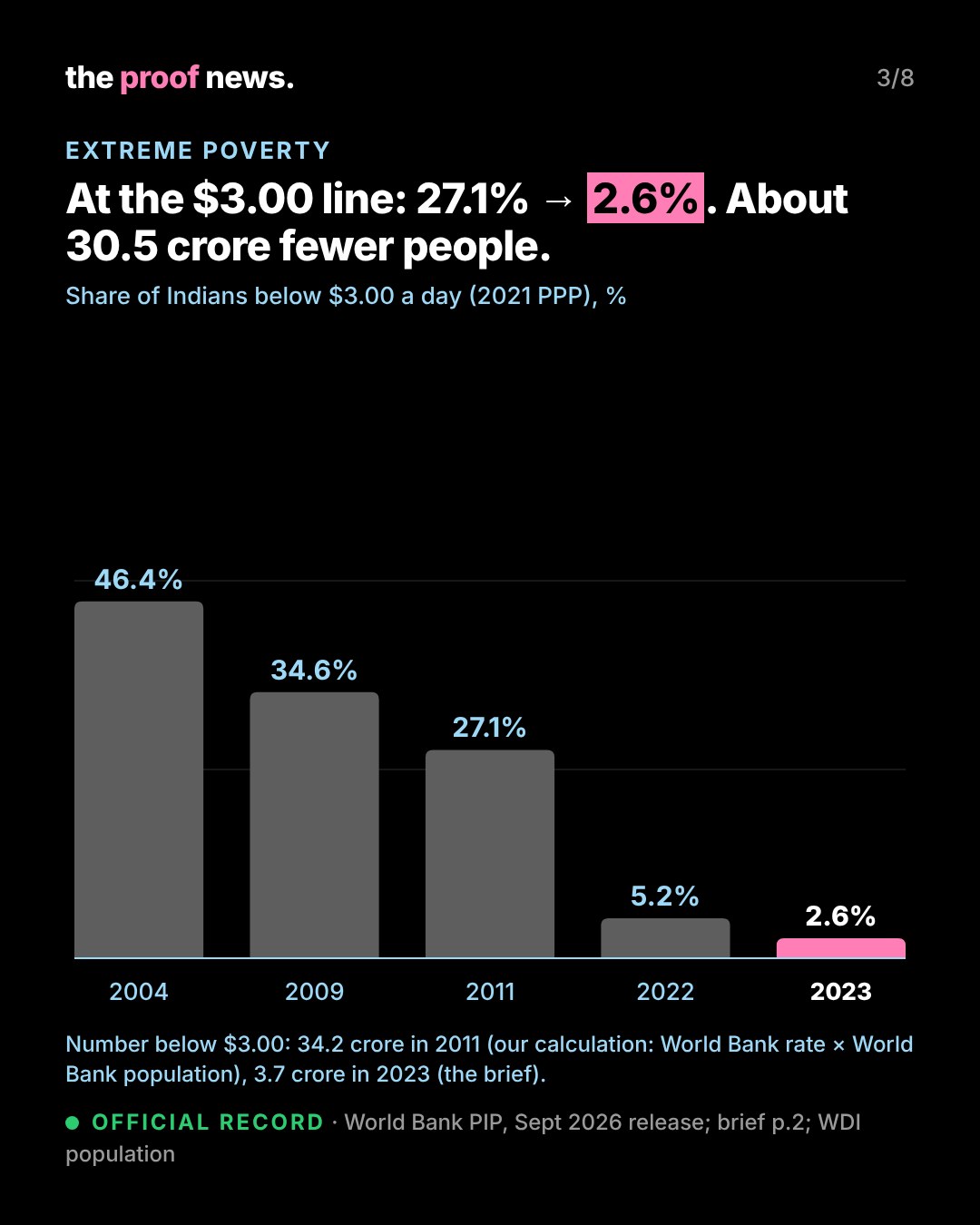
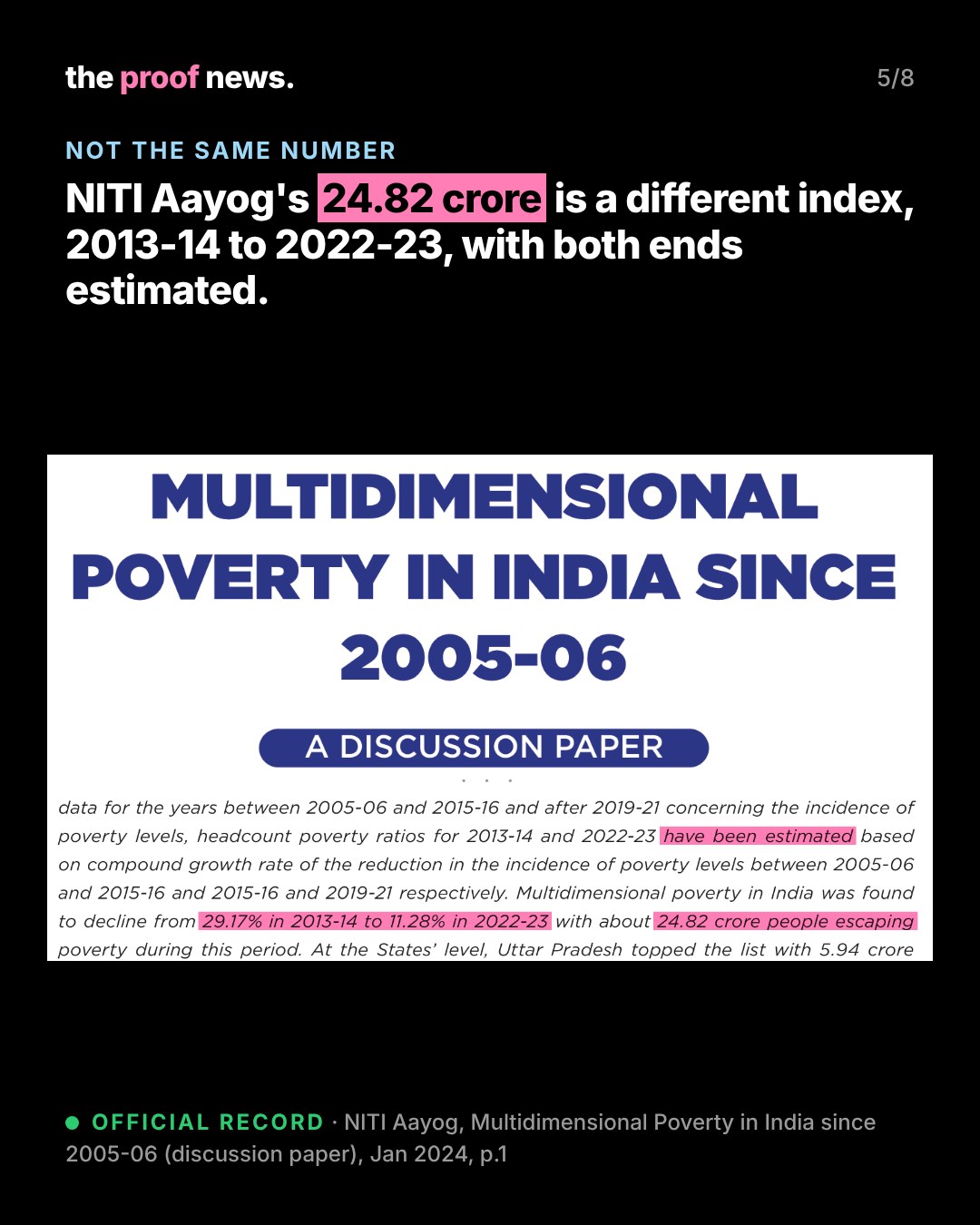
The World Bank's October 2026 brief says 496 million Indians rose above its $4.20-a-day line between 2011 and 2023. Extreme poverty, at $3.00 a day, fell from 27.1% to 2.6%, about 30.5 crore fewer people. The figure is not NITI Aayog's 24.82 crore.
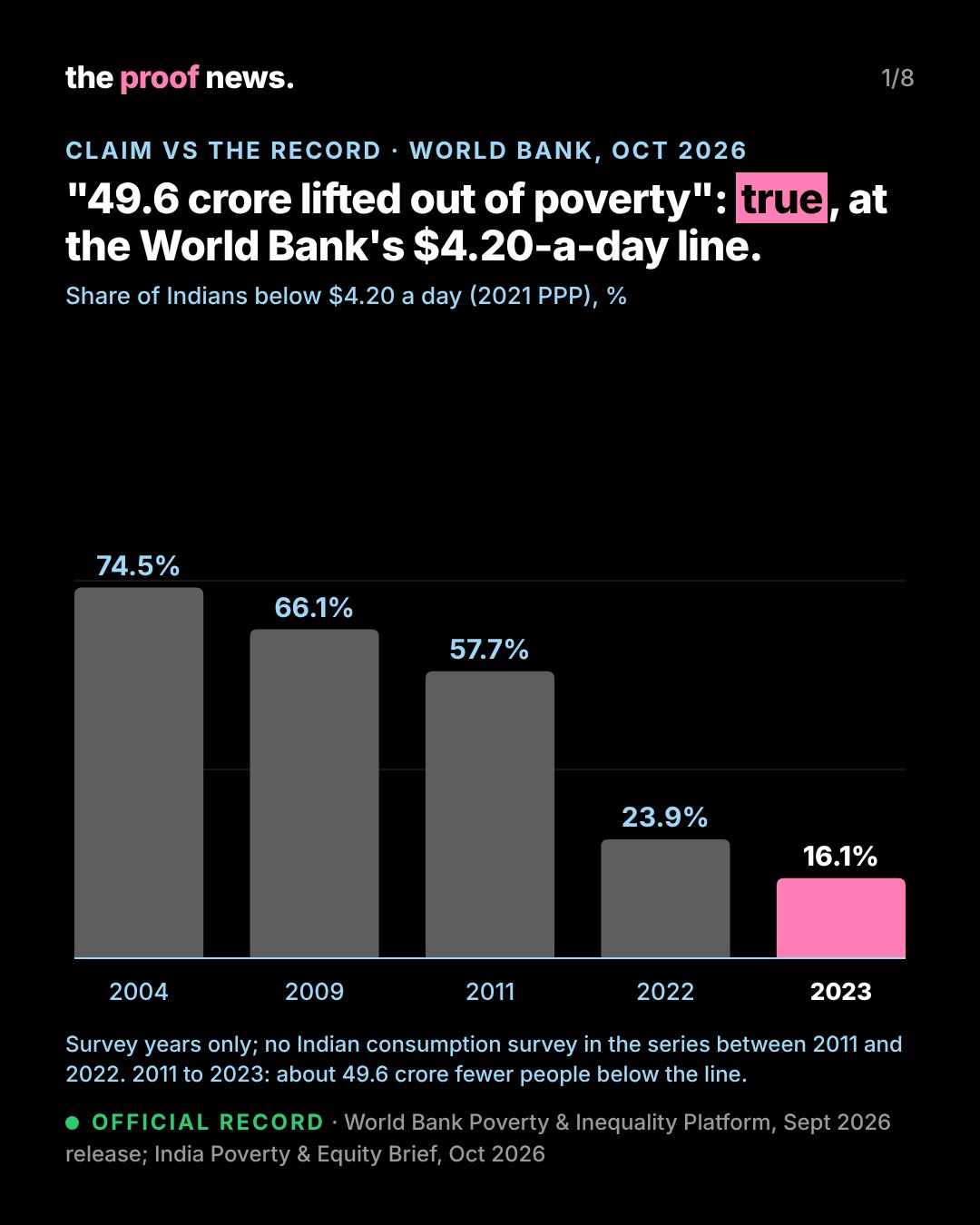
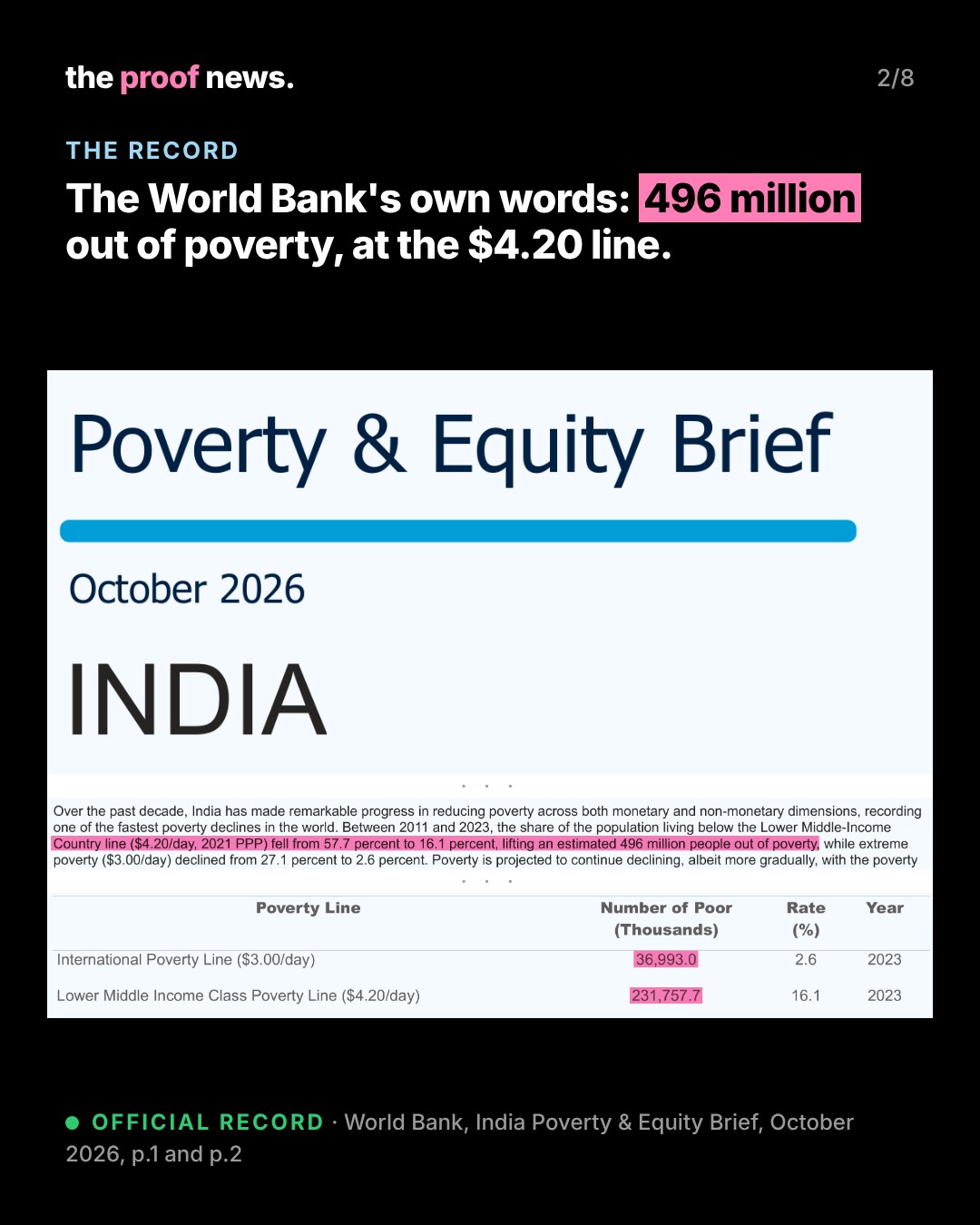
Official recordThe claim: on 16 November 2026, the lead report said the World Bank had praised India's poverty reduction and that 49.6 crore people had been lifted out of poverty. The World Bank's India Poverty & Equity Brief (October 2026) says: "Between 2011 and 2023, the share of the population living below the Lower Middle-Income Country line ($4.20/day, 2021 PPP) fell from 57.7 percent to 16.1 percent, lifting an estimated 496 million people out of poverty, while extreme poverty ($3.00/day) declined from 27.1 percent to 2.6 percent" (p.1). It calls this "one of the fastest poverty declines in the world".
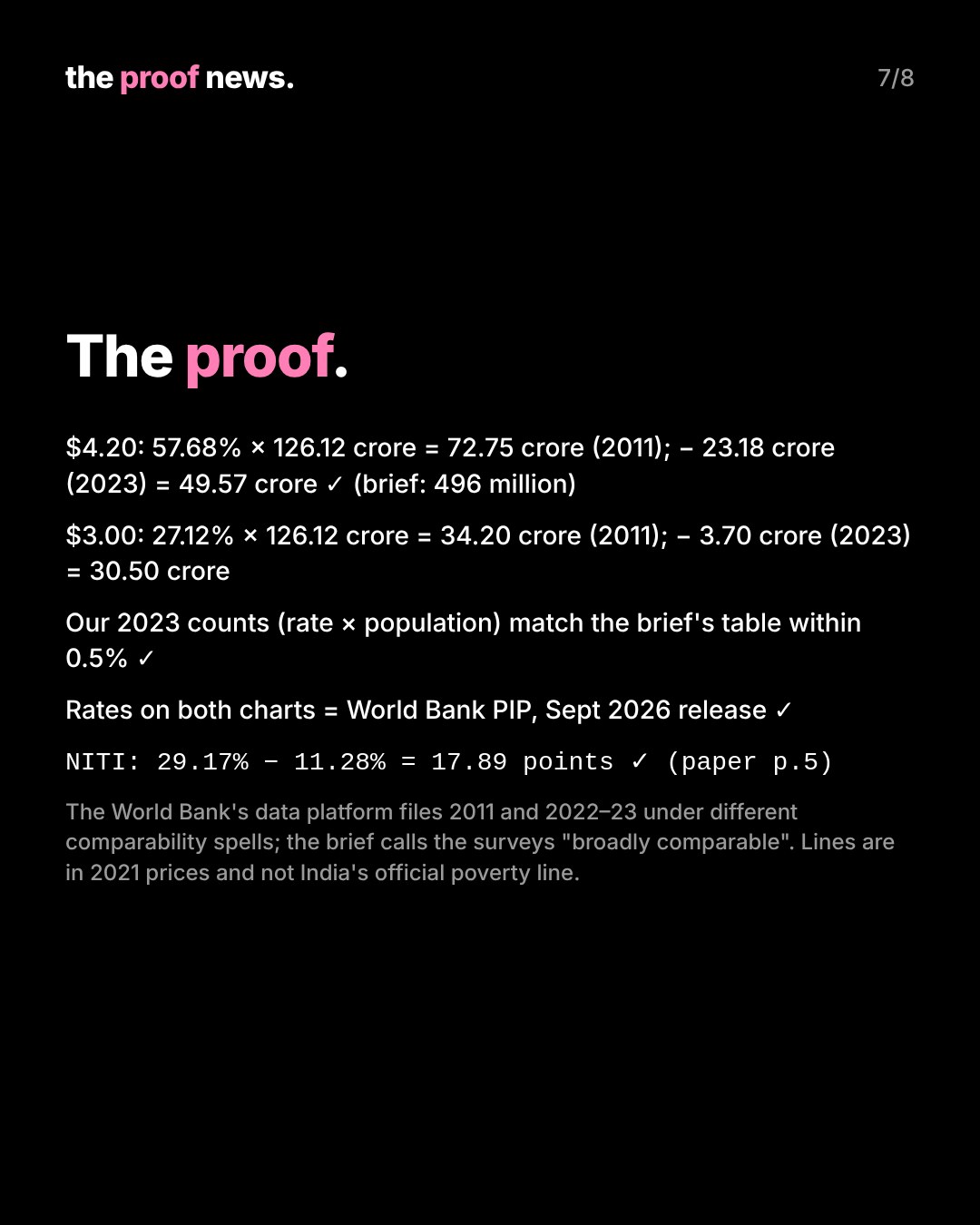
Verified factVerdict: true as stated. Recomputed from the World Bank's own rates (Poverty & Inequality Platform, September 2026 release) and its population data: 72.75 crore people were below $4.20 a day in 2011 and 23.18 crore in 2023, a fall of 49.57 crore, which rounds to the brief's 496 million.
Official recordWhat the number measures: the $4.20 line is the World Bank's line for lower-middle-income countries, in 2021 prices adjusted for purchasing power. The brief says it is used to measure "(moderate) poverty"; extreme poverty is measured at $3.00 a day (p.2). These are international lines, not India's official poverty line.
Verified factExtreme poverty: the share below $3.00 a day fell from 27.1% in 2011 to 2.6% in 2023. In numbers, about 34.20 crore to 3.70 crore, about 30.5 crore fewer people (2023 count from the brief; 2011 from the World Bank's rate and population).
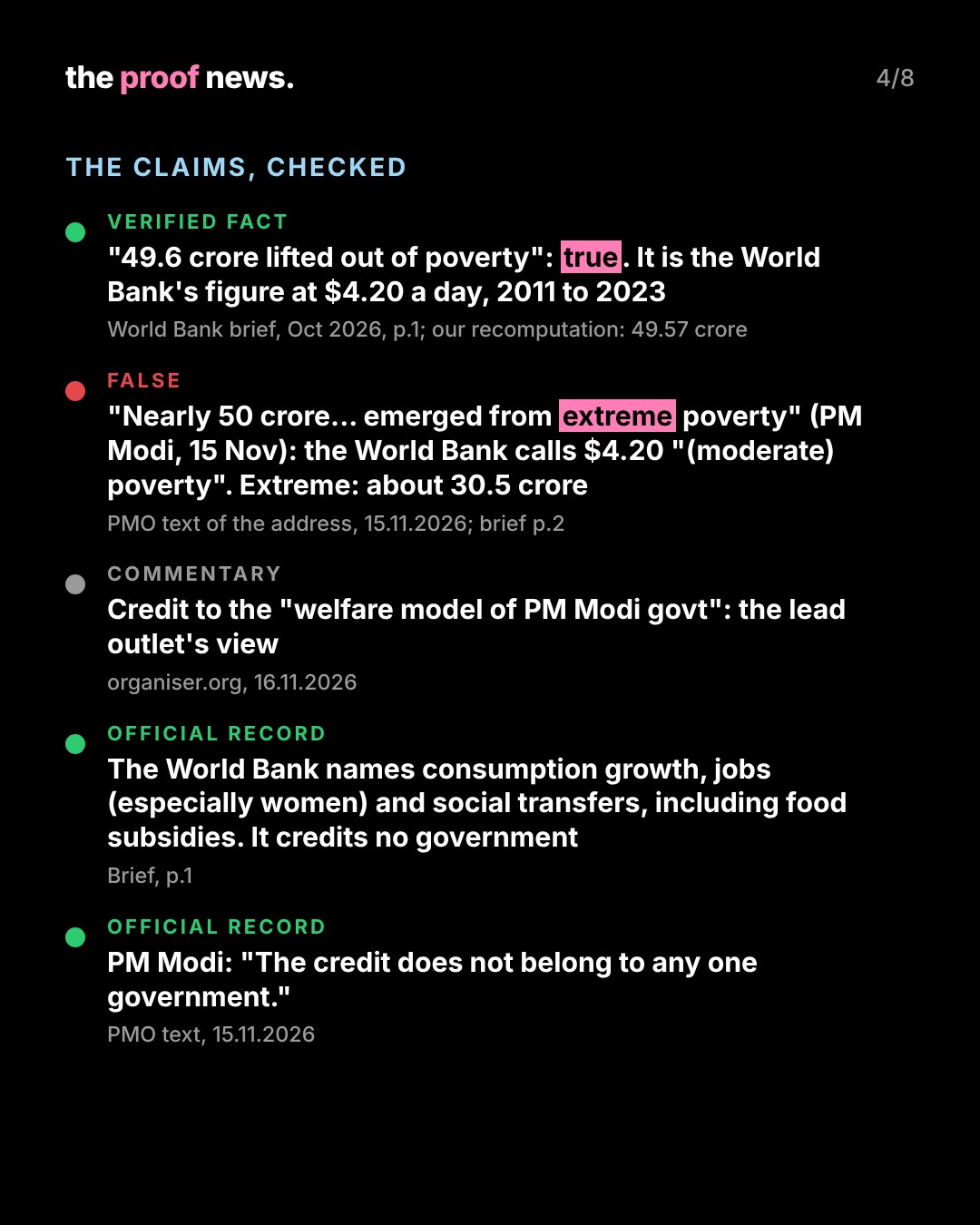
FalseOn 15 November, Prime Minister Narendra Modi said: "A few weeks ago, the World Bank report stated that nearly 50 crore people in India have emerged from extreme poverty over the past 12–13 years" (PMO text). The brief's 496 million is for the $4.20 line, which it describes as moderate poverty. At the extreme line the fall was about 30.5 crore. The number he cited is correct; the word "extreme" is not.
Official recordNot NITI Aayog's figure, and not a sum: NITI Aayog's January 2024 discussion paper estimated that 24.82 crore people escaped multidimensional poverty (health, education and living standards, 12 indicators) between 2013-14 and 2022-23, with the rate falling from 29.17% to 11.28%. Both end points were estimated from survey trends ("have been estimated based on compound growth rate"), not measured. The World Bank's own multidimensional measure for India is 15.5% in 2022-23.
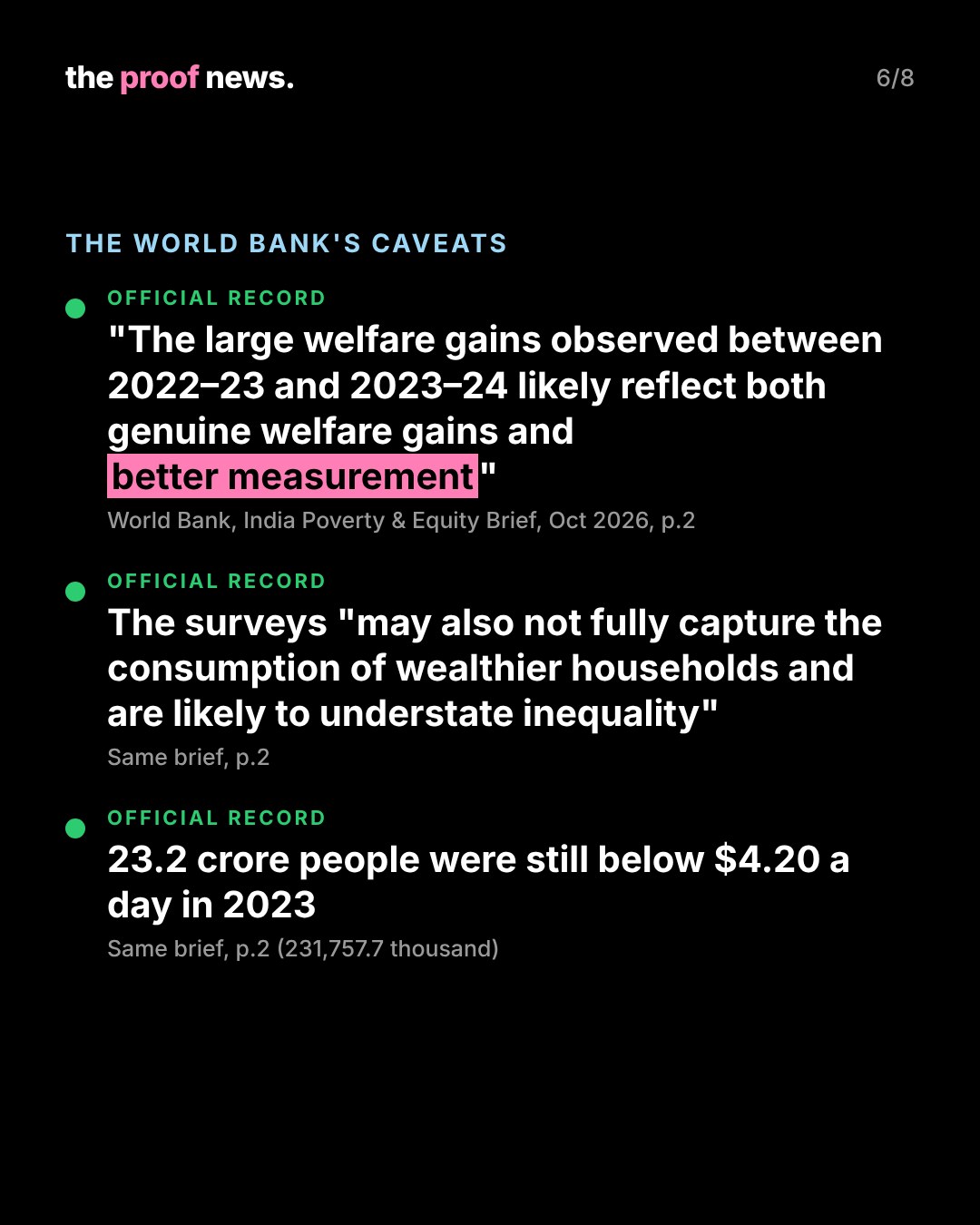
Official recordThe World Bank's caveats (p.2): the 2011–12 survey and the 2022–23 and 2023–24 surveys "are broadly comparable, despite several key improvements introduced"; the large gains between 2022-23 and 2023-24 "likely reflect both genuine welfare gains and better measurement"; and the surveys may not fully capture the consumption of wealthier households and are "likely to understate inequality". The World Bank's data platform files the 2011 and 2022–23 surveys under different comparability spells. Its series has no Indian consumption survey between 2011 and 2022.
Official recordWhat is left: 23.2 crore people were still below $4.20 a day in 2023, and 80.0% of Indians below the $8.30 upper-middle-income line. About 57% of the poor live in a belt from Uttar Pradesh to West Bengal. Median earnings of the top 10% of workers were about 13 times those of the bottom 10% in 2023. The World Bank projects the $4.20 rate to fall from 14.2% in 2026 to 12.1% in 2028 (indicative).
CommentaryWho gets the credit: the lead report attributed the fall to the "welfare model of PM Modi govt". The World Bank says the progress "was mainly driven by strong consumption growth, rising employment, especially among women, and expanded social transfers, including food subsidies", and does not credit any government. The period begins in 2011, three years before the current government took office, and with no survey between 2011 and 2022 in the series, the change before and after 2014 cannot be separated. The Prime Minister said in the same speech: "This achievement belongs to the entire nation. The credit does not belong to any one government."
Official recordOther side: we found no opposition party statement on the October 2026 brief. What to watch: the next World Bank data update (usually around March/April), a new household consumption survey, and NFHS-6 for multidimensional poverty.
The proof.
Recomputed from the World Bank's rates and population: 72.75 crore below $4.20 in 2011 minus 23.18 crore in 2023 = 49.57 crore (the brief: 496 million); at $3.00, 34.20 minus 3.70 = 30.50 crore. Our 2023 counts match the brief's table within 0.5%. Chart rates are the World Bank platform's September 2026 release. NITI Aayog: 29.17% minus 11.28% = 17.89 points, as in the paper.
- World Bank, India Poverty & Equity Brief, October 2026 (PDF)
- World Bank Poverty & Inequality Platform, India, $4.20 line, 2021 PPP (API, Sept 2026 release)
- World Bank Poverty & Inequality Platform, India, $3.00 line, 2021 PPP (API, Sept 2026 release)
- World Bank WDI, India population (SP.POP.TOTL)
- NITI Aayog, Multidimensional Poverty in India since 2005-06, discussion paper, January 2024 (PDF)
- PIB, 24.82 crore Indians escape multidimensional poverty in last 9 years, 15.01.2024 (Release ID 1996271)
- PMO, PM's address at the Janjatiya Gaurav Diwas programme in Gadchiroli, 15.11.2026