Supreme Court awards ₹30 lakh to a man kept in jail for more than seven years after his acquittal
Devilal Gond was acquitted by the Chhattisgarh High Court in January 2018 but released only in May 2025. The court raised his compensation from ₹2 lakh and noted that India has no law setting compensation for such cases; the Law Commission recommended one in 2018.
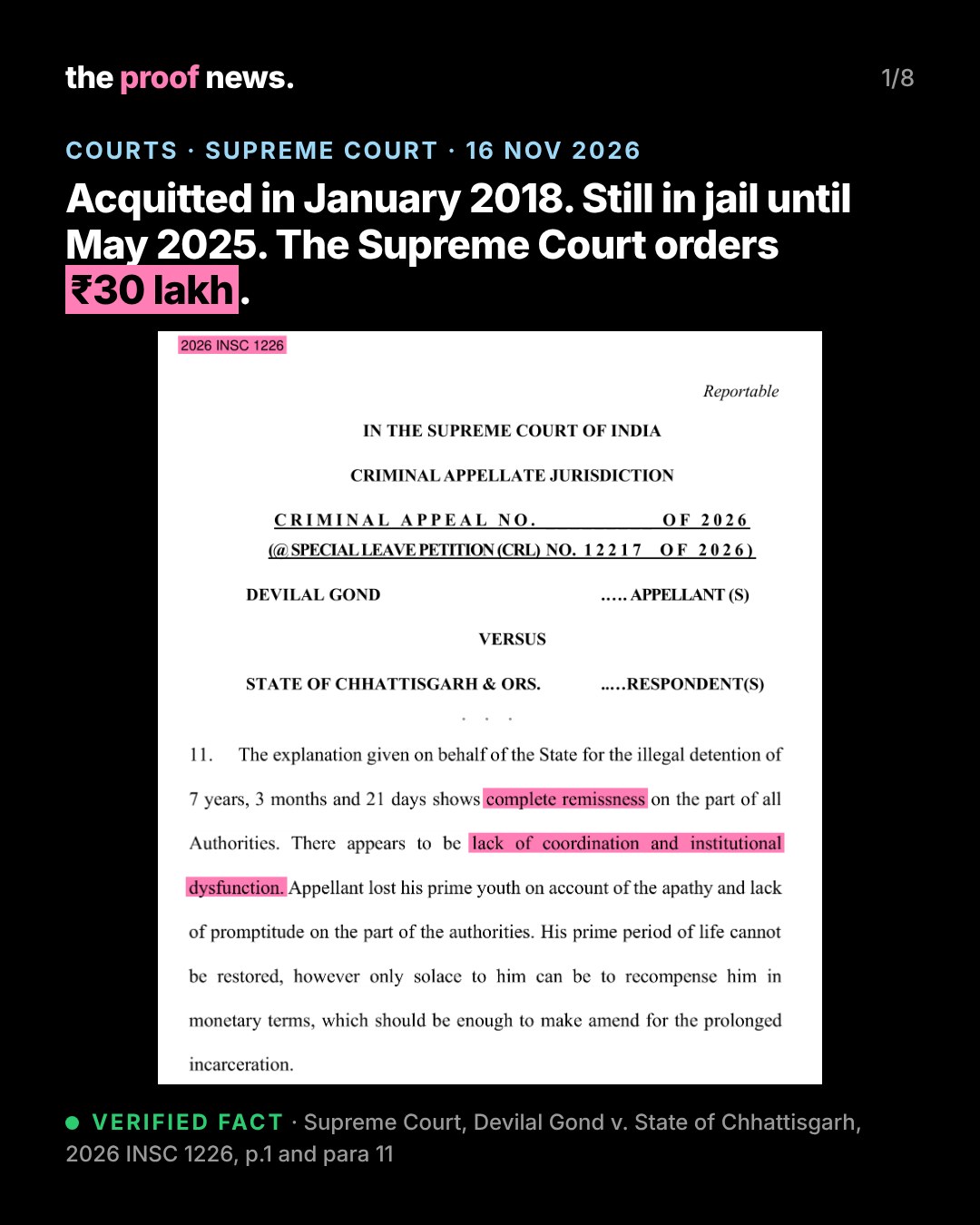
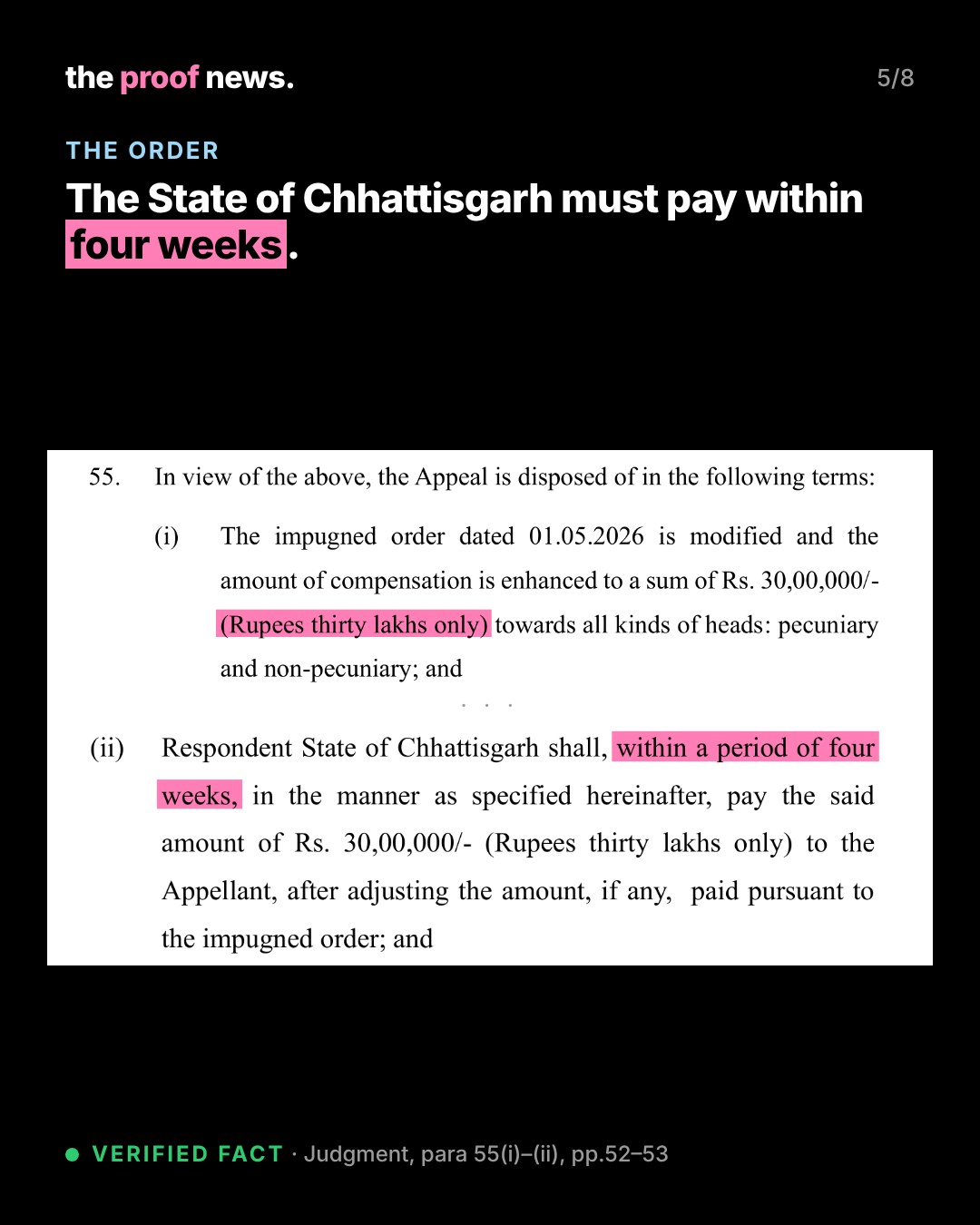
Verified factThe Supreme Court on 16 November 2026 raised the compensation for Devilal Gond, who remained in jail for more than seven years after he was acquitted, from ₹2 lakh to ₹30 lakh, "towards all kinds of heads: pecuniary and non-pecuniary" (Devilal Gond v. State of Chhattisgarh & Ors., 2026 INSC 1226, arising from SLP (Crl) No. 12217 of 2026; Justices Augustine George Masih and Sanjeev Sachdeva, judgment by Justice Sachdeva; para 55).
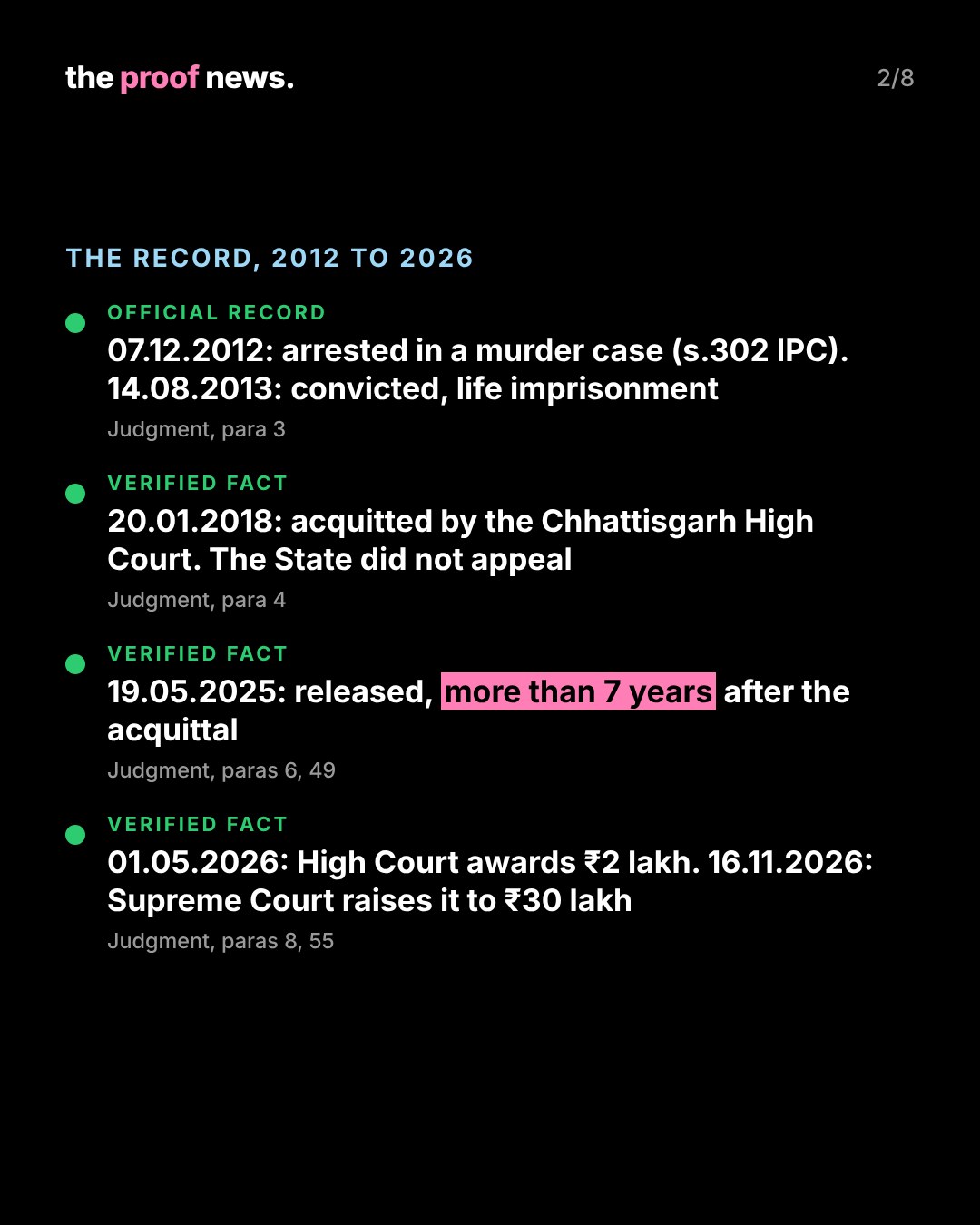
Verified factThe record, as set out in the judgment: he was arrested on 7 December 2012 in a murder case under section 302 IPC and sentenced to life imprisonment by the Sessions Judge, Rajnandgaon, on 14 August 2013 (para 3). The Chhattisgarh High Court allowed his appeal and acquitted him on 20 January 2018; the State did not challenge the acquittal (para 4). He was released on 19 May 2025 (paras 6, 49). He was about 21 when arrested, about 28 when acquitted and about 35 when released (para 50).
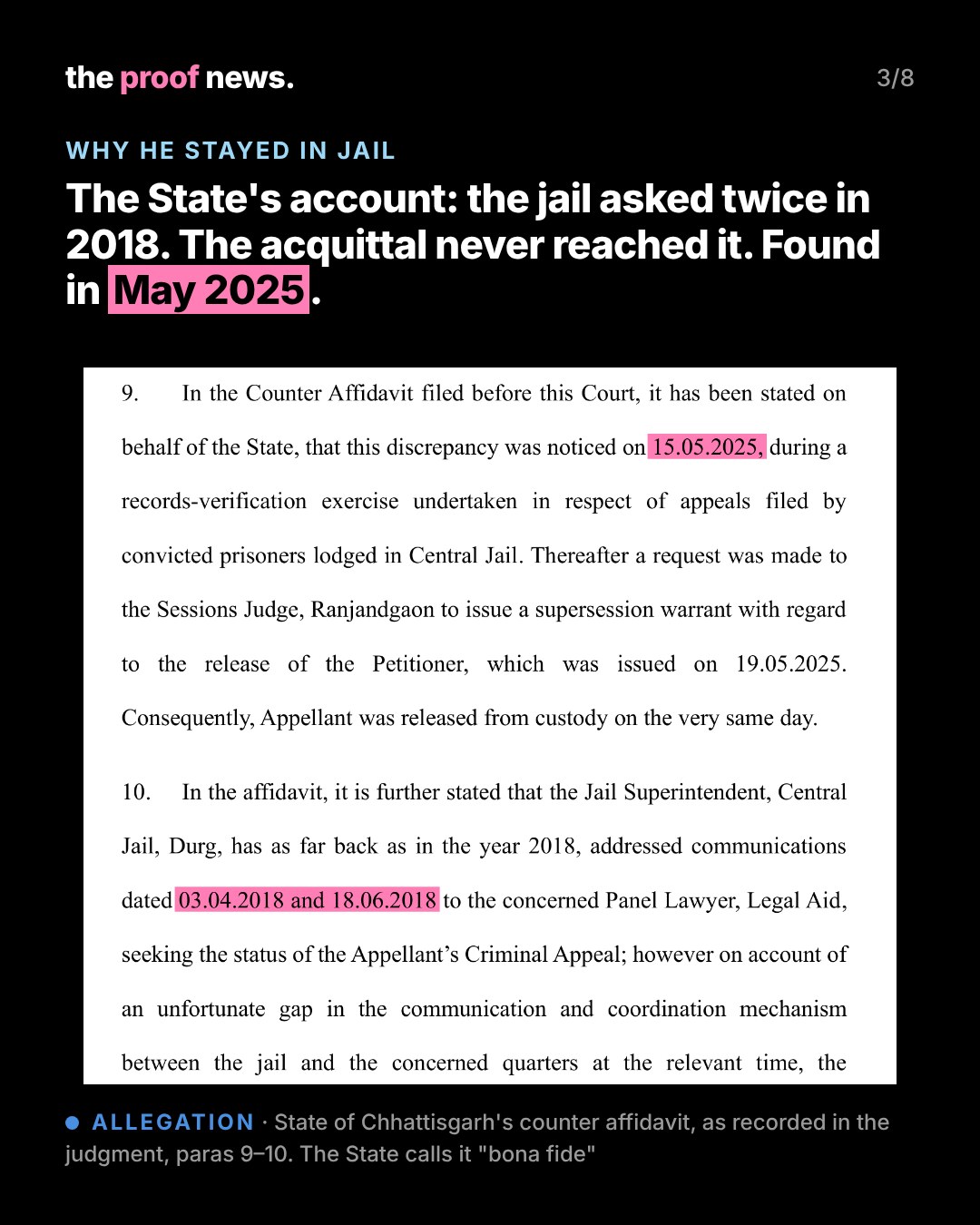
AllegationWhy, in the State of Chhattisgarh's counter affidavit as recorded by the court: the Jail Superintendent, Central Jail, Durg, wrote to the legal-aid panel lawyer on 3 April and 18 June 2018 asking about the appeal, but the outcome "did not reach the jail authorities"; the discrepancy was noticed on 15 May 2025 during a records-verification exercise, and he was released on the day the supersession warrant was issued (paras 9–10). An inquiry by the DIG (Prisons) found "a bona fide and unfortunate gap" and no mala fide motive, the State said (para 10). The court also noted that when the High Court acquitted him, it was not told he was in custody and was given the impression his sentence had been suspended (para 5).
Verified factThe court found that the explanation "shows complete remissness on the part of all Authorities", with "lack of coordination and institutional dysfunction", and that he "lost his prime youth on account of the apathy and lack of promptitude on the part of the authorities" (para 11).
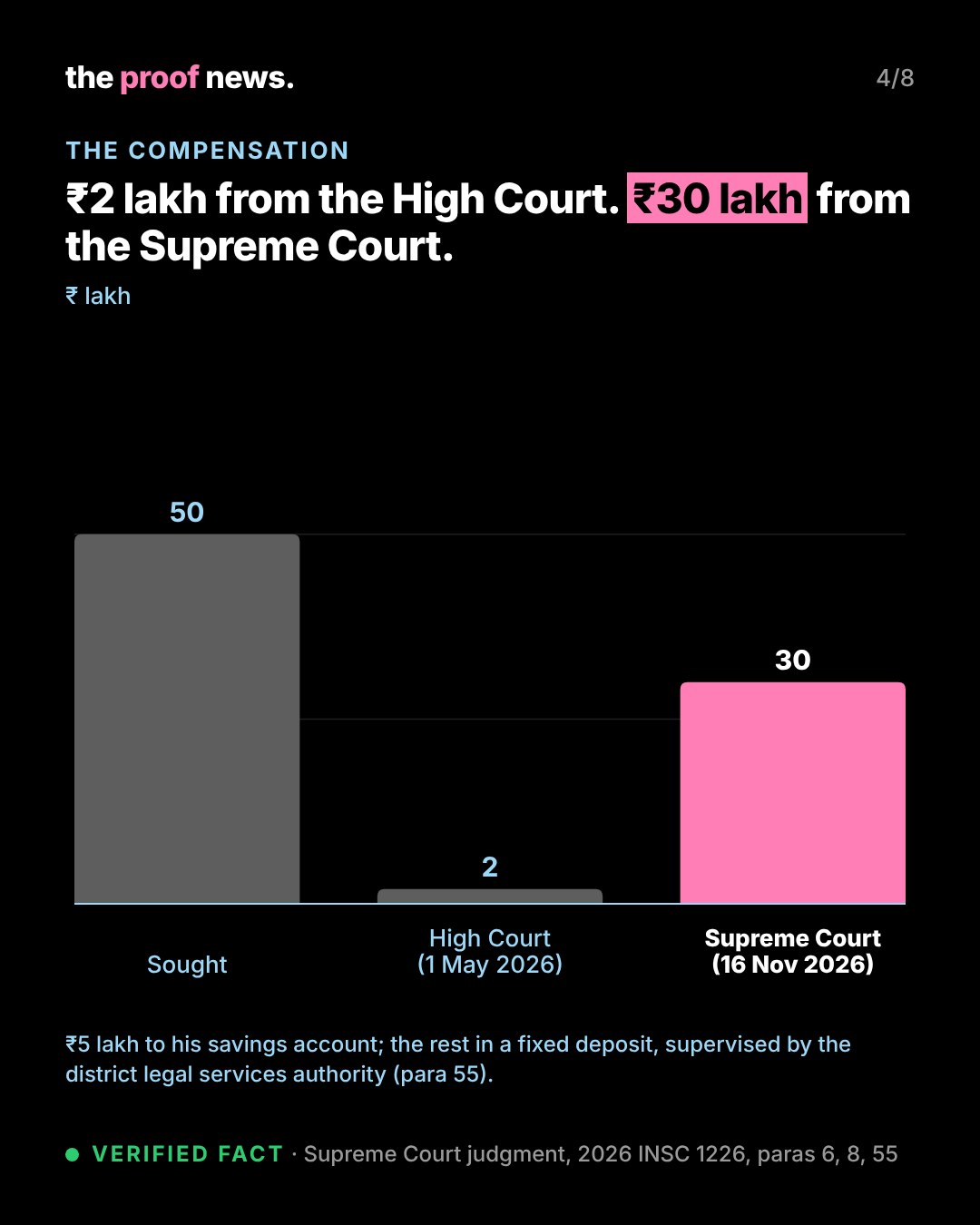
Verified factThe order: the State of Chhattisgarh must pay ₹30 lakh within four weeks, adjusting any amount paid under the High Court's order of 1 May 2026; ₹5 lakh goes to his savings account and the balance into a fixed deposit, with withdrawals supervised by the District Legal Services Authority, Mohla-Manpur (para 55). The High Court had awarded ₹2 lakh; he had sought ₹50 lakh (paras 6, 8). The court directed all High Courts to consider directions like those issued by the Madhya Pradesh High Court after a similar case, Sohan Singh @ Bablu (₹25 lakh for over four years of detention beyond sentence, 8 September 2025), and an online criminal justice system linking courts and prisons (paras 36–38, 55(xii)).
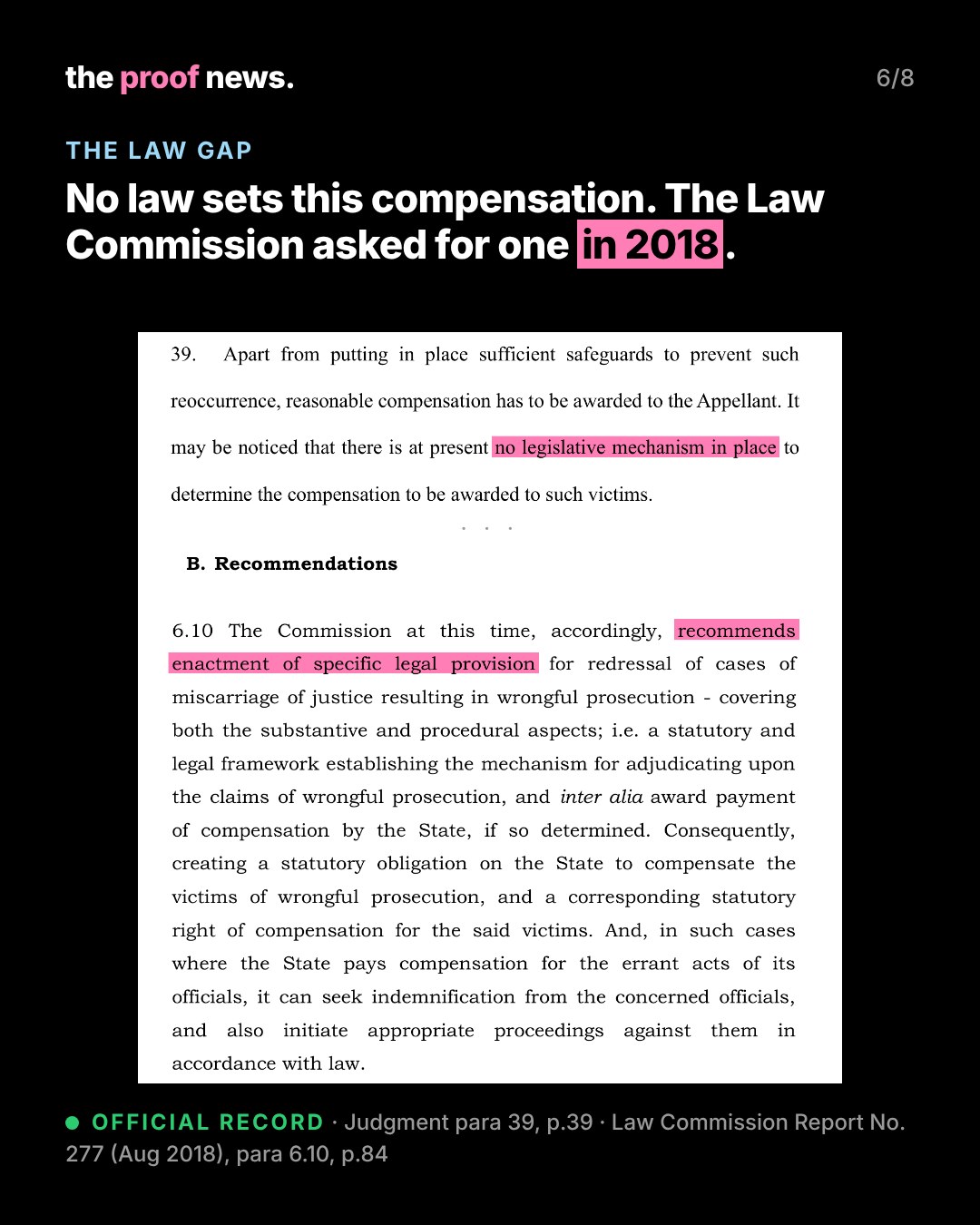
Official recordThe law gap: "there is at present no legislative mechanism in place to determine the compensation to be awarded to such victims" (para 39). The court set out the Law Commission's Report No. 277, "Wrongful Prosecution (Miscarriage of Justice): Legal Remedies" (August 2018), which "recommends enactment of specific legal provision for redressal of cases of miscarriage of justice resulting in wrongful prosecution", with special courts in each district to decide claims (Report, paras 6.10–6.11). The Commission submitted it to the government on 30 August 2018 with a draft Code of Criminal Procedure (Amendment) Bill, 2018 (PIB). No such law has been enacted. The judgment does not direct Parliament or the government to legislate.
CommentaryOur reading, on fit: the Law Commission's proposed standard is "wrongful prosecution" (malicious prosecution, or prosecution instituted without good faith; Report, para 6.11(ii)). Detention continuing after an acquittal, as in this case, would not necessarily fall within it as drafted.
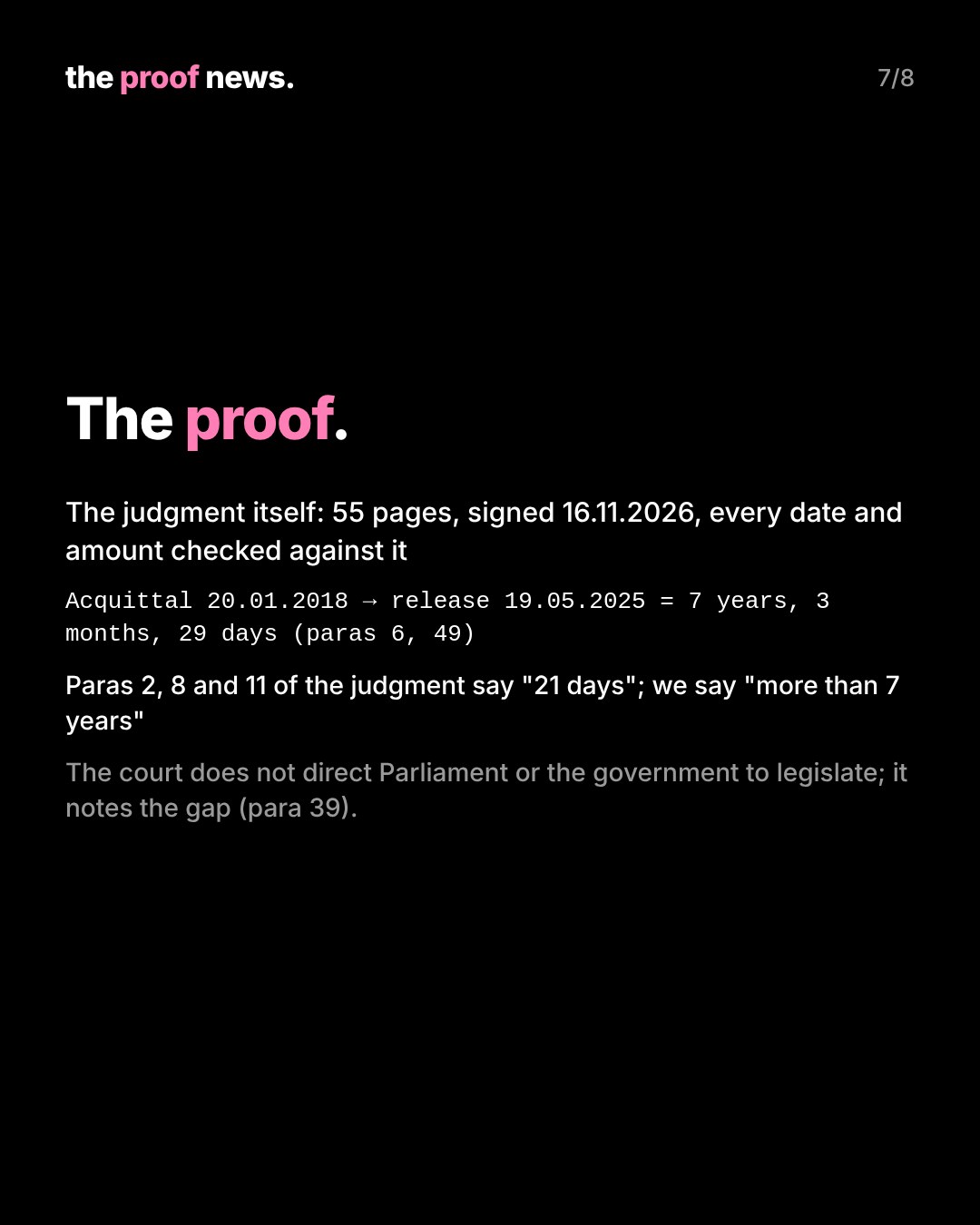
The proof.
Every date, amount, quote and paragraph number is checked against the judgment PDF (55 pages, digitally signed 16 November 2026) and the Law Commission report; check.py passes. The judgment gives the post-acquittal period as both 7 years 3 months 21 days (paras 2, 8, 11) and 29 days (paras 6, 49); the dates give 29 days, and we say "more than seven years".