Karnataka High Court stays police investigation in five FIRs over SIR voter-deletion forms
In five orders of 17 November, the High Court stayed "till further orders" the investigation in FIRs that Karnataka police registered against 12 people over Form 7 objections filed during the Special Intensive Revision of electoral rolls. The complaints allege bulk forms aimed at deleting voters of one community; the State argued the investigation cannot be stalled. The court said, prima facie, that the Registration Officer's statutory inquiry must run its course first.
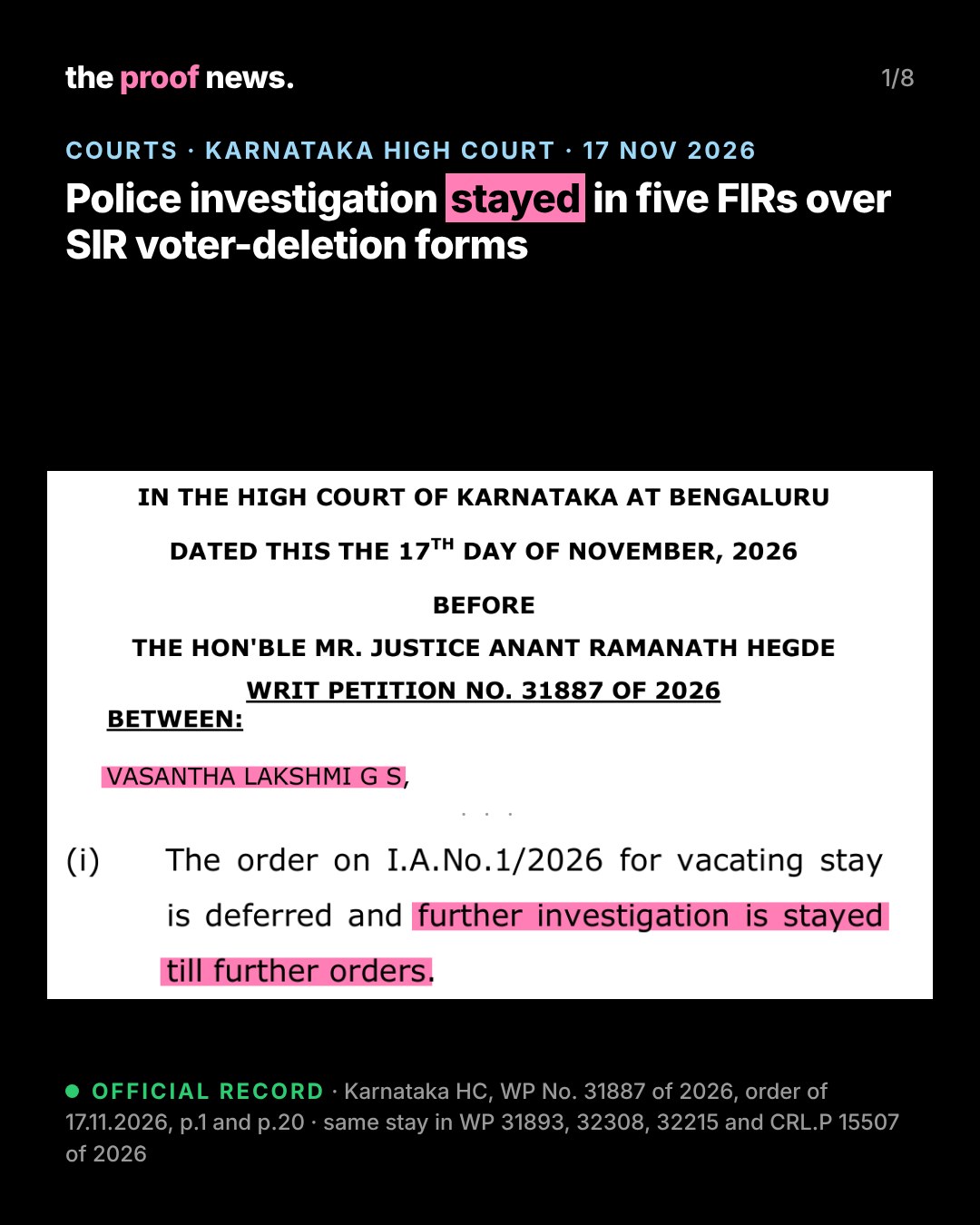
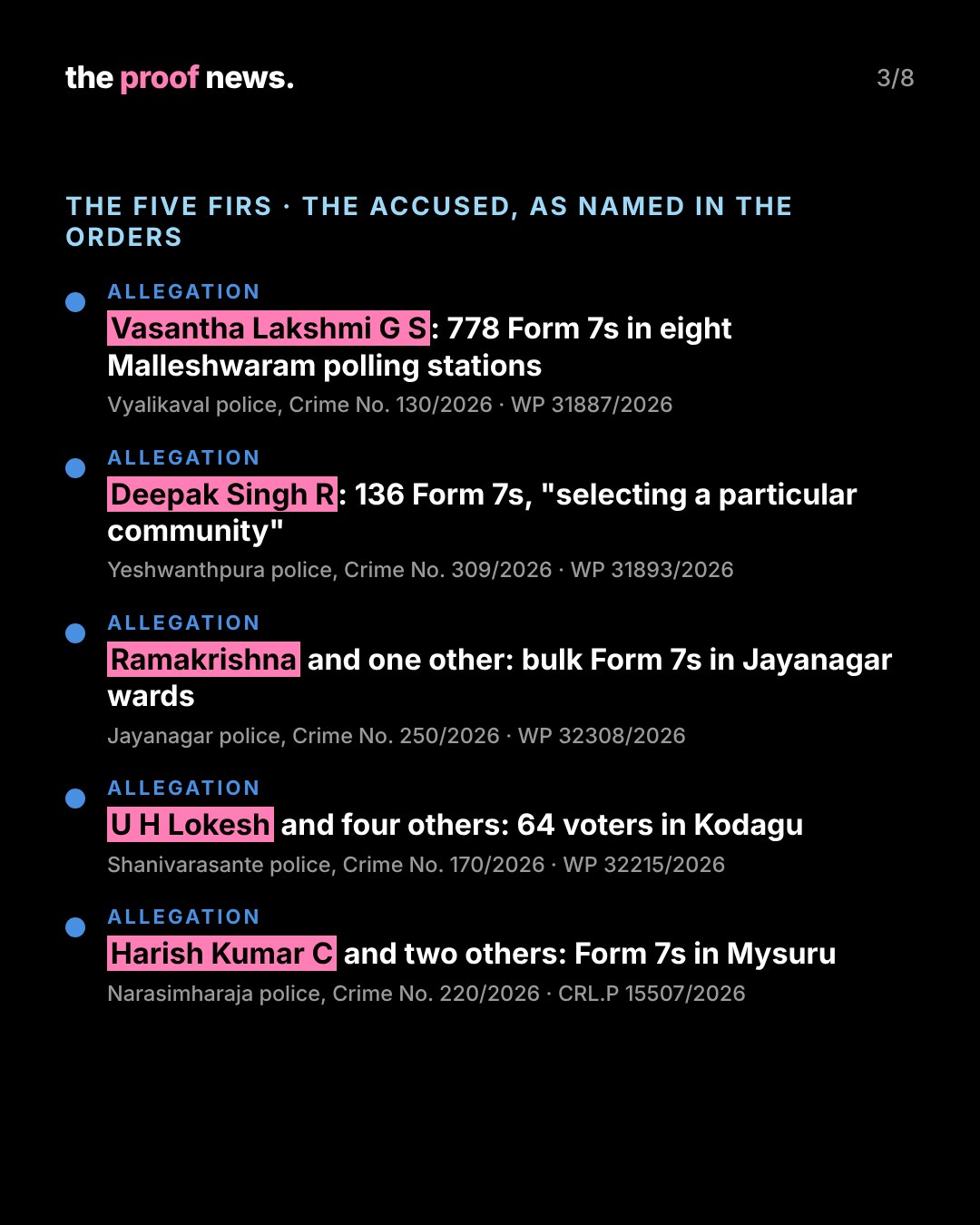
Official recordOn 17 November 2026 Justice Anant Ramanath Hegde of the High Court of Karnataka at Bengaluru pronounced five orders in petitions by people accused in FIRs over Form 7 objections, the form used to object to a name on the electoral roll, filed during the Special Intensive Revision (SIR). In all five, further investigation is stayed "till further orders": Vasantha Lakshmi G S v. State of Karnataka (WP No. 31887 of 2026; Vyalikaval police, Bengaluru, Crime No. 130/2026); Deepak Singh R (WP No. 31893 of 2026; Yeshwanthpura police, FIR No. 309/2026); Ramakrishna and another (WP No. 32308 of 2026; Jayanagar police, Crime No. 250/2026); U H Lokesh and others (WP No. 32215 of 2026; Shanivarasante police, Kodagu, Crime No. 170/2026); and Harish Kumar C and others (CRL.P No. 15507 of 2026; Narasimharaja police, Mysuru, Crime No. 220/2026). Twelve petitioners in all are the accused in these FIRs, which were registered between 1 and 5 October 2026.
Official recordIn the first two cases the State had applied to vacate an interim order of 9 October; the court ordered that its application "is deferred and further investigation is stayed till further orders". In the other three the stay is new. In each case the Election Commission was directed "to place the materials relating to the decisions taken on the Form No.7" filed by the petitioners, and in the last three the complainants and the State may apply to modify or vacate the stay. The orders give no next hearing date.
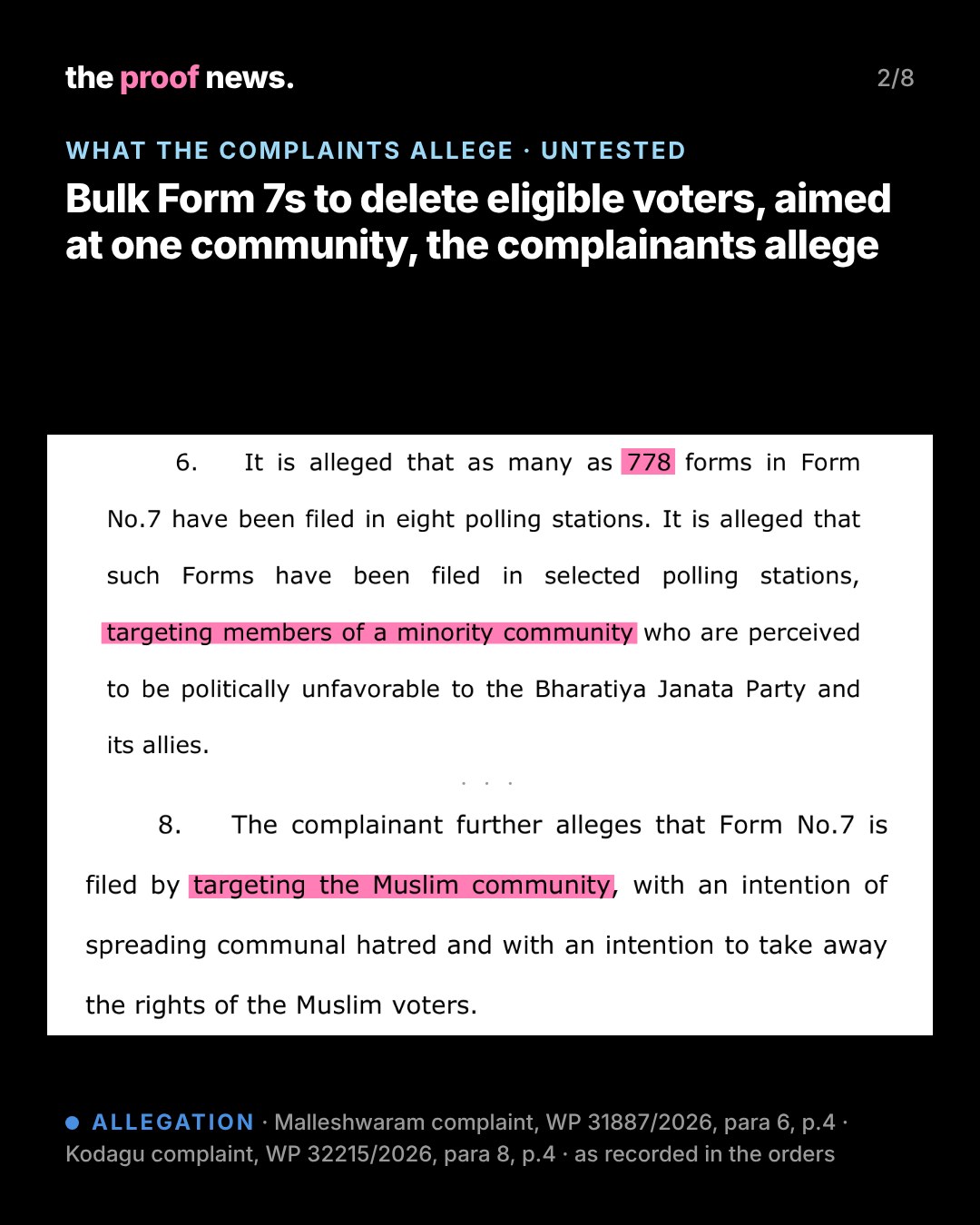
AllegationWhat the complaints allege, as the orders record them (untested): in Malleshwaram, "as many as 778 forms in Form No.7 have been filed in eight polling stations", in selected polling stations, "targeting members of a minority community who are perceived to be politically unfavorable to the Bharatiya Janata Party and its allies", and the signatures of Vasantha Lakshmi G S, described as a BJP booth-level agent, "materially differ from one another" and are alleged to be forged (WP 31887, paras 5–7). Against Deepak Singh R: 136 Form 7s "selecting a particular community" (WP 31893, para 5). In Jayanagar, where the complainant is described as a former MLA and member of the Indian National Congress: Form 7s in wards "dominated by religious minority voters", many in the name of Ramakrishna, said to be a BJP booth-level agent; the complaint states a total of 5,698, though the rows it lists add up to 5,707 (WP 32308, paras 4–8). In Kodagu: an attempt to delete 64 voters, with Form 7s "filed by targeting the Muslim community" (WP 32215, paras 6, 8), against U H Lokesh, his wife, A.C. Nagaraj alias Nagesh, Savita Mallalli and B.N. Basavaraj. In Mysuru: Harish Kumar C, Raghavendra M. and Dr. Anil Thomas, described as president of the BJP's minority wing, are accused of Form 7s with false information: by Harish Kumar C against the complainant's family and 28 other voters, by Raghavendra M. against 27, and by Dr. Anil Thomas against 36, and of targeting "voters from Muslim community" (CRL.P 15507, paras 3–6).
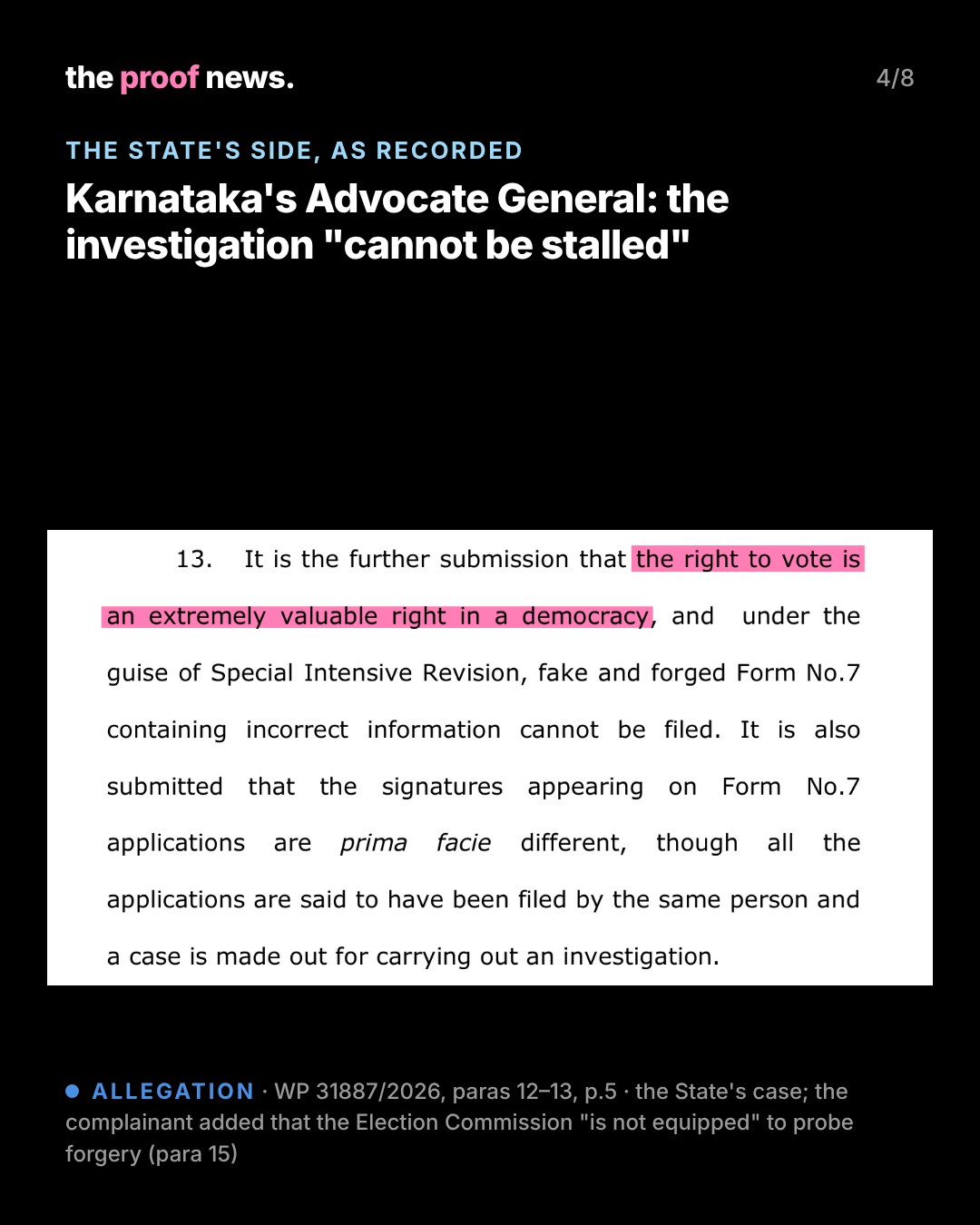
AllegationThe State's case, as recorded: Advocate General K Shashi Kiran Shetty argued that the complaints disclose cognizable offences, so "the investigation cannot be stalled"; that "the right to vote is an extremely valuable right in a democracy, and under the guise of Special Intensive Revision, fake and forged Form No.7 containing incorrect information cannot be filed"; that the signatures are prima facie different; and that "digital records" about who filed the forms must be examined (WP 31887, paras 12–13, 19–20). Counsel for the Malleshwaram complainant said the Election Commission "is not equipped to investigate" forgery, which must be investigated by the police (para 15).
AllegationThe petitioners' case, as recorded: a booth-level agent files forms on behalf of the party, which the law permits; any error or false information is for the Registration Officer to verify; none of the voters named in the forms has complained; and the complaints were lodged "to dissuade Booth Level Agents of political party from filing such Forms" (WP 31887, paras 16–18).
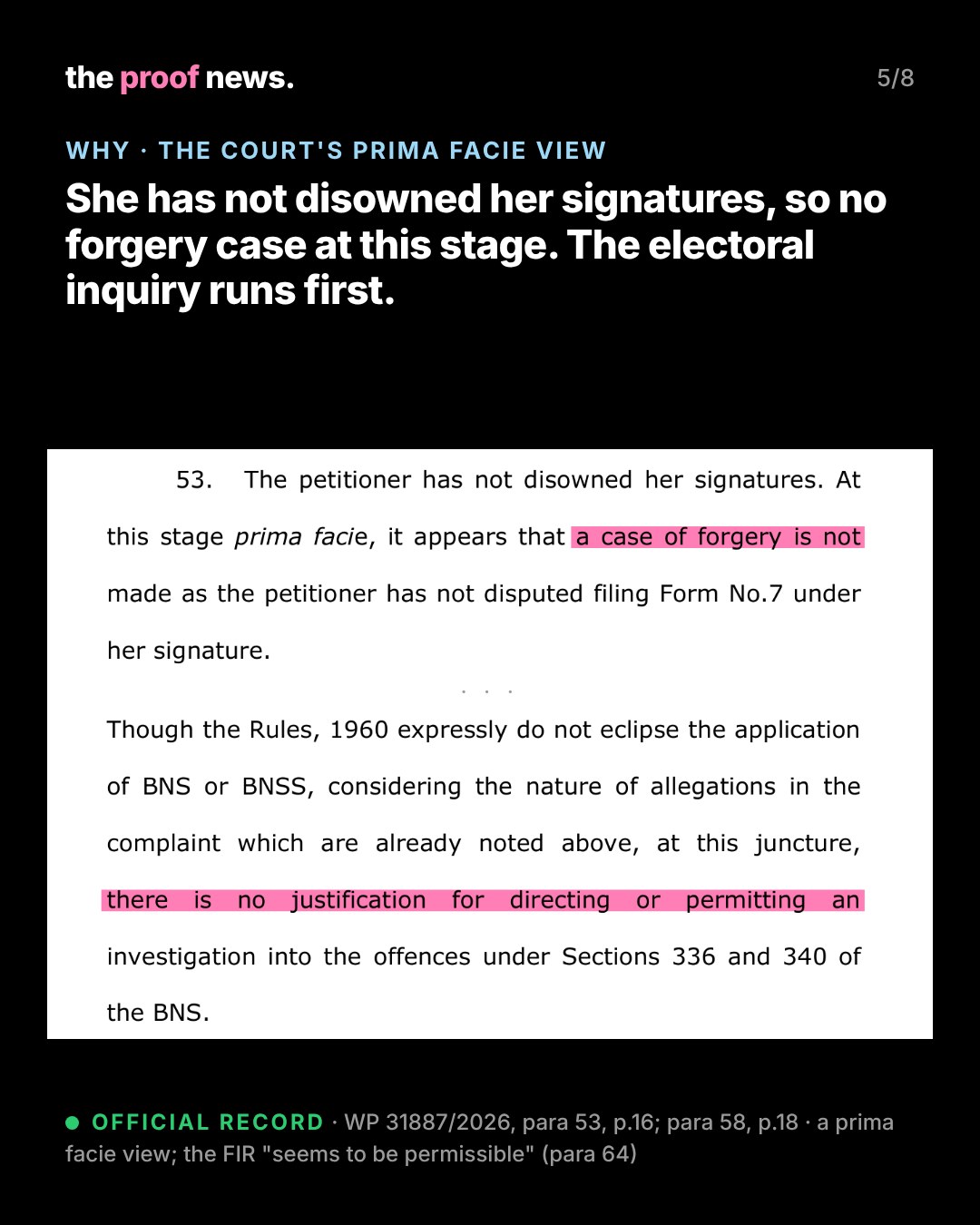
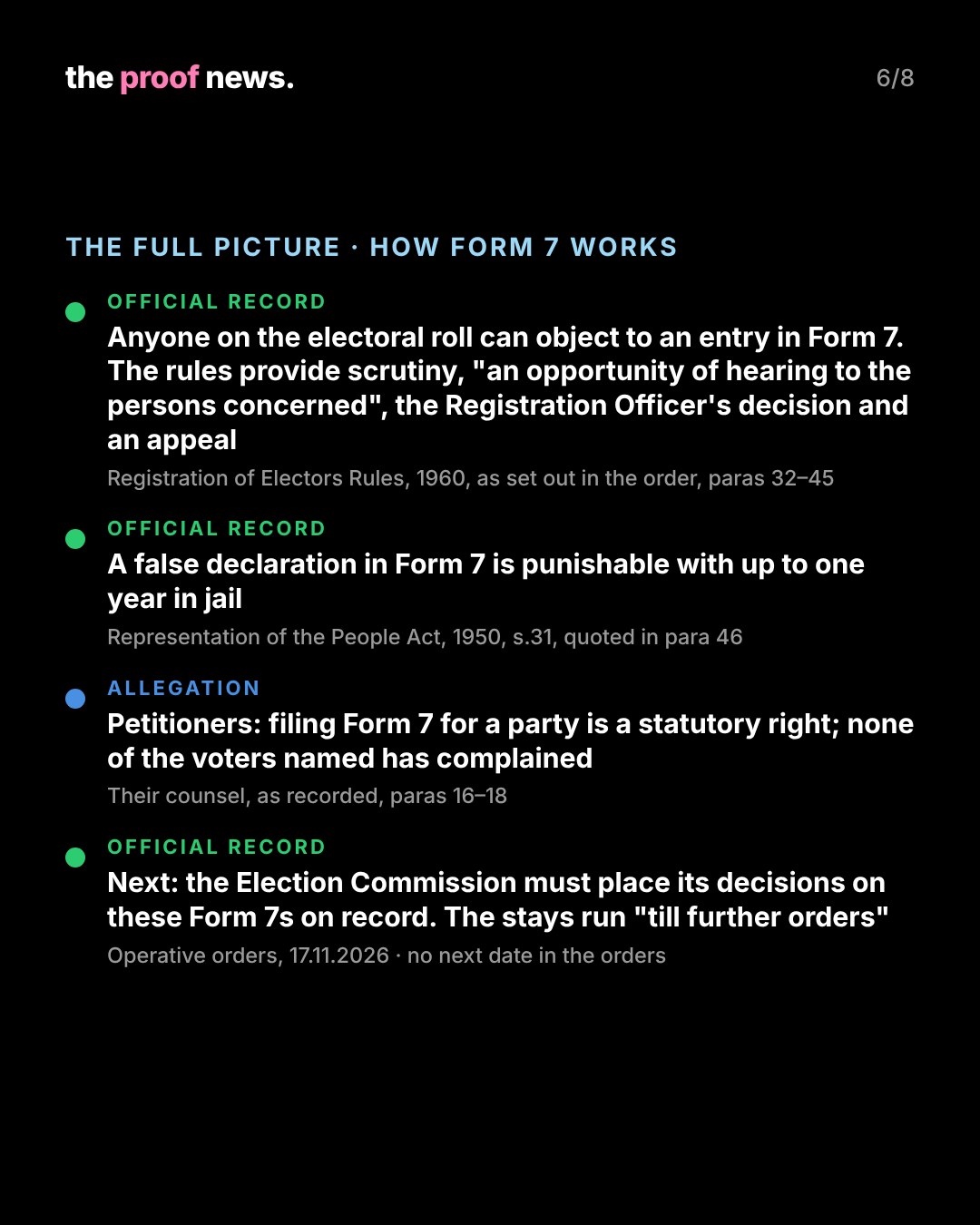
Official recordThe court's reasons, a prima facie view at the interim stage (WP 31887): the Registration of Electors Rules, 1960 give "a comprehensive statutory scheme" for adding and deleting names, with scrutiny, "an opportunity of hearing to the persons concerned, a decision by the Registration Officer and a statutory appellate remedy" (para 45), and section 31 of the Representation of the People Act, 1950 punishes a false declaration with up to one year in jail (paras 46–47). The forged signatures alleged are not those of the complainant or the voters, and "The petitioner has not disowned her signatures. At this stage prima facie, it appears that a case of forgery is not made" (paras 52–53). "Though the Rules, 1960 expressly do not eclipse the application of BNS or BNSS", there is "at this juncture" no justification for investigating the forgery offences (para 58), and the inquiry under the Rules "has to run its course" (para 60). On the false-information offence (section 217 BNS), the complaint "is not by the public servant", as the law requires for a court to take cognizance (paras 61–62). "Though the complaint and FIR seems to be permissible", the Registration Officer's decision "will have a bearing on the matter" and "may furnish materials to take a call whether the case is made out to quash the FIR or to direct the investigation" (paras 64–65).
ReportedThe full picture. The Election Commission announced SIR Phase III, covering Karnataka, on 14 May 2026; house-to-house enumeration in Karnataka began on 30 June. The court noted that the Supreme Court has upheld the SIR exercise in Bihar and that Karnataka's is "more or less similar" (para 29). According to figures from the Chief Electoral Officer's press conference on 27 October, as reported by several outlets, Karnataka's roll fell from 5,54,32,314 electors on 16 June 2026 to 4,55,00,011 in the final roll, 99.32 lakh fewer. We could not open the CEO's own release to check these figures. In a separate case on 13 October, as reported, the High Court's Dharwad bench stayed the investigation against BJP leader Ravi Patil, accused over about 198 Form 7s in Belagavi.
CommentaryKarnataka is governed by the Congress; the FIRs were registered by the State's police, and its Advocate General argued for the investigation to go on. The petitioners are accused, not convicted, and the stay is not a finding on the allegations. We found no statement from the State government, the Congress, the BJP or the petitioners on the orders, or on any appeal.
The proof.
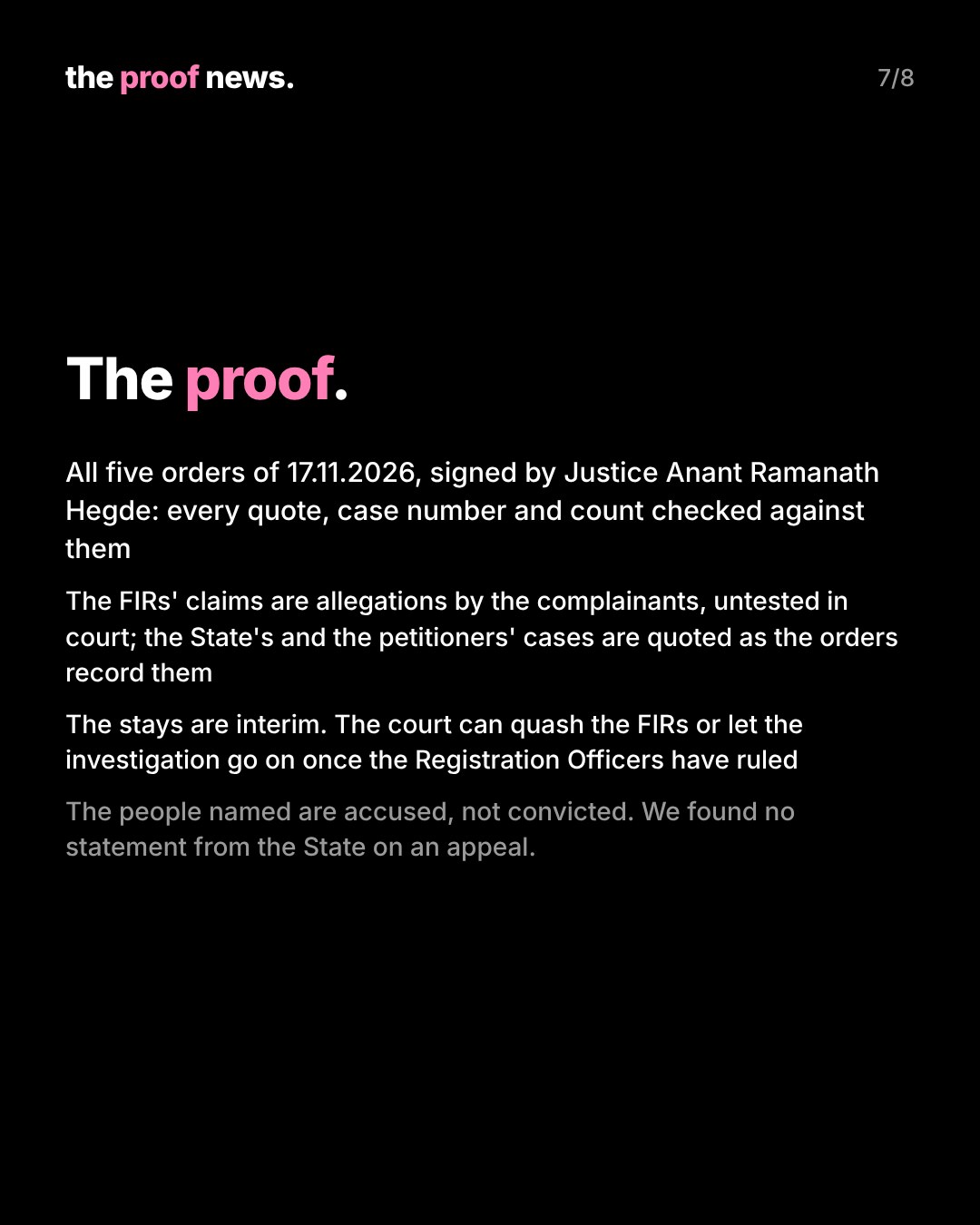
Every quotation, case number, FIR number and count is checked word for word against the five orders of 17 November 2026, each signed by Justice Anant Ramanath Hegde (check.py, all pass). The complaints' claims are given as the orders record them and labelled as allegations; the State's and the petitioners' arguments are quoted as recorded. Slips in the orders are flagged rather than repeated: the Kodagu order's operative part prints "FIR No.120/2026" where its header gives Crime No. 170/2026, and the Jayanagar complaint's table states a total of 5,698 though its rows add up to 5,707. The statewide roll figures are from reports of the Chief Electoral Officer's press conference; we could not open the CEO's own release, so they are labelled Reported.
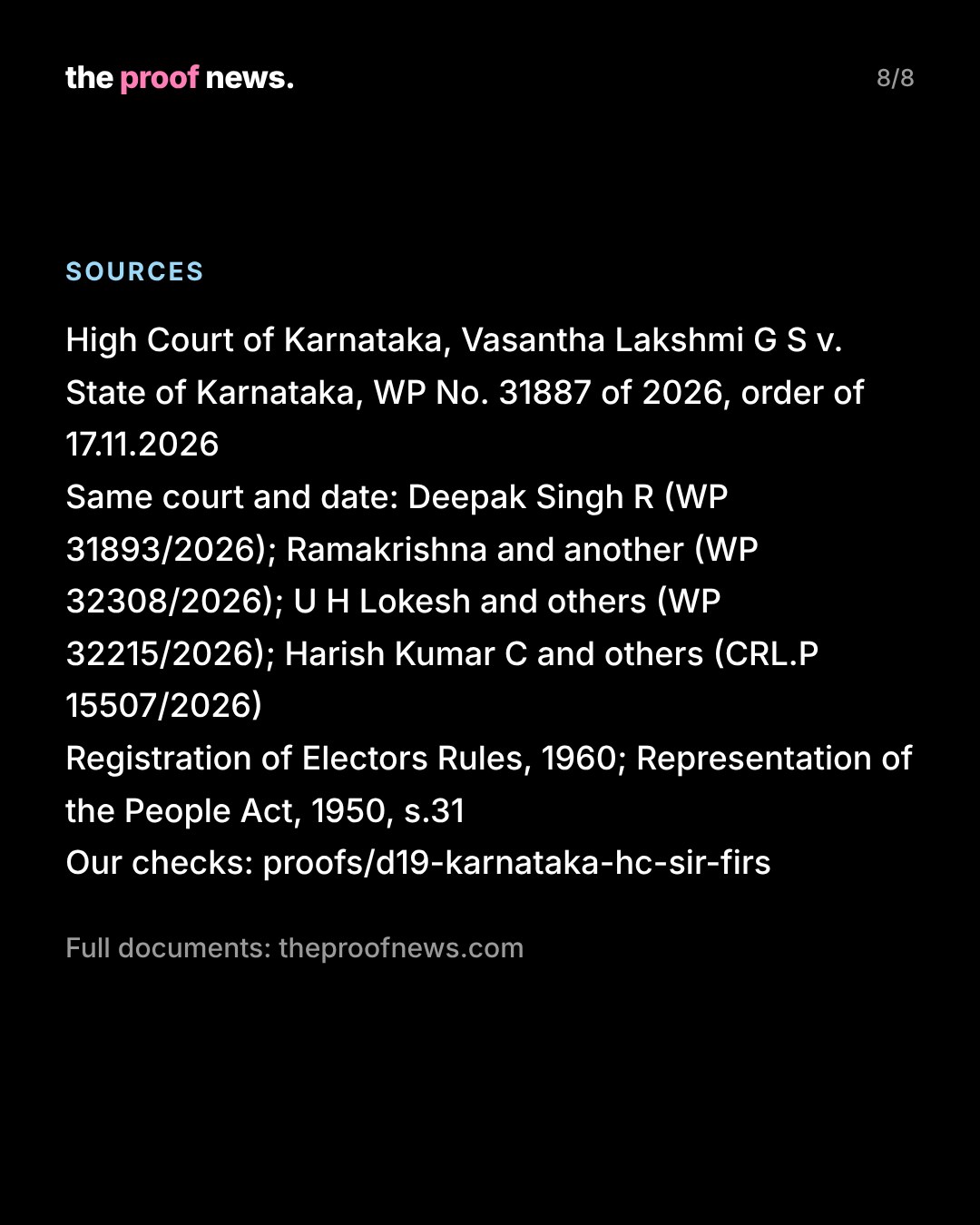
- High Court of Karnataka, Vasantha Lakshmi G S v. State of Karnataka, WP No. 31887 of 2026, order of 17 Nov 2026 (PDF)
- Deepak Singh R v. State of Karnataka, WP No. 31893 of 2026, order of 17 Nov 2026 (PDF)
- Ramakrishna and another v. State of Karnataka, WP No. 32308 of 2026, order of 17 Nov 2026 (PDF)
- U H Lokesh and others v. State of Karnataka, WP No. 32215 of 2026, order of 17 Nov 2026 (PDF)
- Harish Kumar C and others v. State of Karnataka, CRL.P No. 15507 of 2026, order of 17 Nov 2026 (PDF)
- The Week, 27 Oct 2026: Karnataka final roll figures
- The News Minute, 27 Oct 2026: Karnataka final roll figures
- LiveLaw, 13 Oct 2026: stay in the Ravi Patil case (Dharwad bench)