Maharashtra's wage rules are in force: an 8-hour normal day for daily-paid workers, 48 normal hours a week for others
The Maharashtra Wage Rules, 2026, published in the state gazette on 5 November, replace two sets of rules from 1963. They fix normal working hours and how minimum wages are calculated, but not the rupee rates, rest breaks or the overtime ceiling.
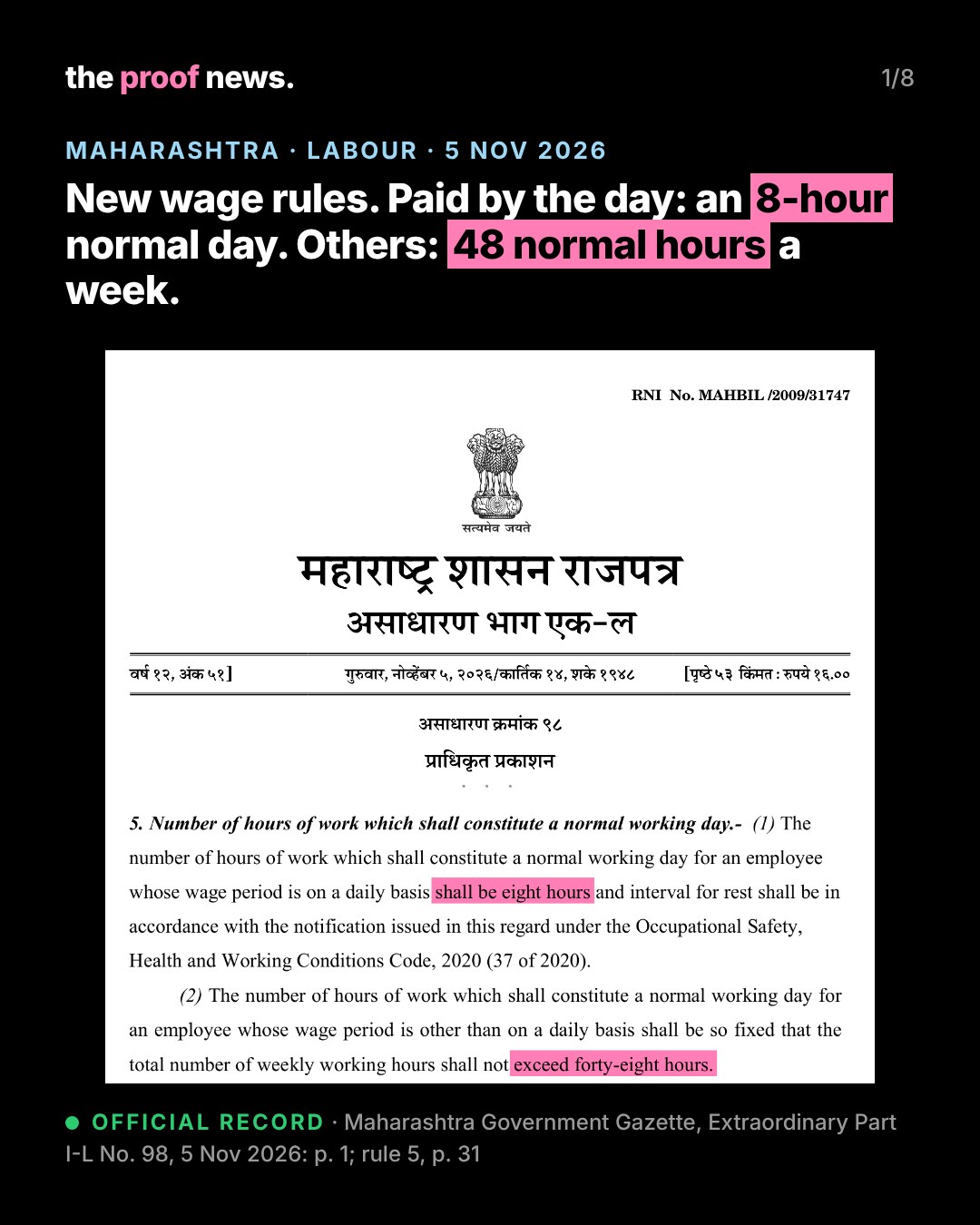
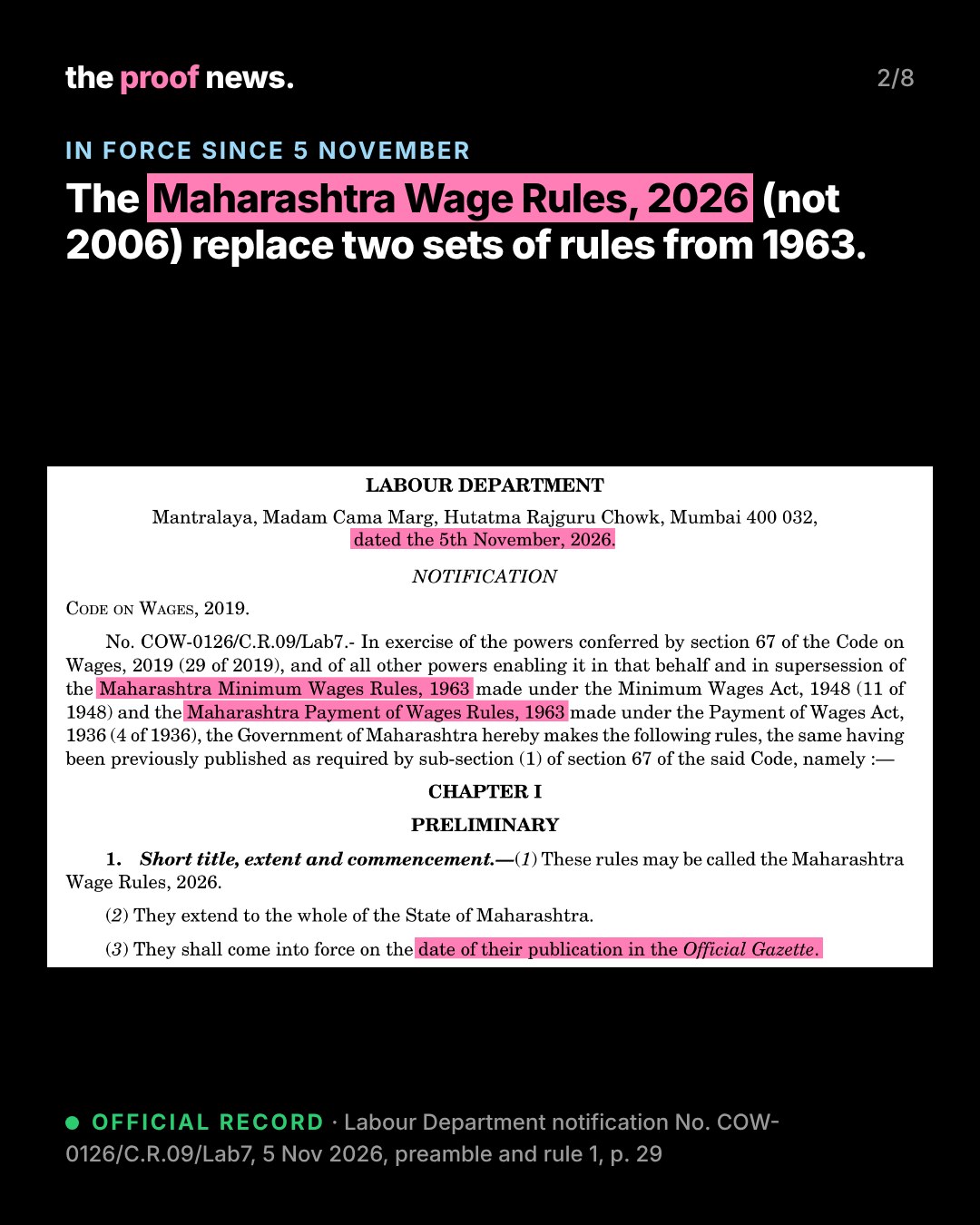
Official recordThe Maharashtra government's Labour Department notified the Maharashtra Wage Rules, 2026 (notification No. COW-0126/C.R.09/Lab7, dated 5 November 2026) in the Maharashtra Government Gazette, Extraordinary Part I-L, No. 98, of the same date. The rules "shall come into force on the date of their publication in the Official Gazette" (rule 1(3), p. 29), so they have applied since 5 November. They are made under section 67 of the Code on Wages, 2019 and are "in supersession of the Maharashtra Minimum Wages Rules, 1963" and "the Maharashtra Payment of Wages Rules, 1963" (preamble, p. 29). The gazette carries the rules in Marathi (pp. 1–28) and English (pp. 29–53); we quote the English text.
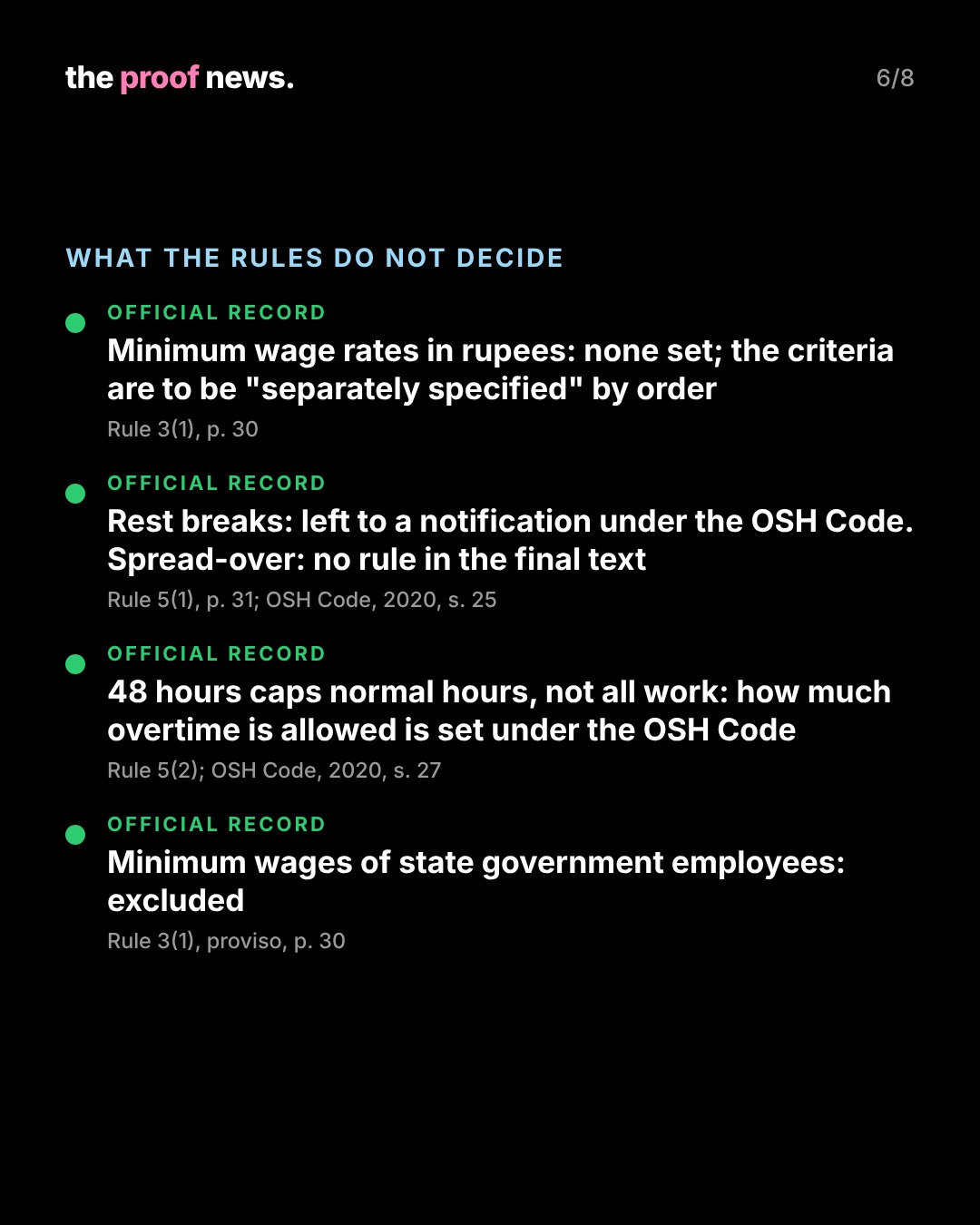
Official recordWorking hours. For an employee paid by the day, the normal working day "shall be eight hours", with rest intervals as notified under the Occupational Safety, Health and Working Conditions (OSH) Code, 2020. For everyone else, the normal working day is to be fixed so that "the total number of weekly working hours shall not exceed forty-eight hours" (rule 5, p. 31).
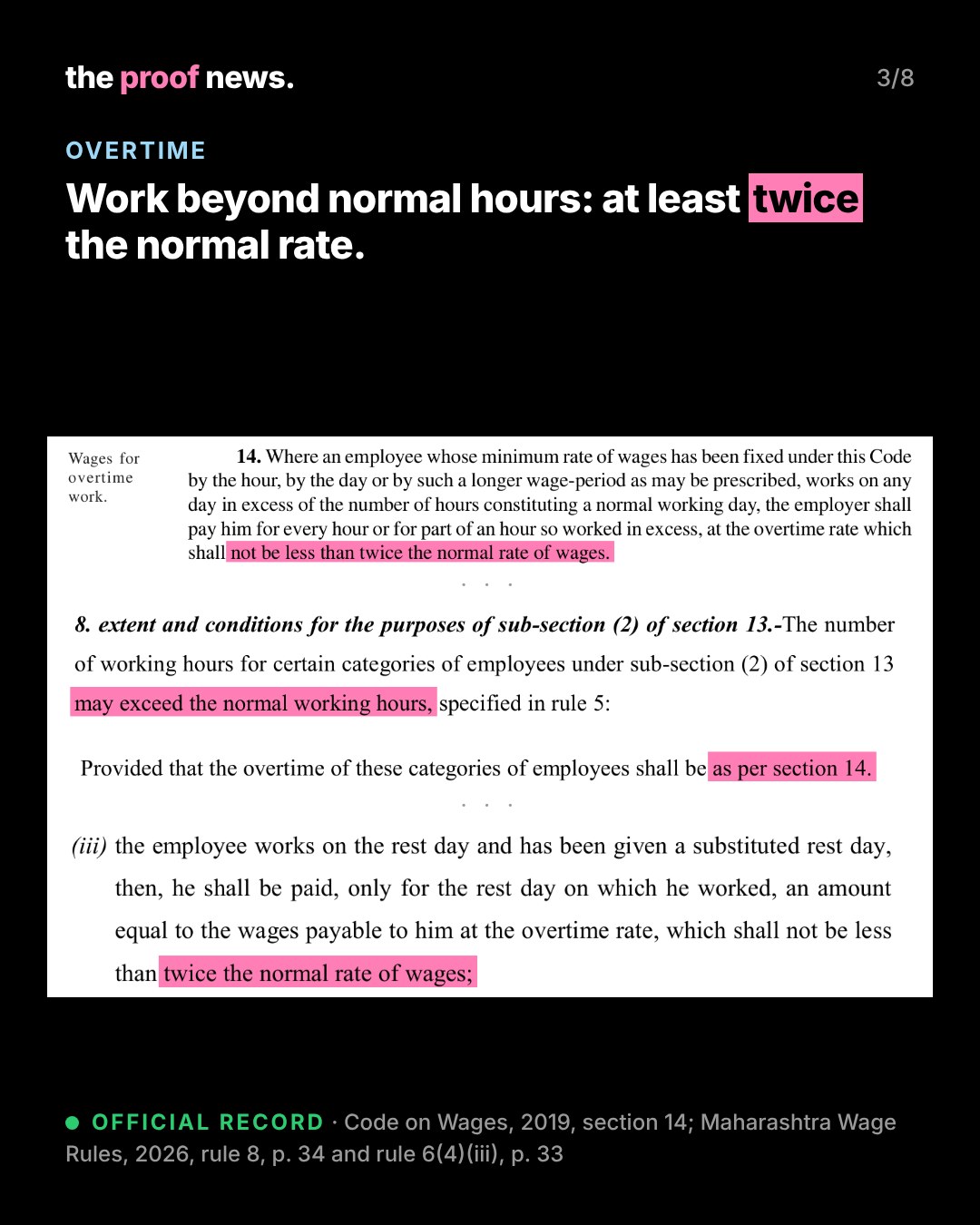
Official recordOvertime. The 48-hour figure limits normal hours, not all work. Hours beyond the normal working day are overtime, paid "at the overtime rate which shall not be less than twice the normal rate of wages" (Code on Wages, section 14). The rules apply this to work on a rest day (rule 6(4)(iii), p. 33) and to employees in categories, such as emergencies or intermittent work, whose hours "may exceed the normal working hours" (rule 8, p. 34).
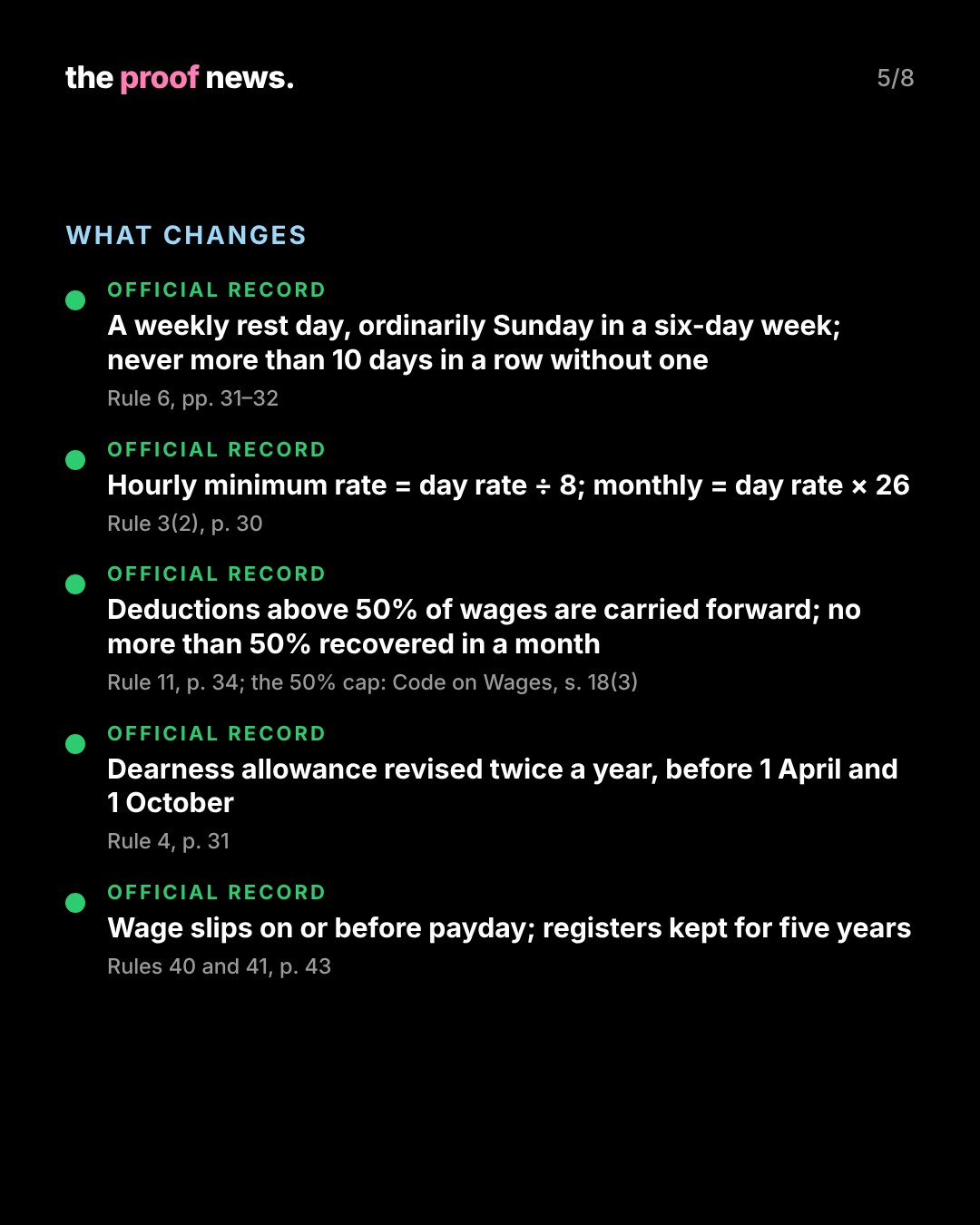
Official recordWeekly rest. Every employee gets a rest day each week, "ordinarily" Sunday in a six-day week; the employer may fix other days, and substitutions may not make anyone work "more than ten days consecutively without a rest day" (rule 6, pp. 31–32).
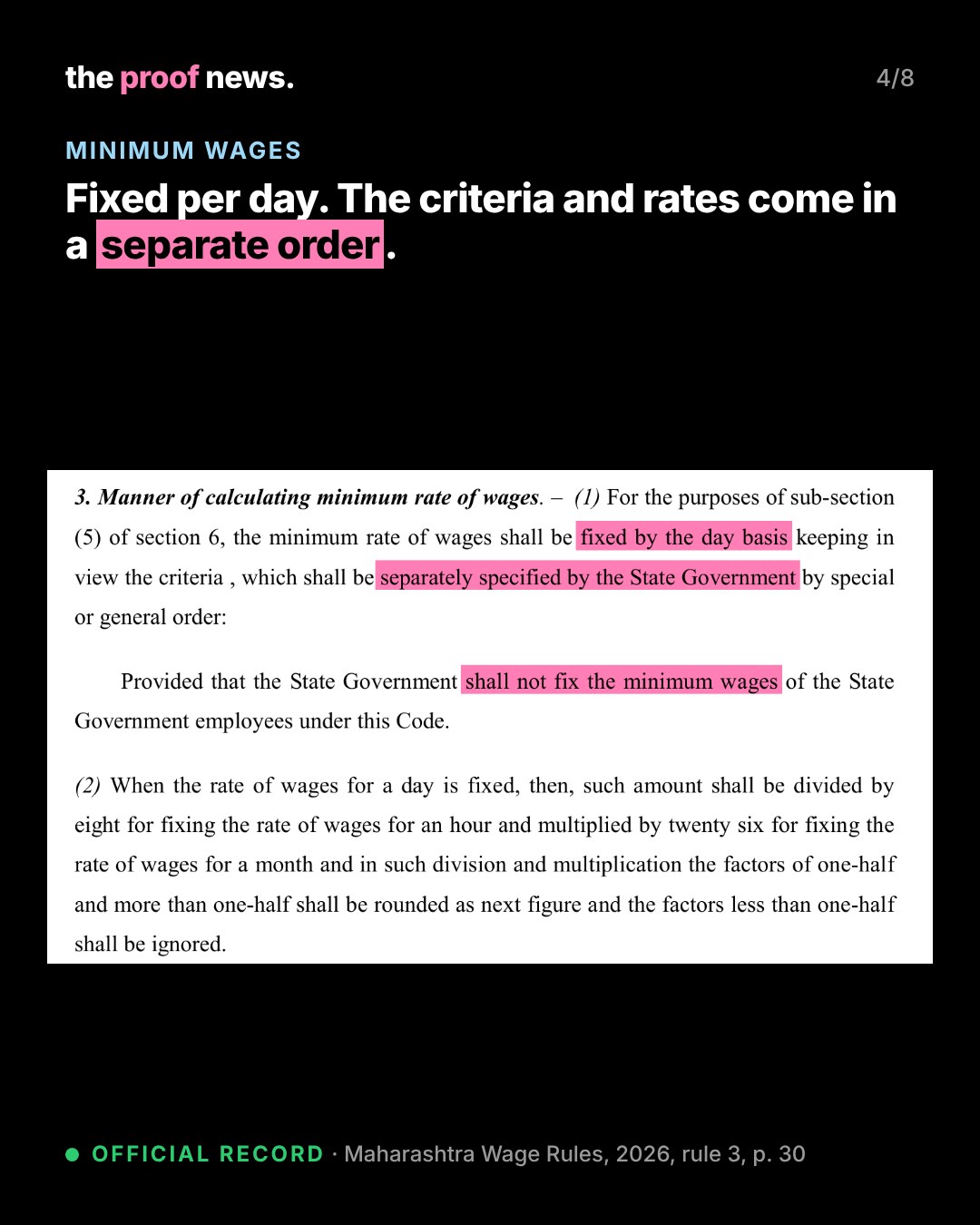
Official recordMinimum wages. The minimum rate "shall be fixed by the day basis keeping in view the criteria, which shall be separately specified by the State Government by special or general order" (rule 3(1), p. 30). The hourly rate is the day rate divided by eight and the monthly rate the day rate multiplied by twenty-six, with halves rounded up (rule 3(2)). As an illustration only (not a notified rate): ₹500 a day gives ₹62.5 an hour, rounded to ₹63, and ₹13,000 a month. The state government "shall not fix the minimum wages of the State Government employees" under the Code (rule 3(1), proviso). Variable dearness allowance is revised twice a year, before 1 April and before 1 October, using the Consumer Price Index for Industrial Workers (rule 4, p. 31).
Official recordDeductions and records. The Code caps total deductions at 50% of wages in a wage period (section 18(3)); under rule 11 (p. 34) any excess is carried forward and no more than 50% may be recovered in a month. Employers must issue wage slips on or before payday and keep registers for five years after the last entry (rules 40 and 41, p. 43).
Official recordWhat the rules do not decide. They set no rupee minimum wage rates. They leave rest intervals to a notification under the OSH Code, and the final text has no spread-over rule (the April draft had left both normal hours and spread-over to government orders). The daily limit, spread-over and the total overtime a worker may do are matters for the OSH Code (sections 25 and 27) and its state rules; the Maharashtra Labour Department's site still lists its OSH, social security and industrial relations rules as drafts (checked 19 November).
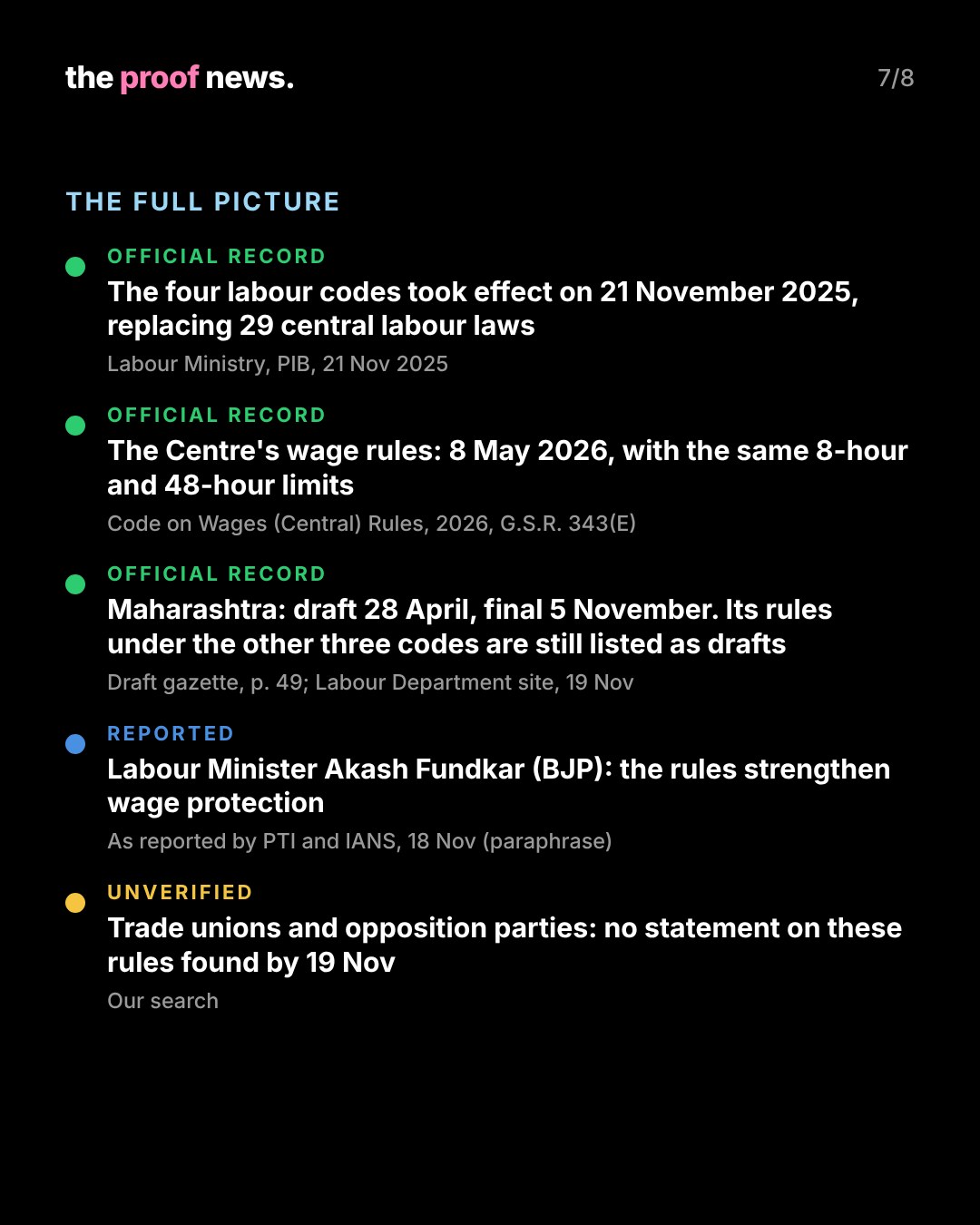
Official recordFrom draft to final. The draft rules were published on 28 April 2026 with 45 days for objections. The draft listed criteria for fixing minimum wages (including a net intake of 2,700 calories a day per consumption unit and 66 metres of cloth a year for a family); the final rules replace that list with criteria to be specified by order. The final hours rule matches the Centre's Code on Wages (Central) Rules, 2026, notified on 8 May 2026.
Official recordThe full picture. The four labour codes (on wages, industrial relations, social security, and occupational safety) took effect on 21 November 2025, replacing 29 central labour laws, according to the Labour Ministry. We could not obtain a current official list of which states have notified final rules, so we give no count.
Verified factMaharashtra is governed by the BJP-led Mahayuti alliance; the Chief Minister is Devendra Fadnavis (BJP), and the Labour Minister is Akash Fundkar (BJP).
ReportedLabour Minister Akash Fundkar said on 18 November that the rules strengthen wage protection for employees covered by the Code, according to reports by PTI and IANS (no direct quote was reported).
UnverifiedWe found no statement on these rules from trade unions or opposition parties by 19 November. This story will be updated if one is made.
FalseSome reports give the year of the rules as 2006. The gazette names them the Maharashtra Wage Rules, 2026.
The proof.
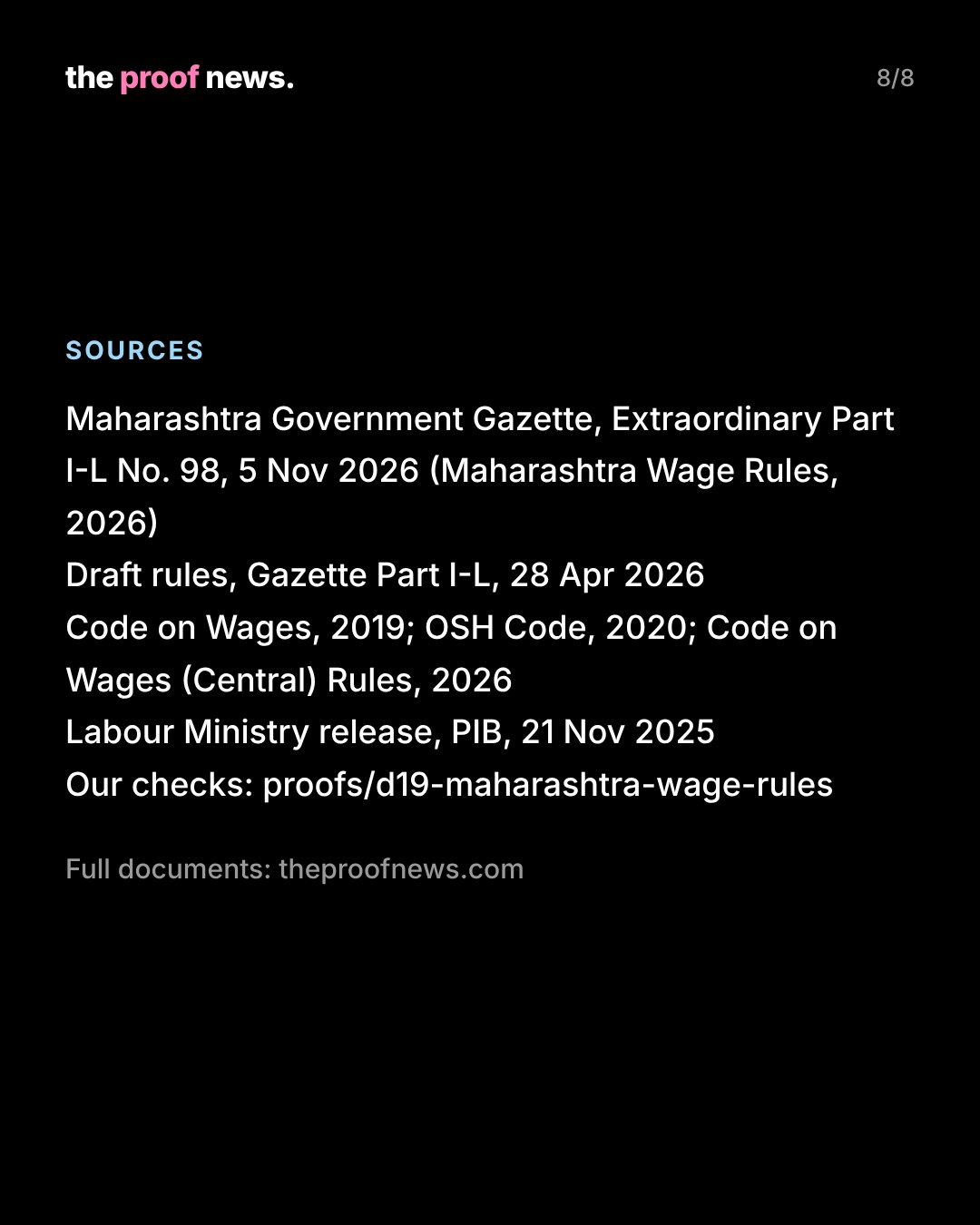
proofs/d19-maharashtra-wage-rules/dossier.md
- Maharashtra Wage Rules, 2026: Gazette Extraordinary Part I-L No. 98, 5 Nov 2026 (Labour Department, Maharashtra)
- Draft Maharashtra Code on Wages Rules, 2026: Gazette Part I-L, 28 Apr 2026
- Maharashtra Labour Department: Labour Code page (state and central rules)
- The Code on Wages, 2019 (No. 29 of 2019)
- The Occupational Safety, Health and Working Conditions Code, 2020
- Code on Wages (Central) Rules, 2026, G.S.R. 343(E), 8 May 2026
- Labour Ministry (PIB): the four labour codes made effective, 21 Nov 2025