Kerala High Court upholds State order abolishing the Kerala Police Officers' Association
A Division Bench set aside a Single Judge's ruling that the order violated the right to form associations. Membership of these associations was "automatic based on their rank", the court held, so no Article 19(1)(c) right was infringed.
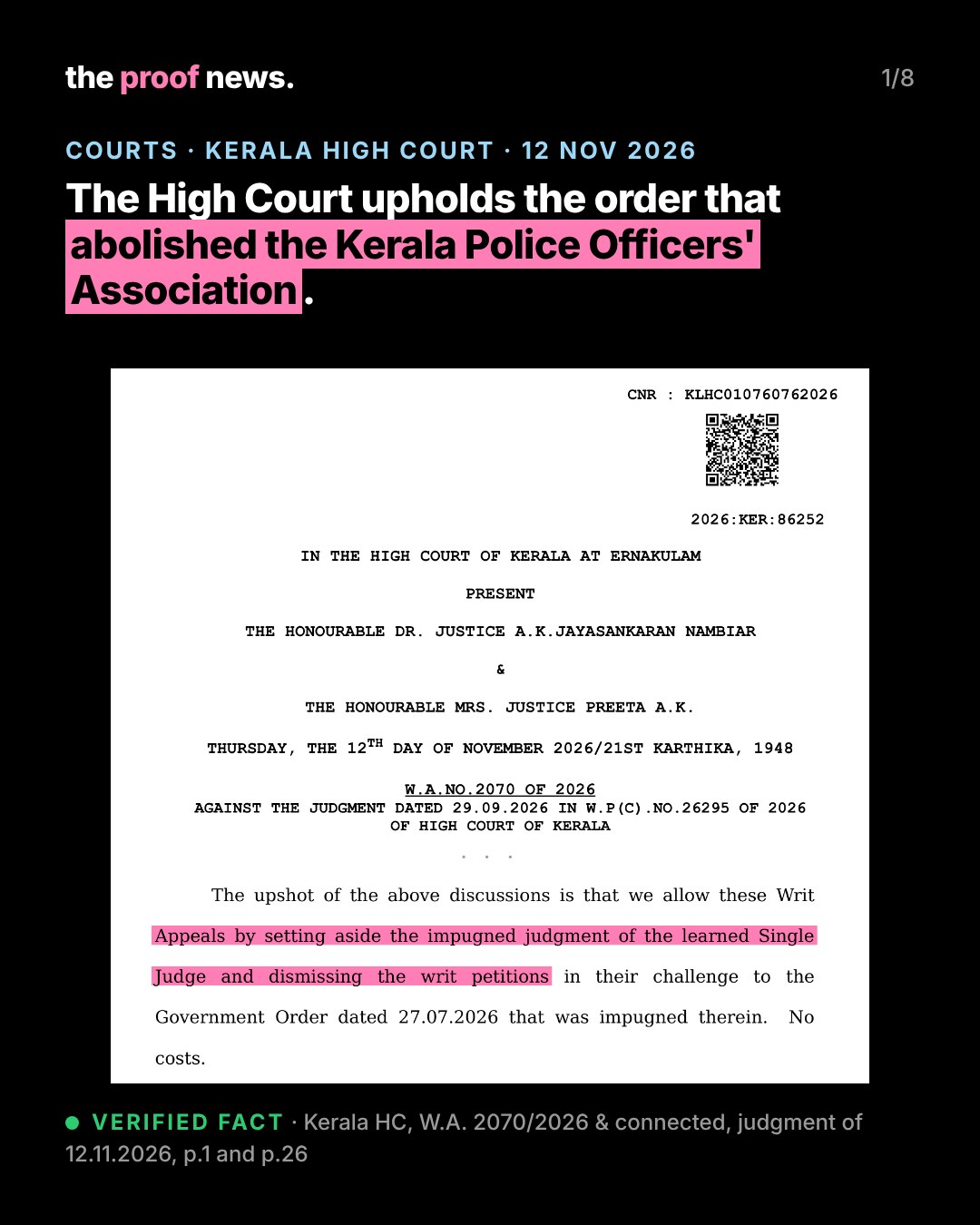
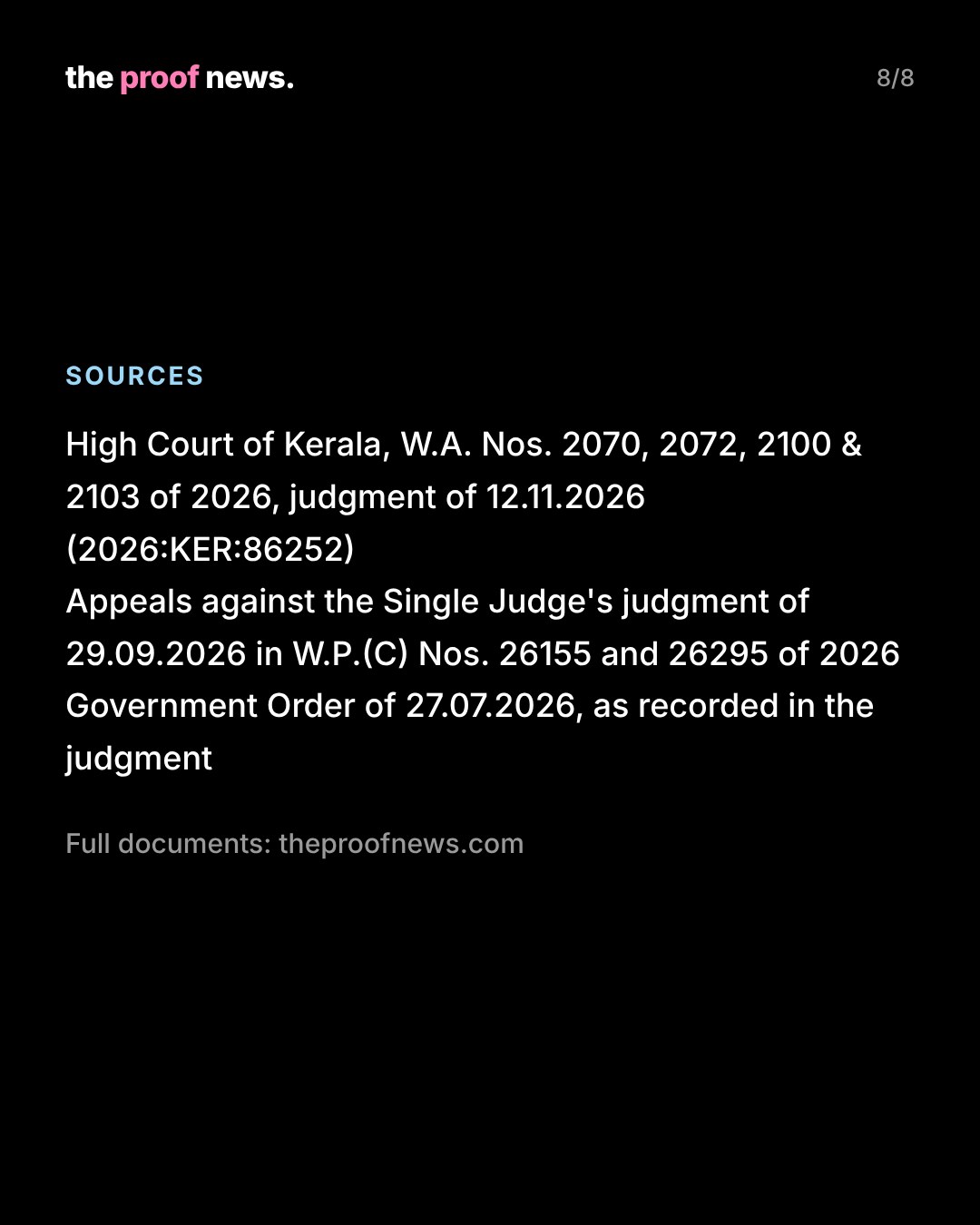
Verified factOn 12 Nov 2026 a Division Bench of the High Court of Kerala (Dr. Justice A.K. Jayasankaran Nambiar and Justice Preeta A.K.) allowed four writ appeals (W.A. Nos. 2070, 2072, 2100 and 2103 of 2026; 2026:KER:86252), set aside a Single Judge's judgment of 29.09.2026, and dismissed the writ petitions "in their challenge to the Government Order dated 27.07.2026" (p.26). The appeals were filed by the State of Kerala and by two officers who are members of the Kerala Police Association and the Kerala Police Senior Officers' Association respectively (para 1).
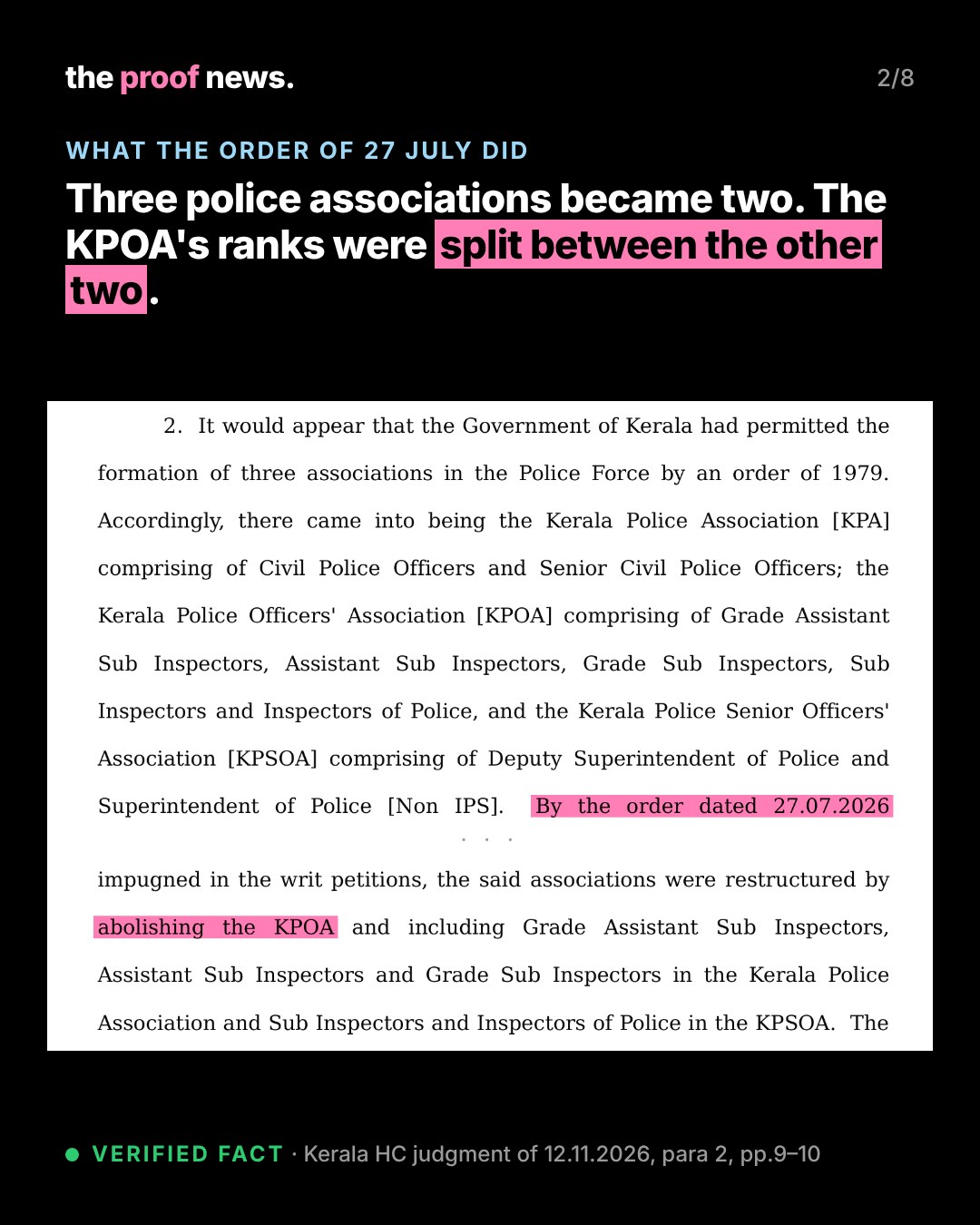
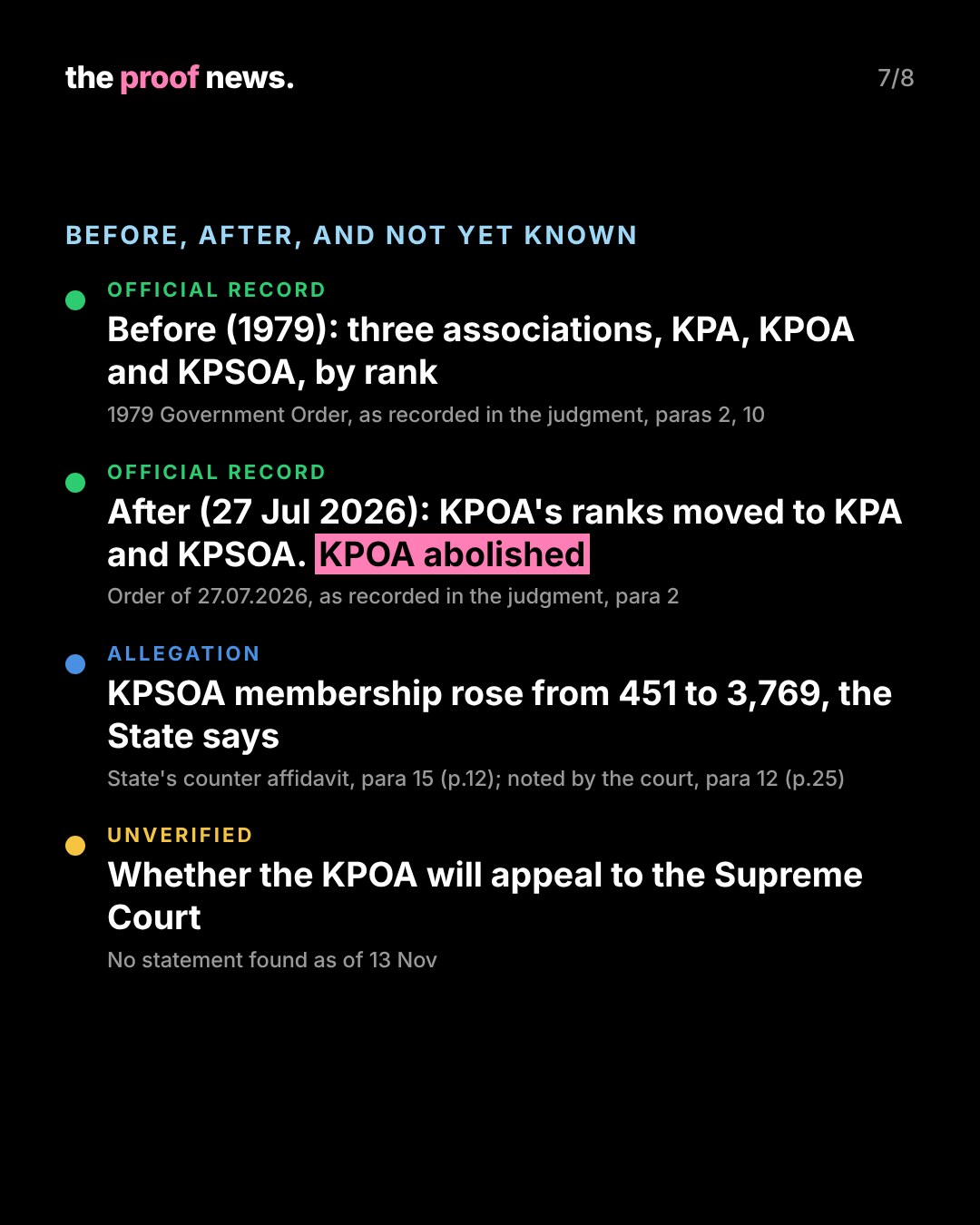
Official recordUnder a Government Order of 1979, there were three recognised associations in the Kerala police: the Kerala Police Association (KPA) for Civil Police Officers and Senior Civil Police Officers; the Kerala Police Officers' Association (KPOA) for Grade Assistant Sub Inspectors, Assistant Sub Inspectors, Grade Sub Inspectors, Sub Inspectors and Inspectors; and the Kerala Police Senior Officers' Association (KPSOA) for Deputy Superintendents and Superintendents of Police (non-IPS). The order of 27.07.2026 abolished the KPOA, moved Grade Assistant Sub Inspectors, Assistant Sub Inspectors and Grade Sub Inspectors into the KPA, and Sub Inspectors and Inspectors into the KPSOA (para 2, pp.9-10).
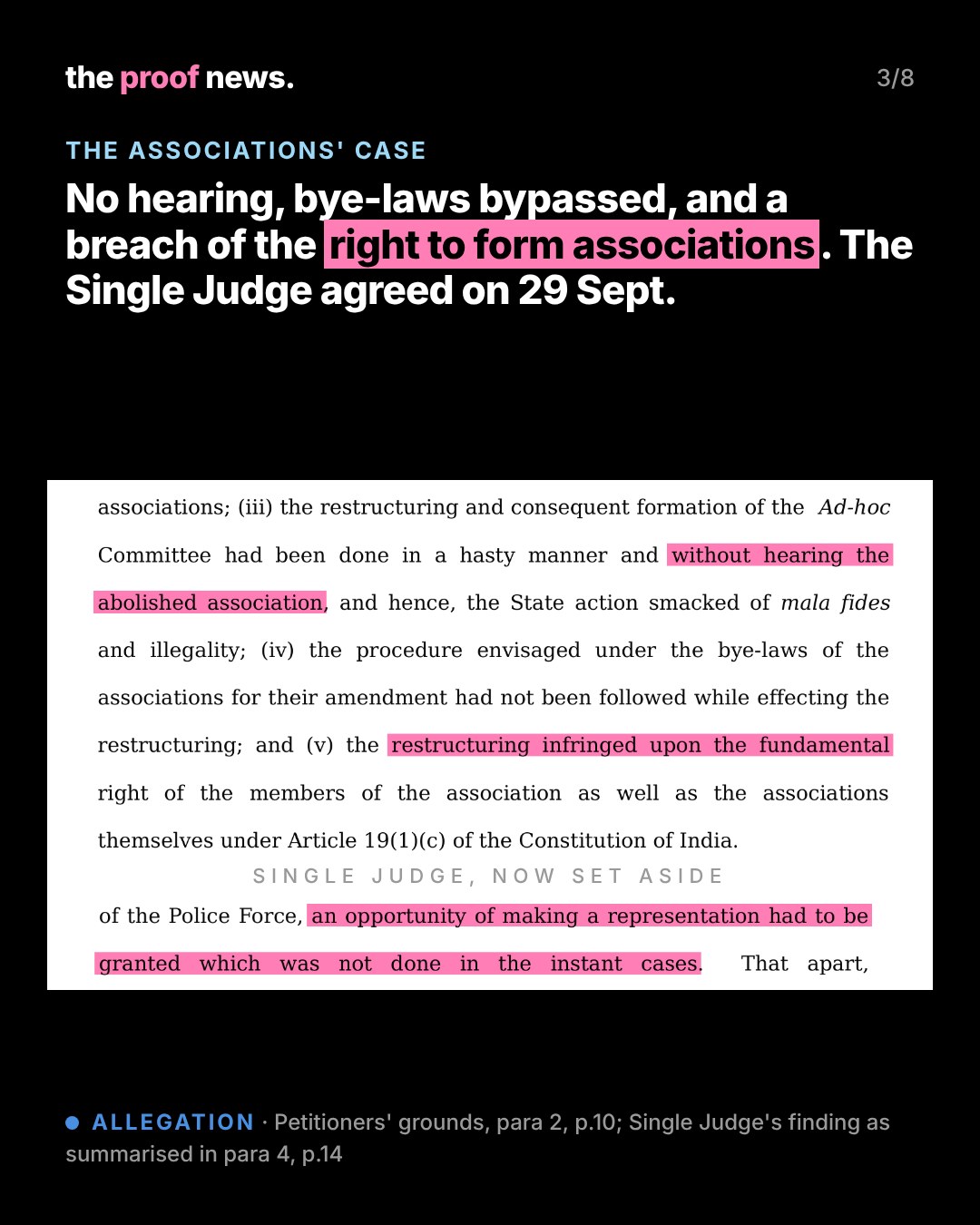
AllegationThe KPOA and the KPA, which challenged the order (W.P.(C) Nos. 26295 and 26155 of 2026), argued that the Government had no power to issue it; that a recognised association could not be unilaterally abolished or merged without revoking the 1979 order; that the restructuring was done "in a hasty manner and without hearing the abolished association"; that the bye-law procedure for amendments was not followed; and that it infringed the right of the members and the associations under Article 19(1)(c) of the Constitution (para 2, p.10).
Official recordThe Single Judge had agreed. Rule 8 of the Police Forces (Restriction of Rights) Rules, 1966 required an opportunity to make a representation before recognition was revoked, "which was not done in the instant cases"; bye-law amendments needed a two-thirds majority of the General Body; and Article 19(1)(c) protects the right to continue an association with its agreed composition (para 4, pp.13-14). That judgment has now been set aside.
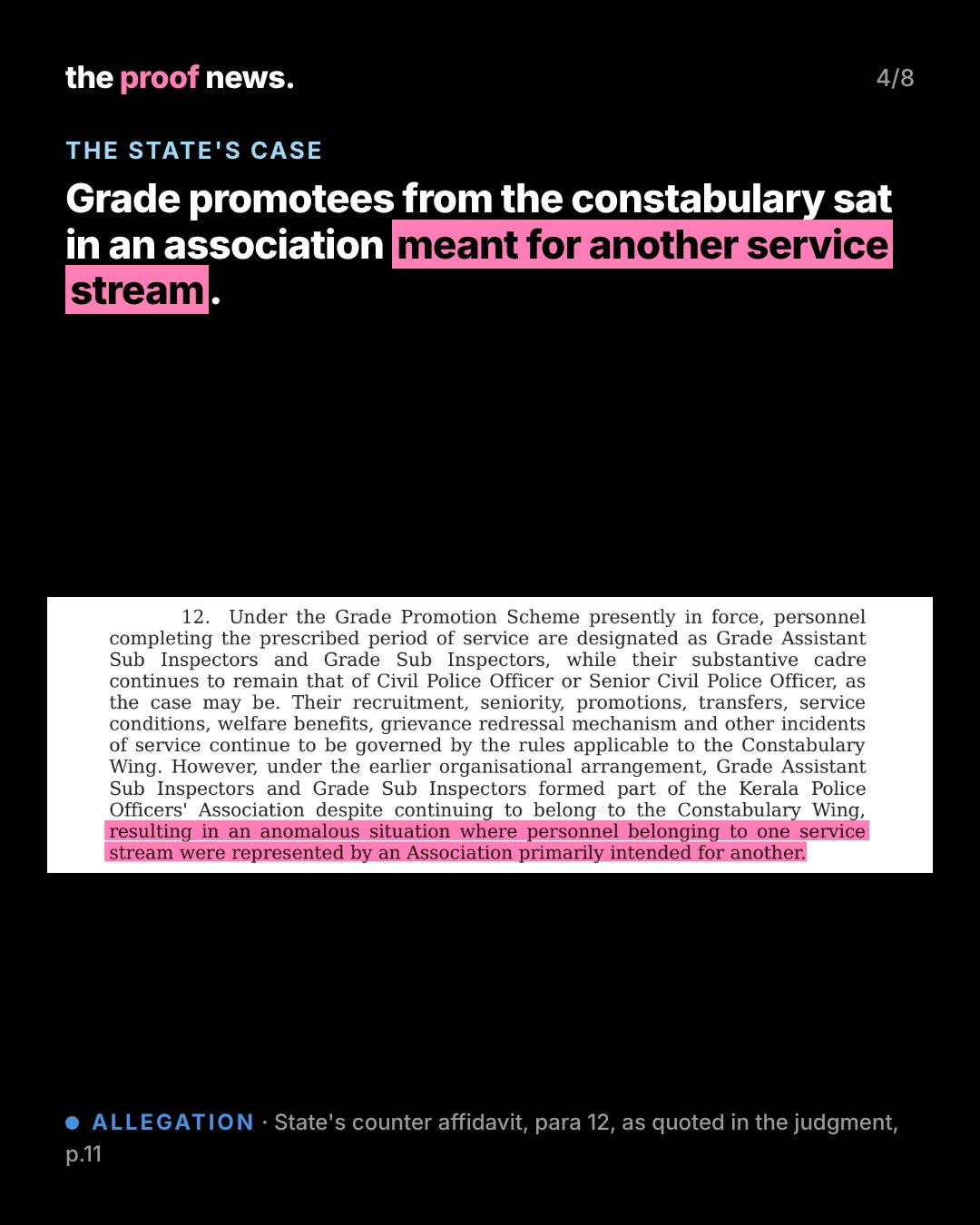
AllegationThe State said in its counter affidavit that the membership pattern pre-dated the Grade Promotion Scheme of 2008. Grade Assistant Sub Inspectors and Grade Sub Inspectors remain in the constabulary cadre but sat in the KPOA, "resulting in an anomalous situation where personnel belonging to one service stream were represented by an Association primarily intended for another" (counter affidavit paras 11-12, quoted at p.11). It said the order followed the recommendations of the State Police Chief, and that KPSOA membership rose from 451 to about 3,769 (paras 13, 15, pp.11-12).
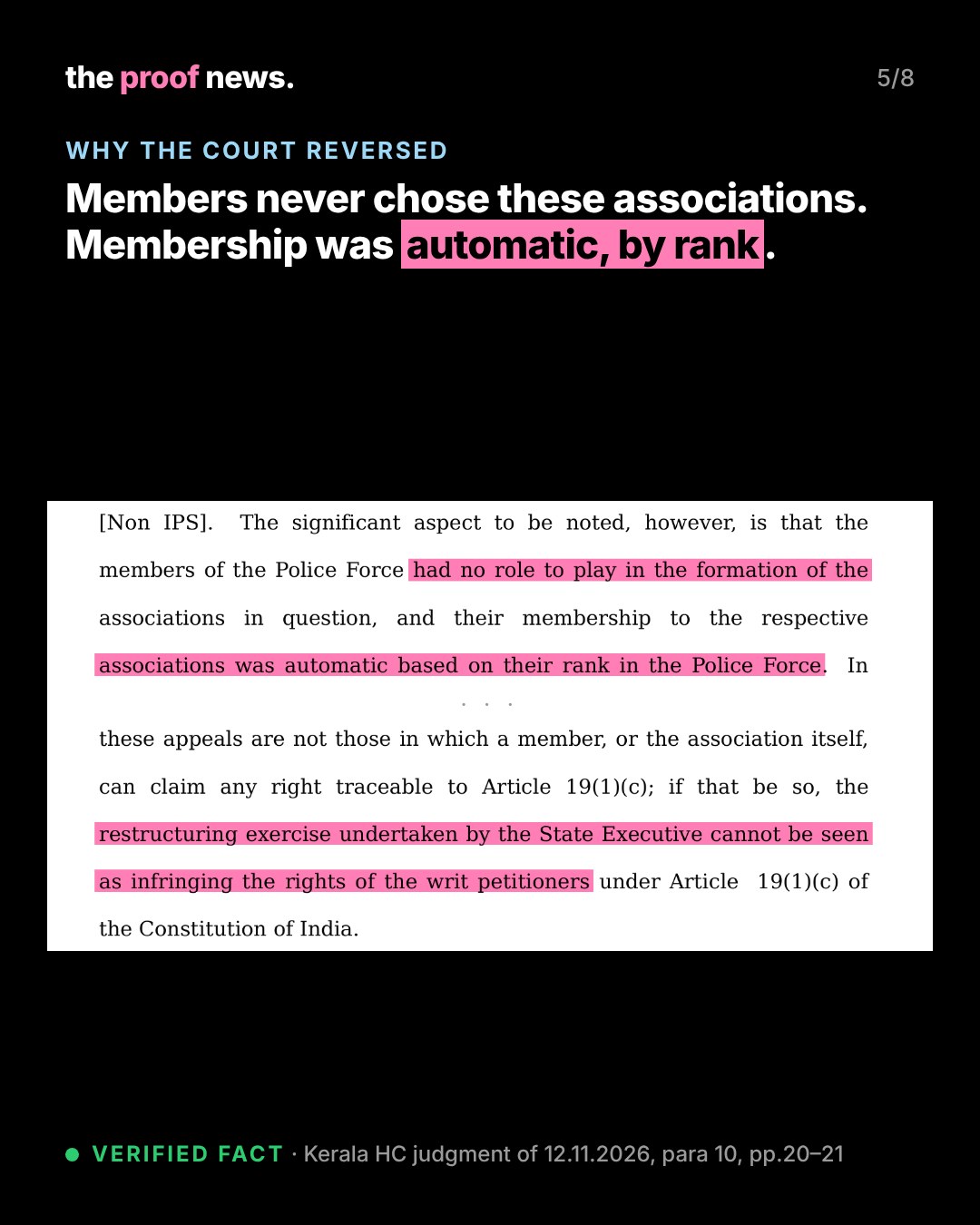
Verified factThe bench held that the 1979 associations were "formed by the Government itself based on a categorization of the police personnel by rank"; members "had no role to play in the formation of the associations in question, and their membership to the respective associations was automatic based on their rank in the Police Force" (para 10, p.20). Because the right under Article 19(1)(c) must be exercised "through individual agency", the "restructuring exercise undertaken by the State Executive cannot be seen as infringing the rights of the writ petitioners under Article 19(1)(c)" (para 10, p.21).
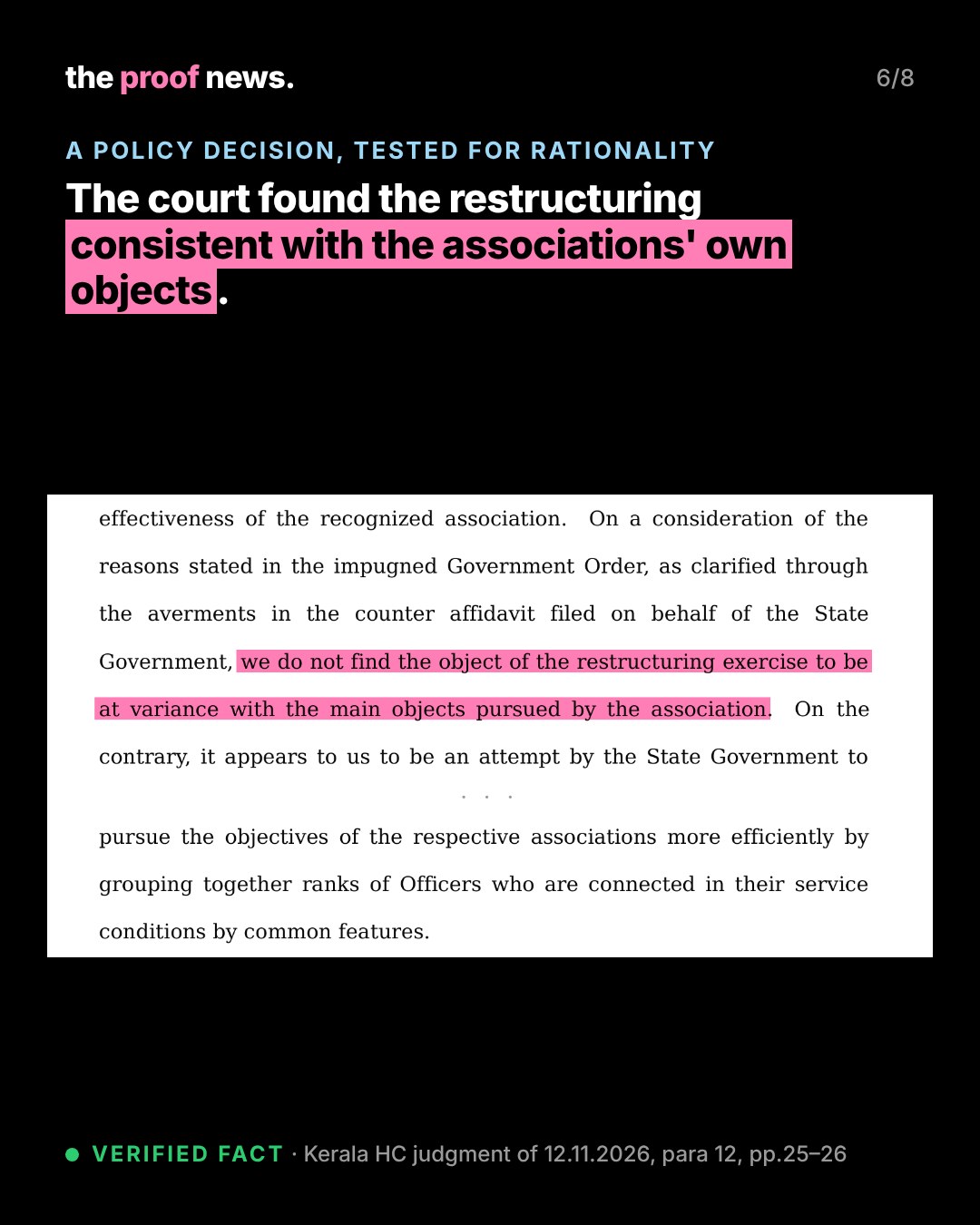
Verified factIt held that the bye-laws "do not, and cannot by themselves, confer any rights or powers on the members of the association with regard to either the formation or continuation of the association" (para 11, p.22); that forming and restructuring these associations are "essentially matters of policy of the State Government", to be interfered with only if the action fails the test of rationality (para 12, p.23); and that "we do not find the object of the restructuring exercise to be at variance with the main objects pursued by the association" (p.25).
UnverifiedNot yet known: whether the KPOA or the KPA will appeal to the Supreme Court. No public statement from either after the judgment was found as of 13 Nov 2026. The text of the Government Order of 27.07.2026 was not obtained; it is described here as recorded in the judgment.
The proof.
Every quotation is verbatim from the Division Bench judgment, with page and paragraph, and was machine-checked against the judgment text; the highlighted page images are rendered from the judgment PDF.