Supreme Court: a grandson has no birthright in his father's share of a partitioned family property
Under Section 8 of the Hindu Succession Act, the son of a living son is not a Class I heir, the court held, and once the grandfather's estate was divided the father's share became his own. A 1997 suit for half of it fails after 29 years.
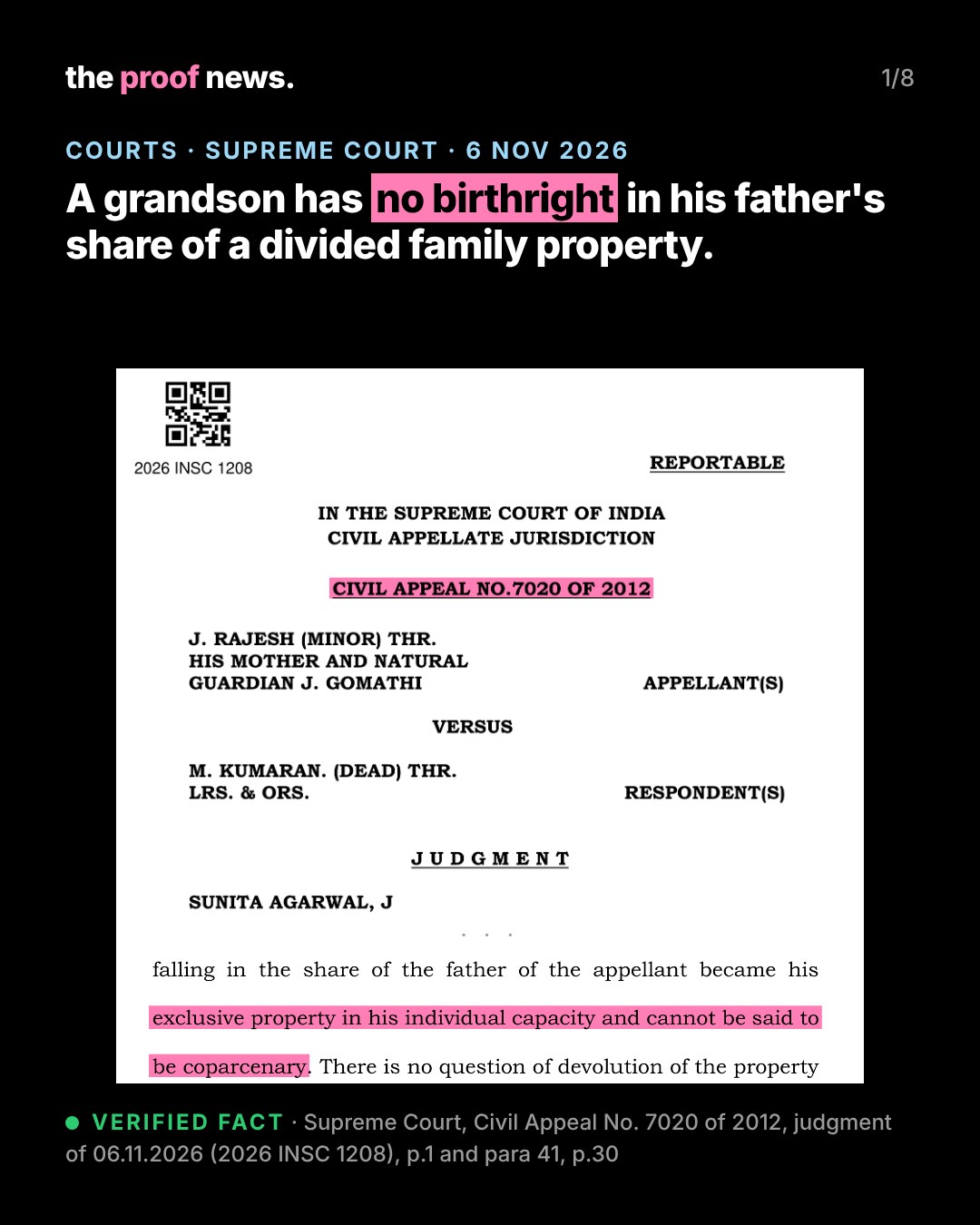
Verified factOn 6 November 2026 the Supreme Court dismissed an appeal by a grandson who claimed half of a property his father had received when the grandfather's estate was divided (J. Rajesh (Minor) v. M. Kumaran (Dead) through LRs & Ors., Civil Appeal No. 7020 of 2012, 2026 INSC 1208). The bench was Justices Augustine George Masih and Sunita Agarwal, who wrote the judgment. The question, in the court's words, was whether the appellant could claim "half share in the property of his father who is still alive" on the premise that it was "ancestral/joint family property" (para 1).
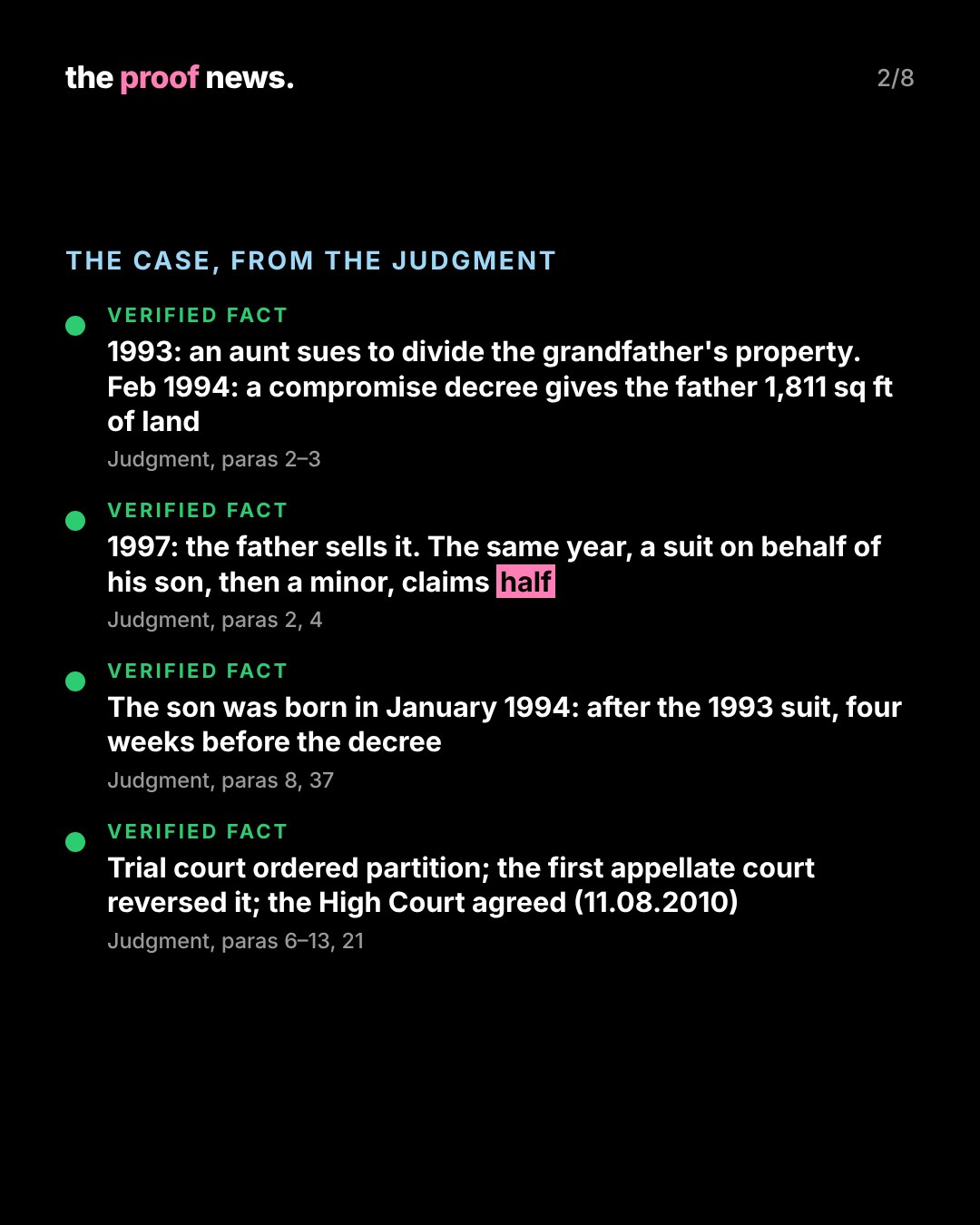
Verified factThe facts, as recorded in the judgment: the father's sister filed a suit in 1993 to divide the property of the grandfather, N. Ramakrishnan. It was decreed on a compromise dated 03.02.1994, under which the father got land of 1,811 sq ft (para 3). The father sold it under sale deeds of 03.04.1997 and 17.04.1997 (para 4). In 1997 a suit (O.S. No. 1698 of 1997) was filed on behalf of his son, then a minor, for partition and half of the land (para 2). The son was born in January 1994, after the 1993 suit was filed and four weeks before the compromise (paras 8, 37). The trial court in Chennai granted a preliminary decree for partition; the first appellate court set it aside; the High Court, on 11.08.2010, agreed with the appellate court (paras 6–13, 21).
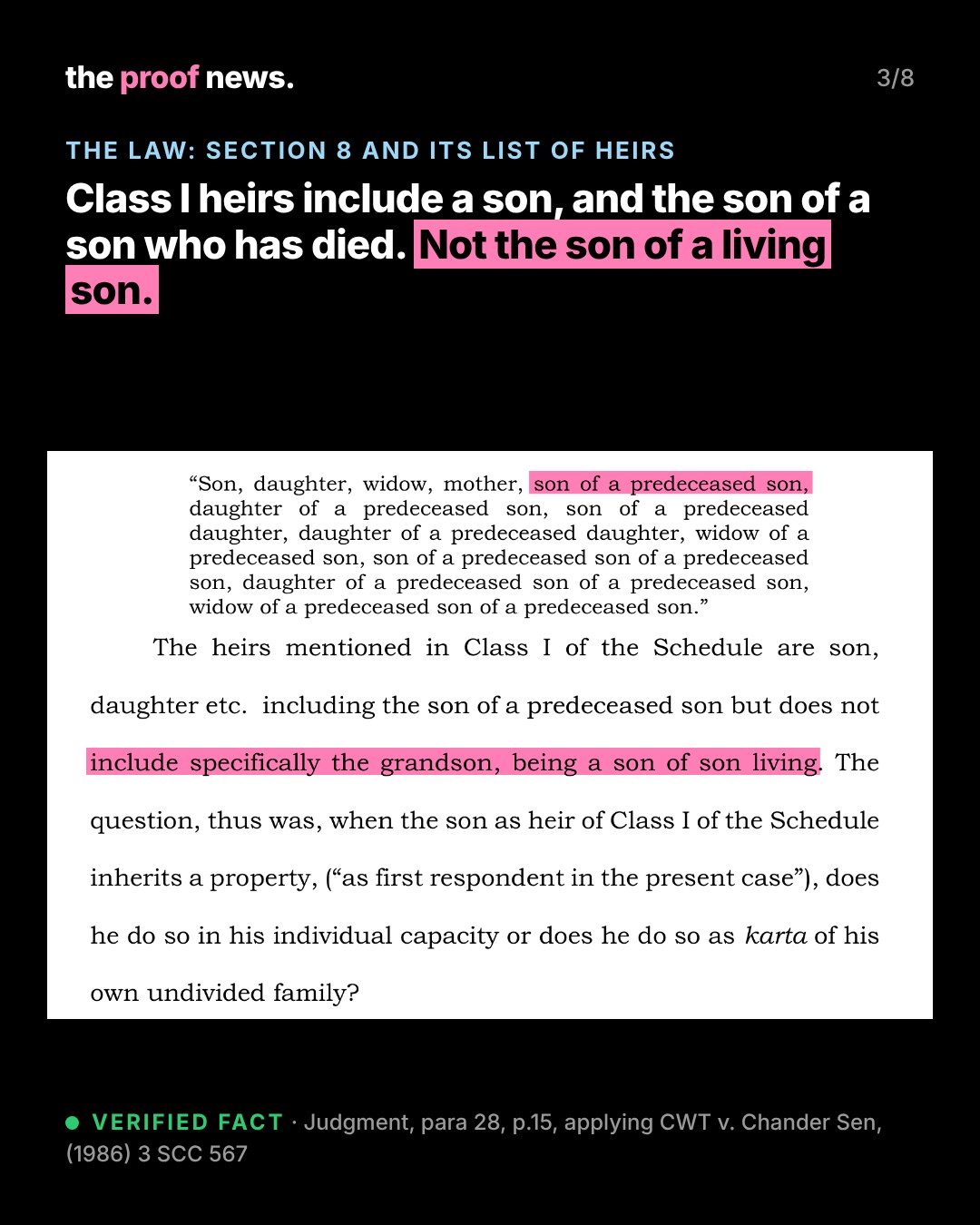
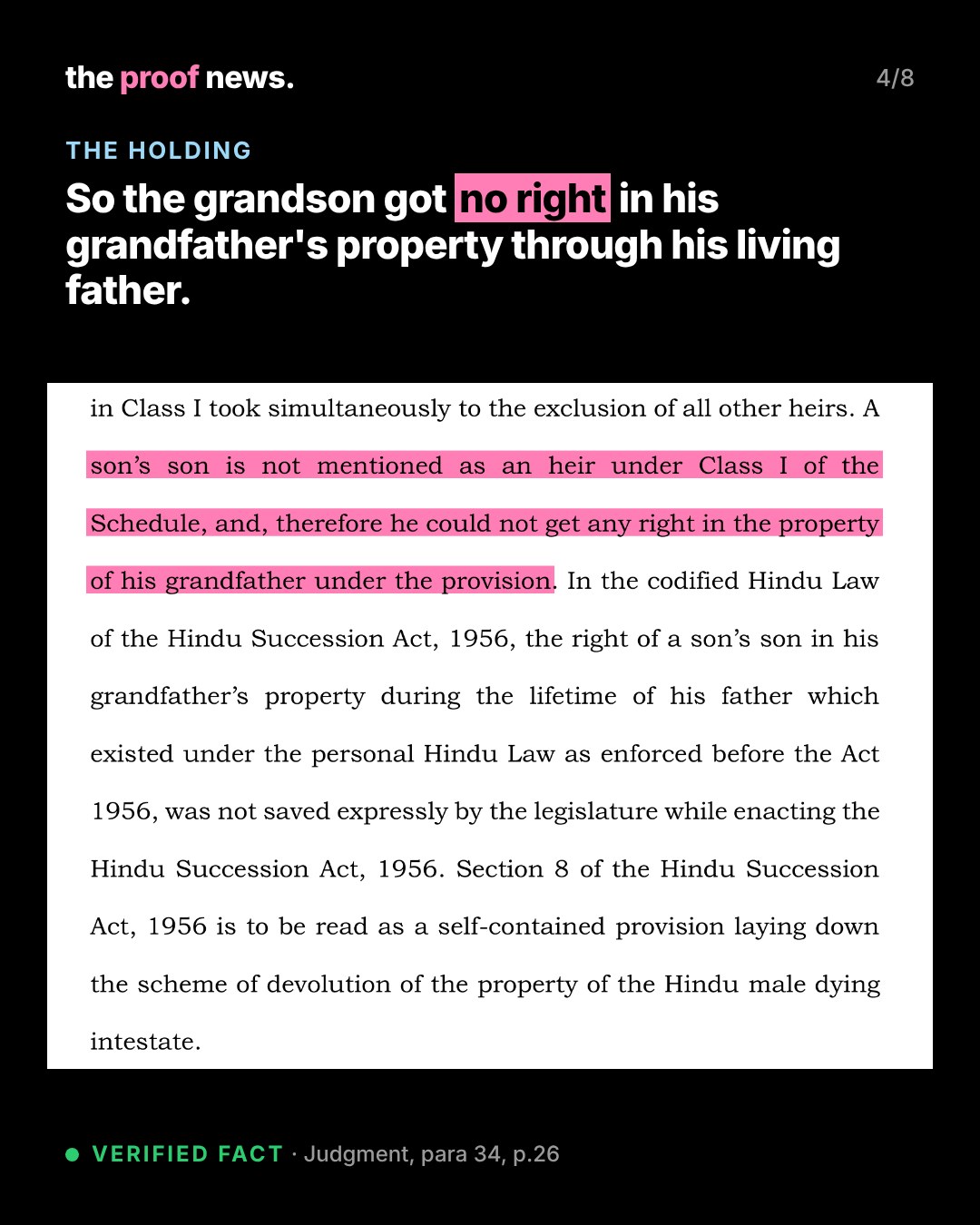
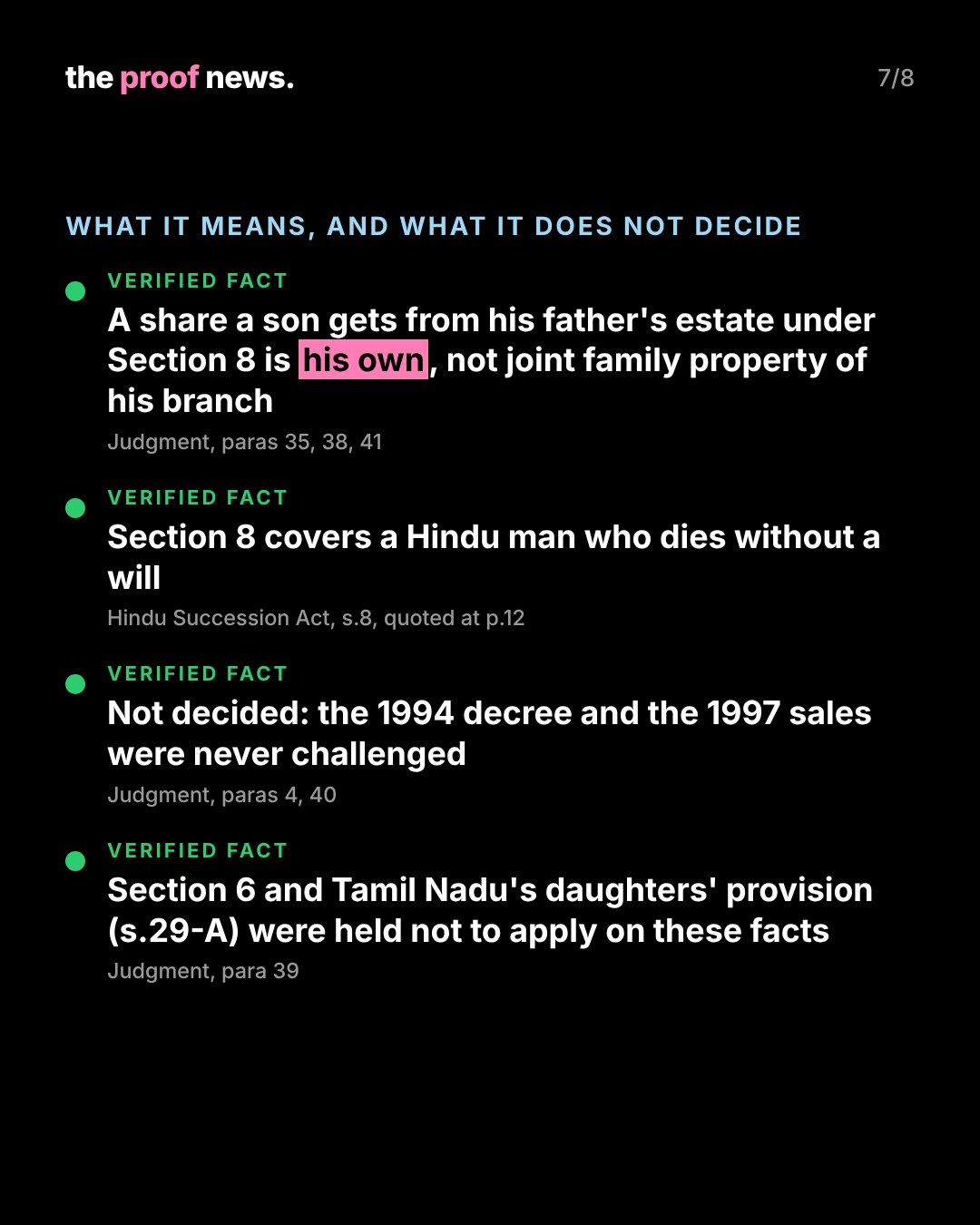
Verified factThe holding. Section 8 of the Hindu Succession Act, 1956 governs the property of a Hindu male who dies without a will. Its Class I heirs, who inherit together to the exclusion of all others, include a son and the son of a predeceased son but not the son of a living son. "A son's son is not mentioned as an heir under Class I of the Schedule, and, therefore he could not get any right in the property of his grandfather under the provision" (para 34, p.26). The court added that the right a son's son had in his grandfather's property under the pre-1956 personal law "was not saved expressly by the legislature" (para 34).
Verified factApplying CWT v. Chander Sen, (1986) 3 SCC 567, the court held that property a son inherits under Section 8 is not joint family (HUF) property in his hands as against his own son; otherwise there would be "two classes among the heirs mentioned in Class I", male heirs holding joint family property and female heirs not (para 38). It also relied on Bhanwar Singh v. Puran and Radha Bai v. Ram Narayan (paras 30–33).
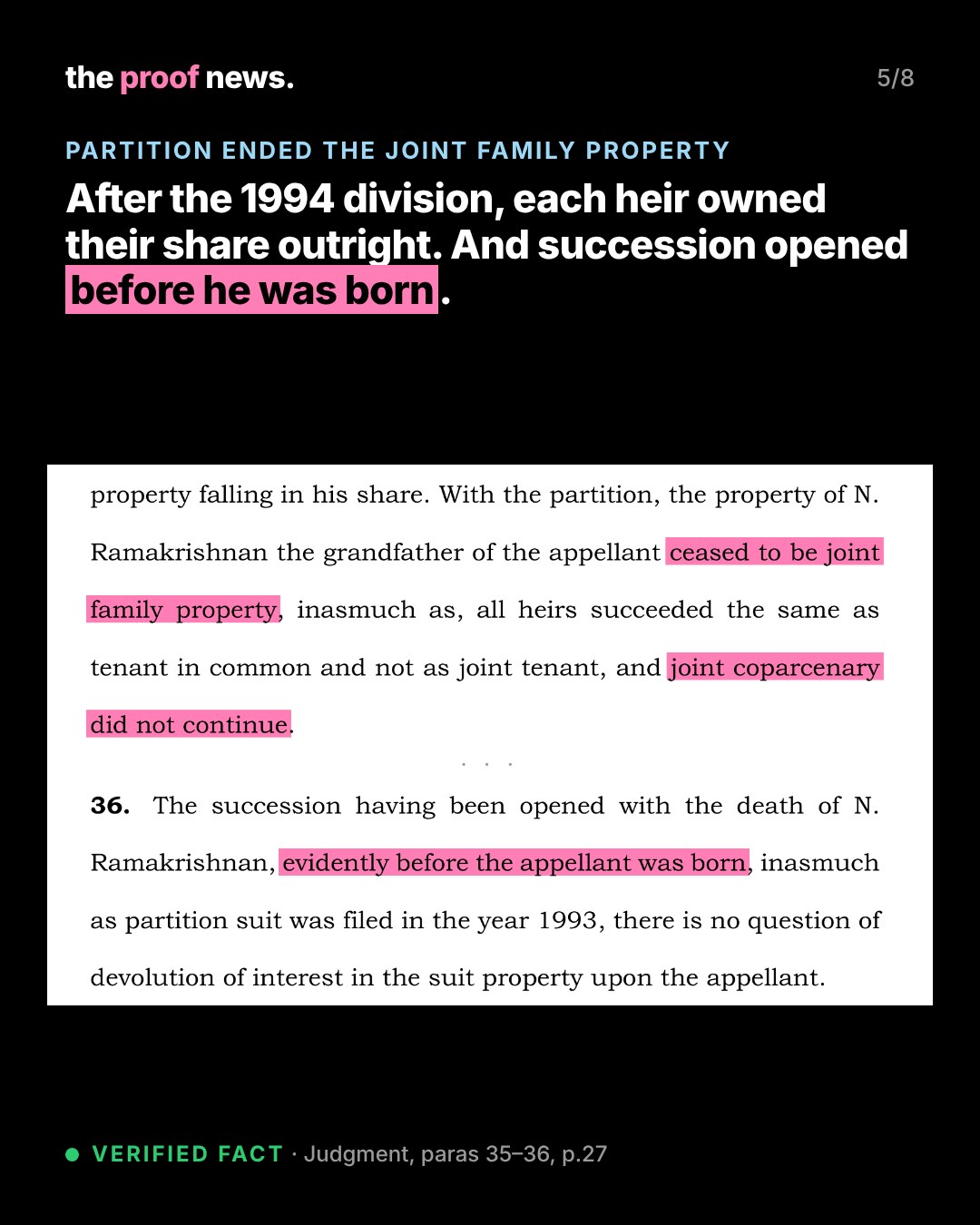
Verified factOn partition: "With the partition, the property of N. Ramakrishnan the grandfather of the appellant ceased to be joint family property"; the heirs held as tenants in common, "and joint coparcenary did not continue" (para 35, p.27). Succession opened on the grandfather's death, "evidently before the appellant was born" (para 36). The father's share "became his exclusive property in his individual capacity and cannot be said to be coparcenary" (para 41). The appeal "stands dismissed with no order as to costs" (para 42).
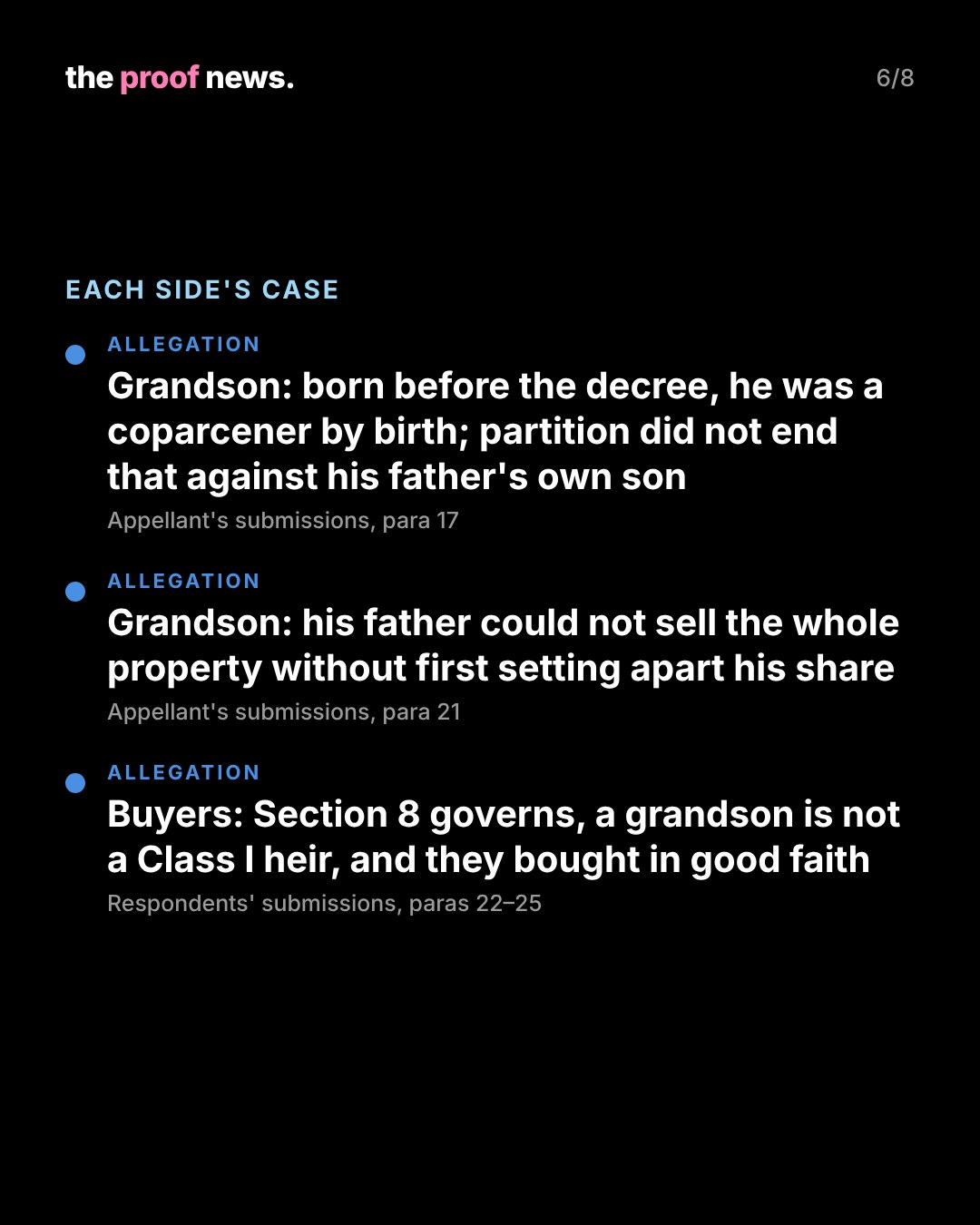
AllegationThe grandson's case (paras 14–21): born before the 1994 decree, he became a coparcener by birth, and partition did not end that as against his father's own son; under Section 29-A of the Hindu Succession (Tamil Nadu Amendment) Act, 1989, the property kept its coparcenary character; his father could not sell the whole property without setting apart his share; and the buyers could not get a better title than the seller. He relied on Rohit Chauhan v. Surinder Singh (2013) and Arshnoor Singh v. Harpal Kaur (2020) (para 18).
AllegationThe buyers' case (paras 22–25): this is a grandson seeking succession to his grandfather's property, governed by Section 8, which excludes a son's son; neither Section 6 nor Section 29-A applies; the compromise decree was never challenged; they were "innocent" purchasers, and the suit was collusive with the father, who did not contest it.
Verified factWhat the judgment does not decide. The compromise decree of 1994 and the 1997 sale deeds were never challenged (paras 4, 40). The court held that Section 6 (as it stood before 2005) and Section 29-A, the Tamil Nadu provision on daughters' coparcenary rights, had no application on these facts (para 39). The grandfather's date of death is not disclosed in the record (paras 35, 39). The judgment records Rohit Chauhan and Arshnoor Singh as cited by the appellant (para 18) but does not discuss them in its reasoning.
CommentaryIn plain words: on these facts, when a Hindu man dies without a will and his children divide his property, each child's share is their own. A grandson cannot sue his living father for a share of it on the ground that he acquired a right by birth. This summary is ours; the judgment's words are quoted above with paragraph numbers.
The proof.
Every quotation is verbatim from the Supreme Court's judgment of 6 November 2026, with paragraph and page, and was machine-checked against the judgment text. Two separately hosted copies of the court's PDF have identical text. The highlighted page images are rendered from the judgment PDF.