Supreme Court suspends life sentences of two convicts in the 2002 Bilkis Yakub Rasool case and grants bail pending appeal
The court cited more than seventeen years in custody and one appellant's severe disability, and said the appeal raises issues "both on fact and law". The prosecution opposed bail. The convictions stand.
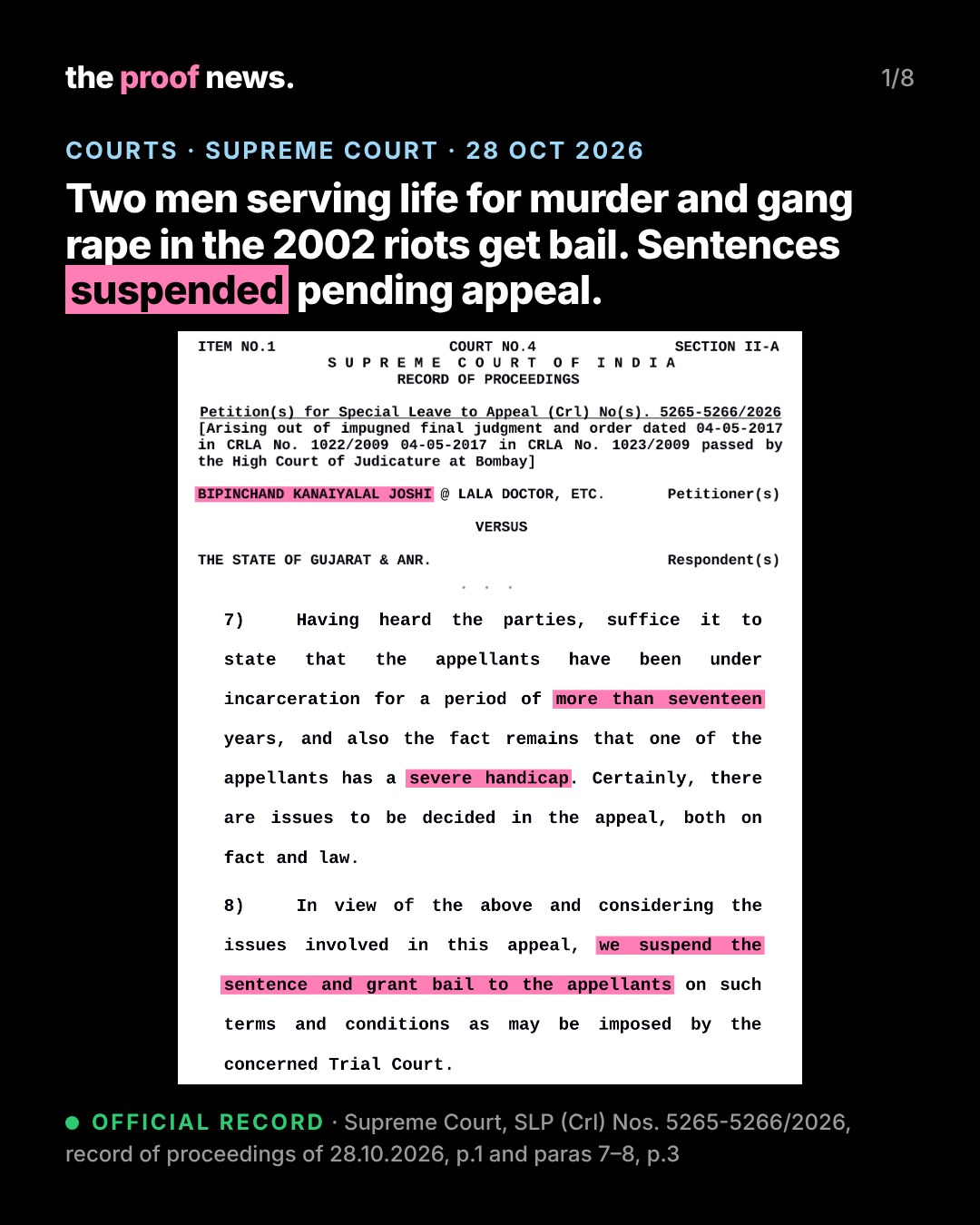
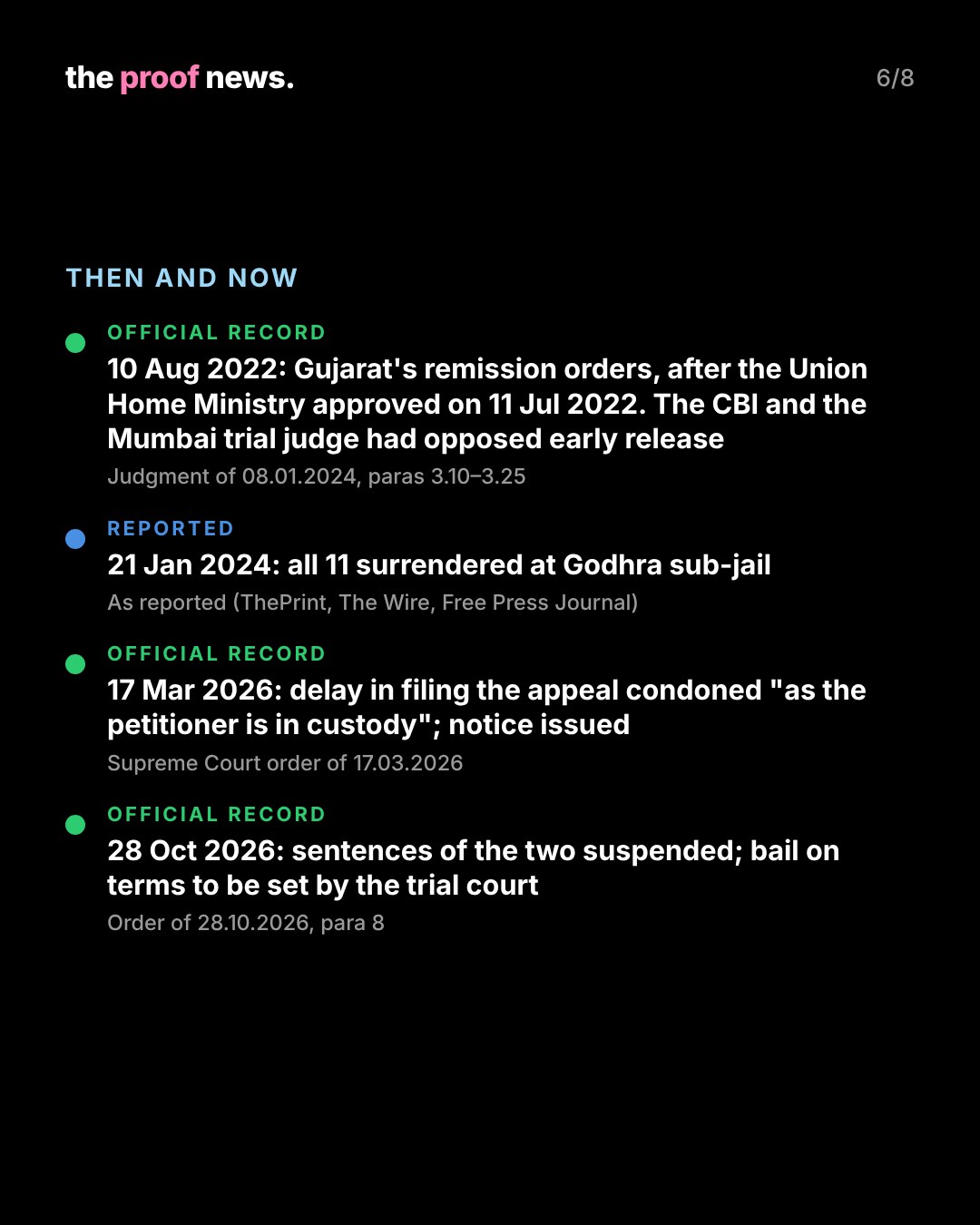
Official recordOn 28 October 2026 a Supreme Court bench of Justices M.M. Sundresh and Prasanna B. Varale granted leave in Special Leave Petition (Crl) Nos. 5265-5266/2026, Bipinchand Kanaiyalal Joshi @ Lala Doctor etc. v. The State of Gujarat & Anr., and ordered: "we suspend the sentence and grant bail to the appellants on such terms and conditions as may be imposed by the concerned Trial Court" (para 8). The record of proceedings was digitally signed on 29 October.
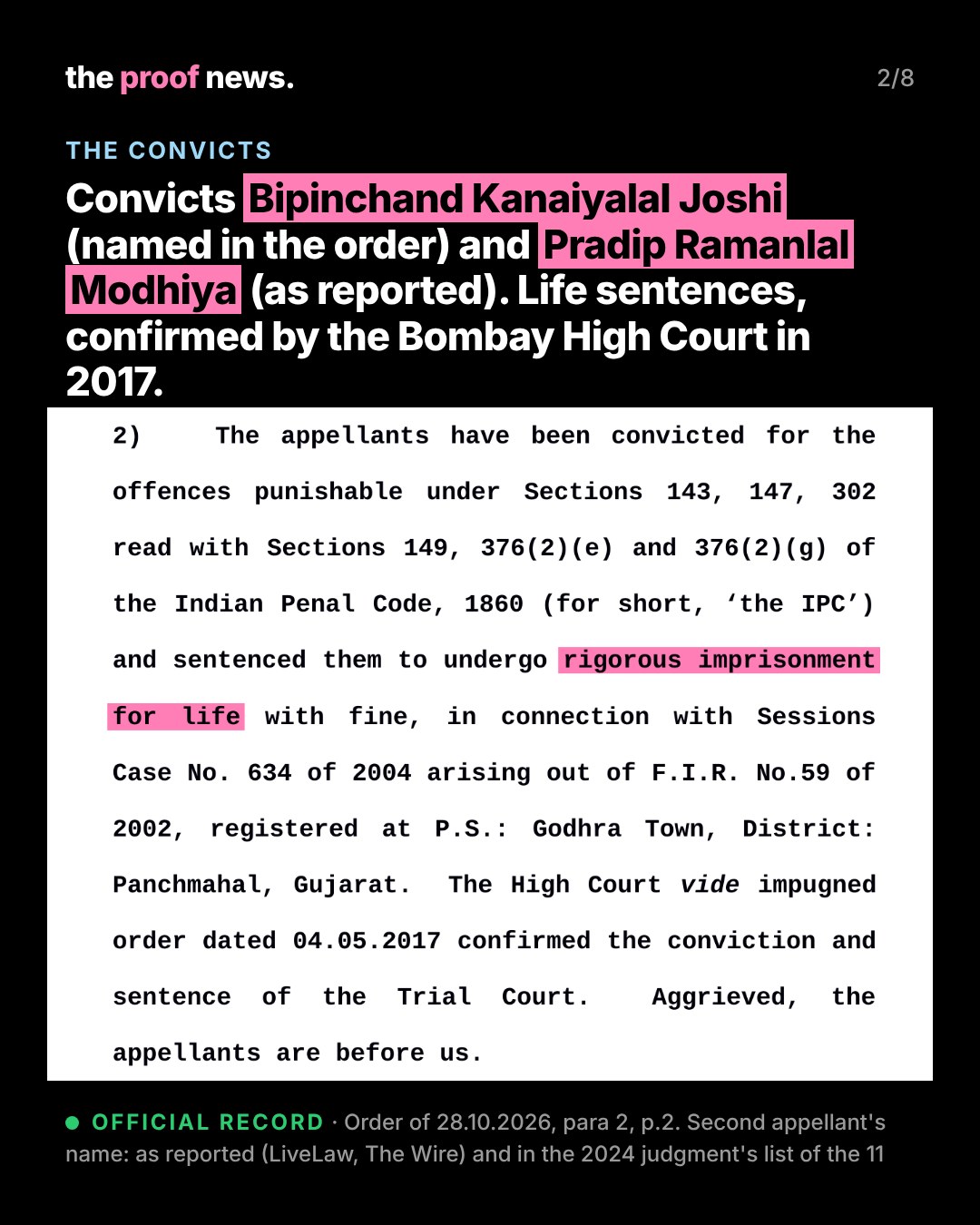
Verified factThe appellants were convicted under Sections 143, 147, 302 read with 149, 376(2)(e) and 376(2)(g) of the Indian Penal Code and sentenced to rigorous imprisonment for life, in Sessions Case No. 634 of 2004; the High Court of Bombay confirmed the conviction and sentence on 4 May 2017 (order, para 2). The order's title names Bipinchand Kanaiyalal Joshi. The second appellant, Pradip Ramanlal Modhiya, is named in reports of the order (LiveLaw, The Wire); both are among the 11 convicts named in the Supreme Court's 2024 judgment.
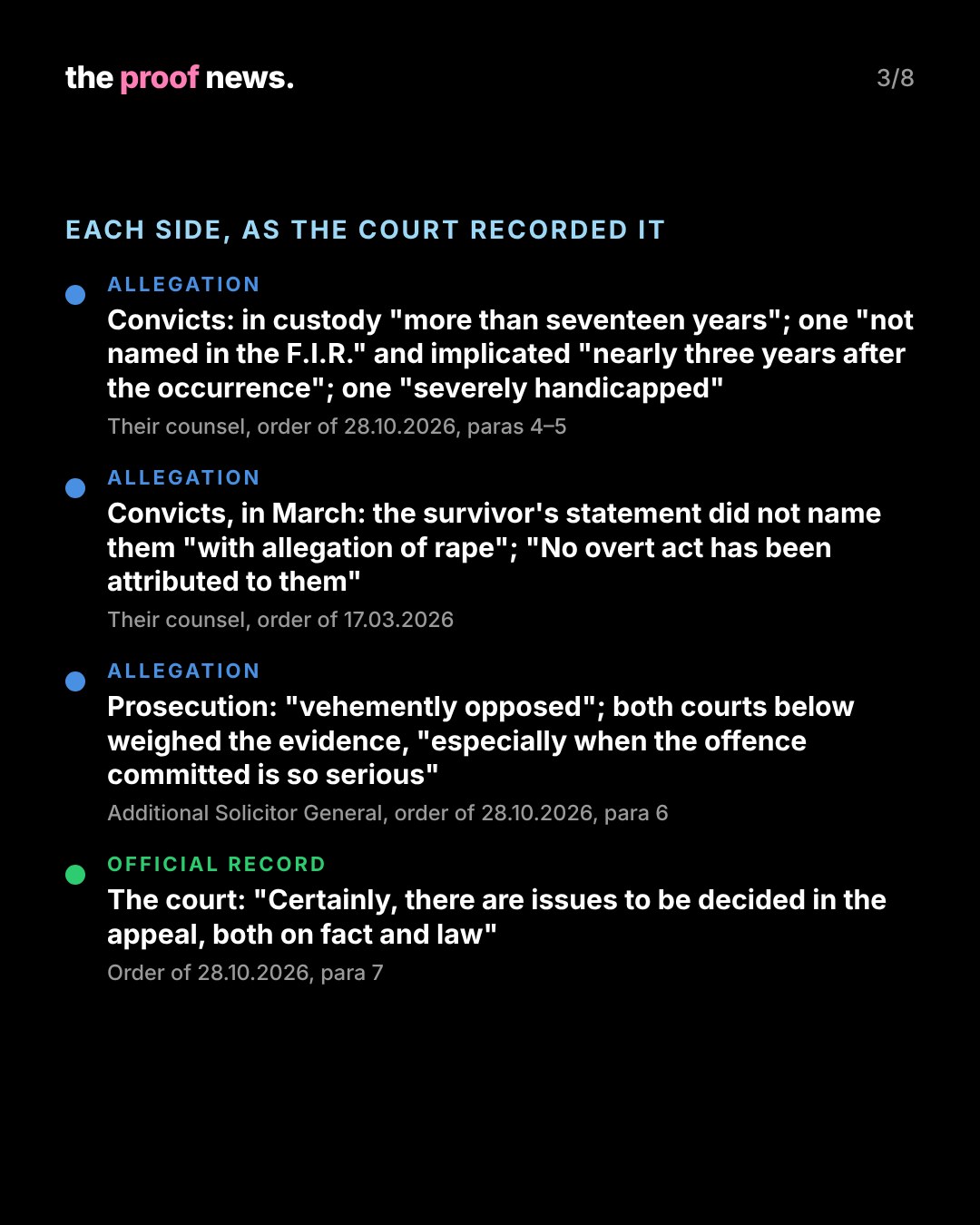
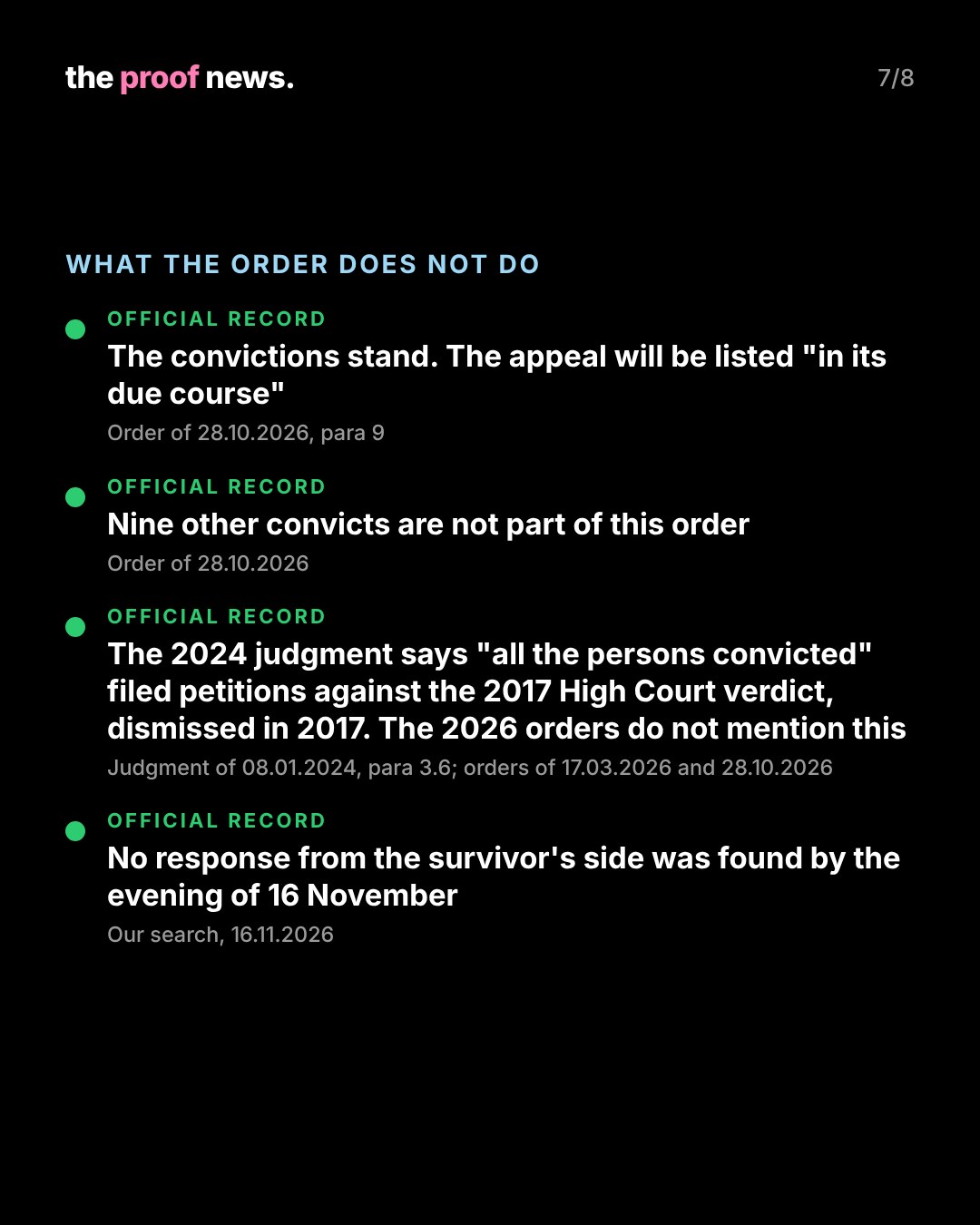
Official recordThe court's reasons: "the appellants have been under incarceration for a period of more than seventeen years, and also the fact remains that one of the appellants has a severe handicap. Certainly, there are issues to be decided in the appeal, both on fact and law" (para 7). The appeal is to be listed "in its due course" (para 9).
AllegationThe convicts' case, as recorded by the court: their counsel, Senior Advocate Siddharth Luthra, submitted that they had been in custody for more than seventeen years, that one of them "has not been named in the F.I.R. and has been implicated after a substantial period of nearly three years after the occurrence", and that one is "severely handicapped" (paras 4–5). On 17 March 2026, when notice was issued, the court recorded their argument that "in the statement of prosecutrix, she has not named the petitioners with allegation of rape", that the only evidence was that "they may be present in the mob", and that "No overt act has been attributed to them"; it recorded that petitioner no. 1 is physically disabled. These are the convicts' submissions; the trial court and the High Court convicted them.
AllegationThe prosecution's case: the Additional Solicitor General, Raja Thakre, "vehemently opposed the contentions", on the premise that "both the Courts below have taken into consideration the relevant material brought on record, especially when the offence committed is so serious" (para 6).
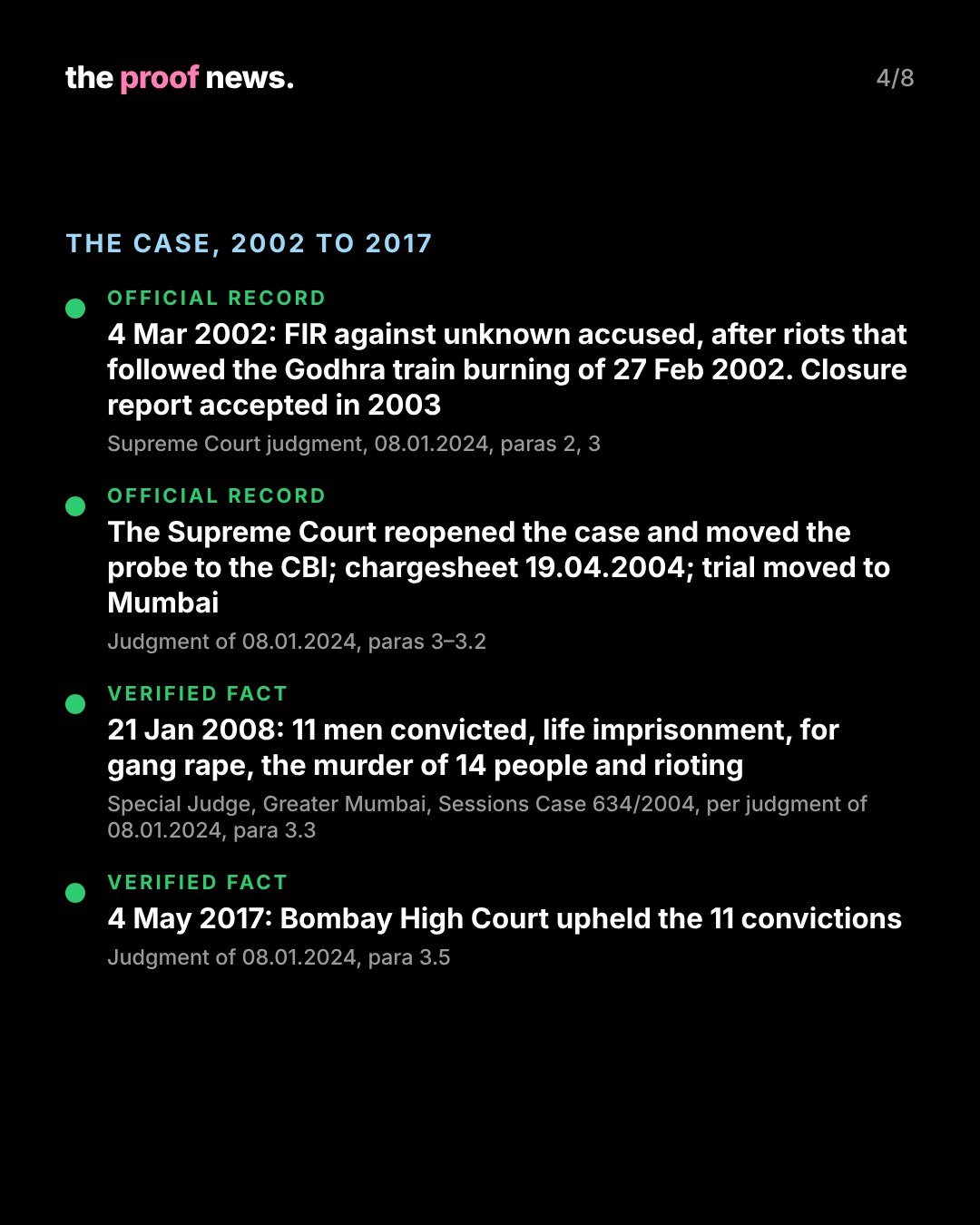
Official recordThe case, from the Supreme Court's judgment of 8 January 2024 (Bilkis Yakub Rasool v. Union of India, 2024 INSC 24): the crimes took place during the riots in Gujarat that followed the burning of a train at Godhra on 27 February 2002 (para 2). An FIR against unknown accused was registered on 4 March 2002; a closure report was accepted in March 2003; the Supreme Court ordered the case reopened and the investigation moved to the CBI, which filed a chargesheet on 19 April 2004, and the trial was moved to Mumbai (paras 3–3.2). On 21 January 2008 the Special Judge, Greater Mumbai, convicted 11 men and sentenced them to life imprisonment; they were convicted for the murder of fourteen people, for gang rape of the petitioner, and for gang rape of other women (para 3.3). The Bombay High Court upheld the convictions on 4 May 2017 (para 3.5).
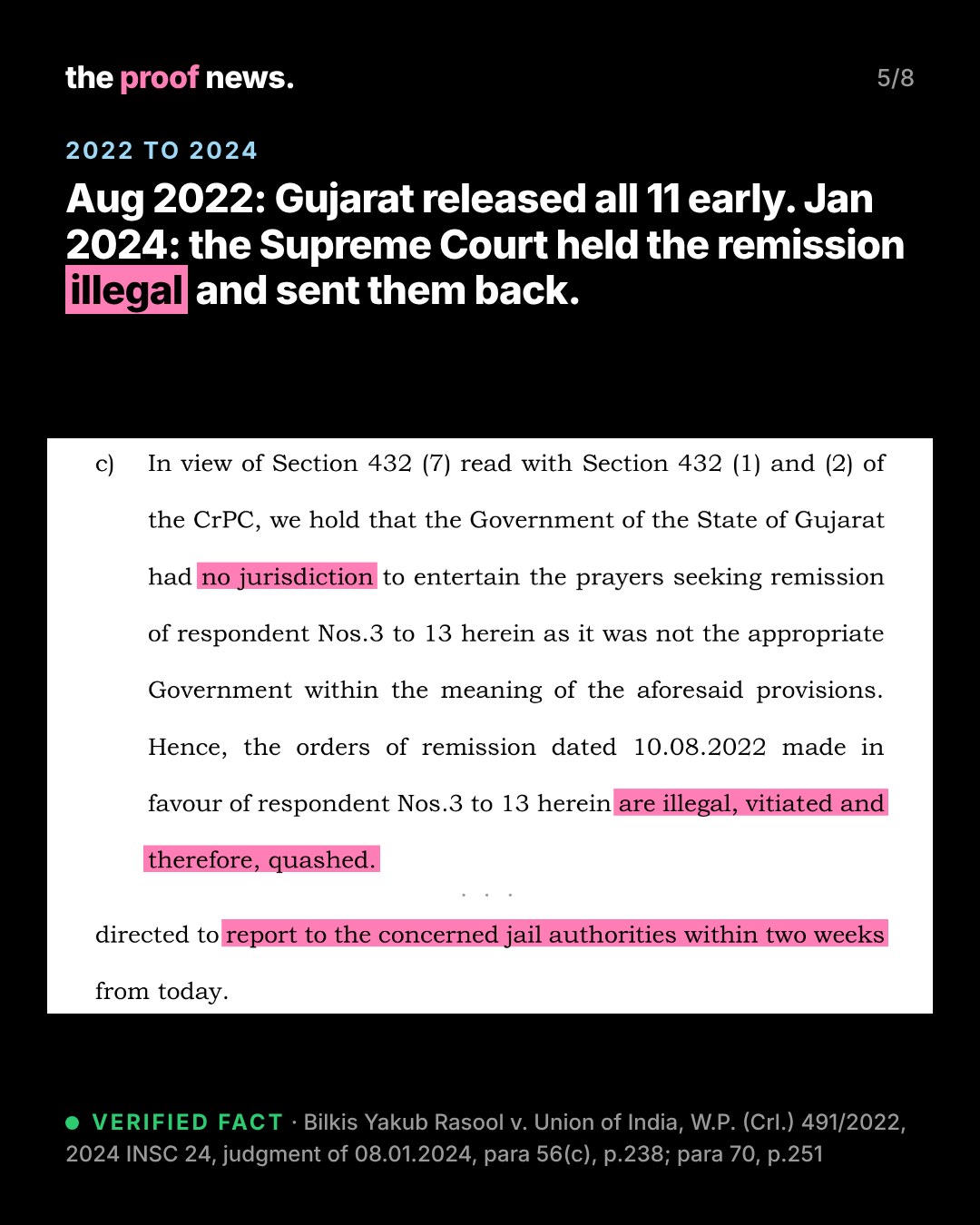
Official recordRemission: after the Union Home Ministry approved on 11 July 2022, the Gujarat government ordered the early release of all 11 on 10 August 2022 (paras 3.24–3.25). The CBI and the Special Judge in Mumbai had given negative opinions on early release (paras 3.10–3.11, 3.17). On 8 January 2024 the Supreme Court (Justices B.V. Nagarathna and Ujjal Bhuyan) held that Gujarat was not the appropriate government, quashed the remission orders as "illegal, vitiated", and directed the 11 to report to jail within two weeks (paras 56(c), 70). The judgment recorded that they had been "in prison for a little over fourteen years (with liberal paroles and furloughs granted to them from time to time)" before release (para 69).
ReportedOn 21 January 2024 all 11 surrendered at the Godhra sub-jail (as reported by ThePrint, The Wire and Free Press Journal).
Official recordNot settled by this order: the convictions stand and the appeal is yet to be heard. The 2024 judgment says "all the persons convicted" filed special leave petitions against the 2017 High Court verdict and that the court dismissed them in 2017 (para 3.6); the 2026 orders, which condoned the delay in filing this appeal "as the petitioner is in custody" (17 March 2026), do not refer to this. The order of 28 October does not say which appellant has the disability; the March order says petitioner no. 1 is physically disabled. The other nine convicts are not part of this order.
Official recordResponses: we found no public response from the survivor or her lawyers to the order by the evening of 16 November. We do not show images of the survivor.
The proof.
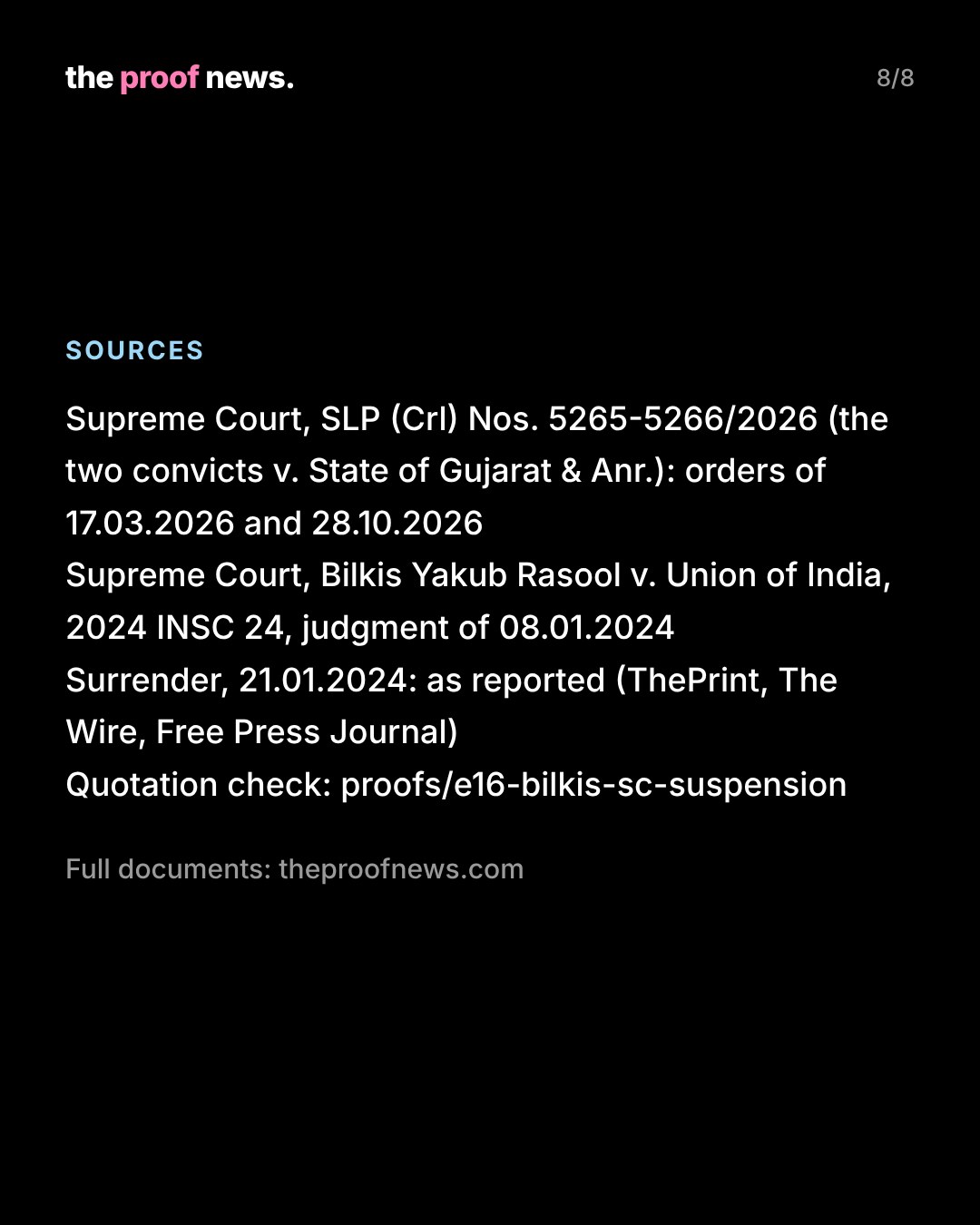
Every quotation is verbatim from the Supreme Court's orders of 17 March and 28 October 2026 and its judgment of 8 January 2024, with paragraph numbers, and is machine-checked against the text of the court PDFs; two separately hosted copies of the 28 October order are byte-identical. The highlighted page images are rendered from those PDFs.
- Supreme Court, SLP (Crl) Nos. 5265-5266/2026, record of proceedings of 28.10.2026 (PDF)
- Same order, second copy (byte-identical)
- Supreme Court, SLP (Crl) Diary No. 45823/2025, record of proceedings of 17.03.2026 (PDF)
- Supreme Court, Bilkis Yakub Rasool v. Union of India, 2024 INSC 24, judgment of 08.01.2024 (PDF)
- Surrender at Godhra sub-jail, 21.01.2024 (The Wire)
- Report of the order naming both appellants (LiveLaw, 16.11.2026)