Supreme Court: states and districts will be penalised if the Yamuna leaves their stretch dirtier
"Despite huge sums being spent on cleaning the river, pollution in the Yamuna has only increased," the court said in an order of 4 November. Basin states have two weeks to name nodal officers; treatment plants get a month to fit smart meters. The order, the deadlines, and what Delhi's own tests show.
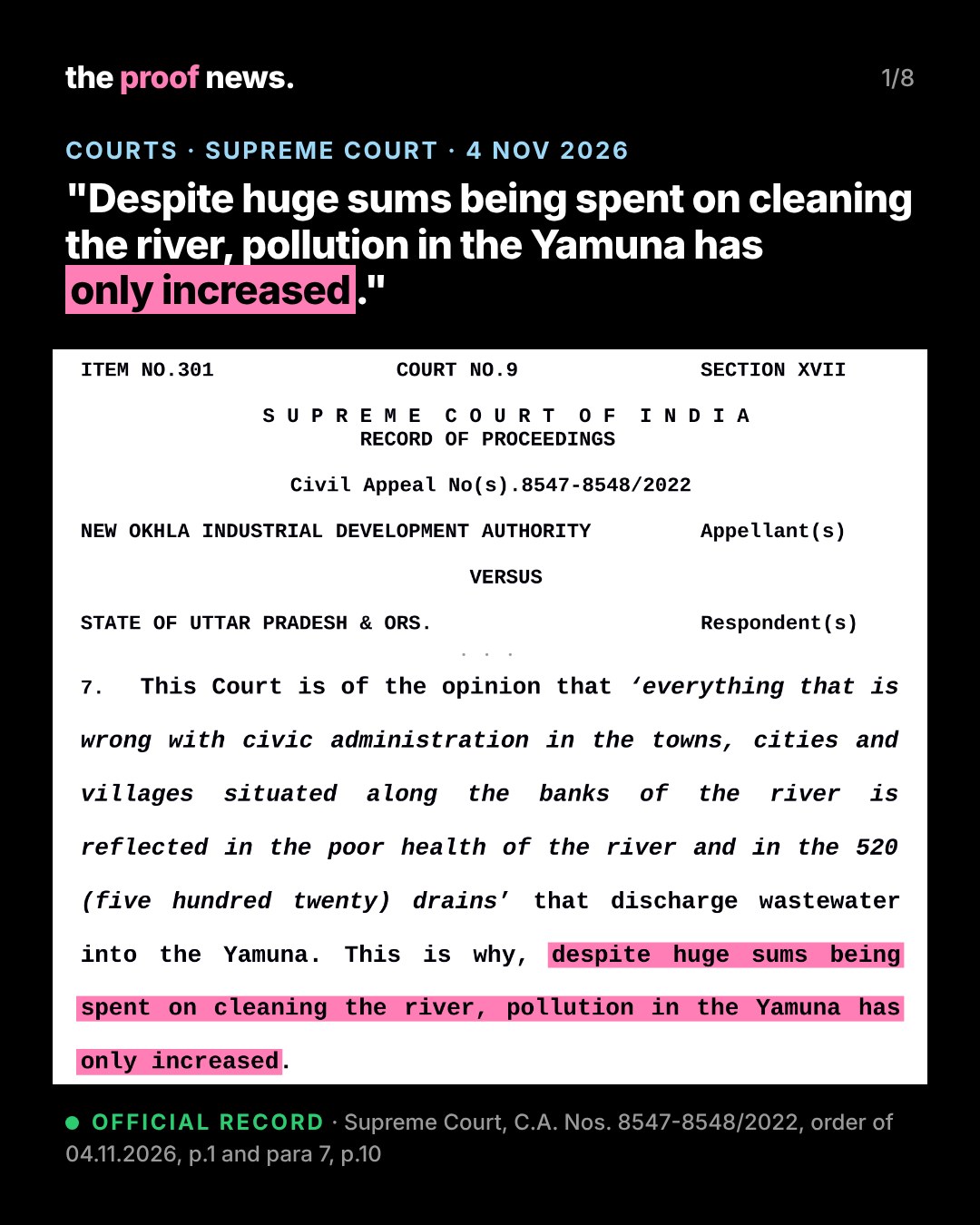
Official recordOn 4 November 2026 a Supreme Court bench of Justices Manoj Misra and Manmohan passed an order in New Okhla Industrial Development Authority v. State of Uttar Pradesh & Ors. (Civil Appeal Nos. 8547-8548/2022, with Civil Appeal Nos. 8967-8968/2022). The signed copy is dated 16 November. The court has been hearing the pollution of the Yamuna in these appeals since at least May 2026: its order of 21 May, reproduced in the new order, set up a committee under the Union Home Secretary, with the chief secretaries of the states and Union Territories through which the river flows, to prepare a Yamuna Action Plan (paras 1–2).
Official recordThe court's finding: "everything that is wrong with civic administration in the towns, cities and villages situated along the banks of the river is reflected in the poor health of the river and in the 520 (five hundred twenty) drains" that discharge wastewater into it. "This is why, despite huge sums being spent on cleaning the river, pollution in the Yamuna has only increased" (para 7, p.10). The order does not cite a data series or a spending figure for this.
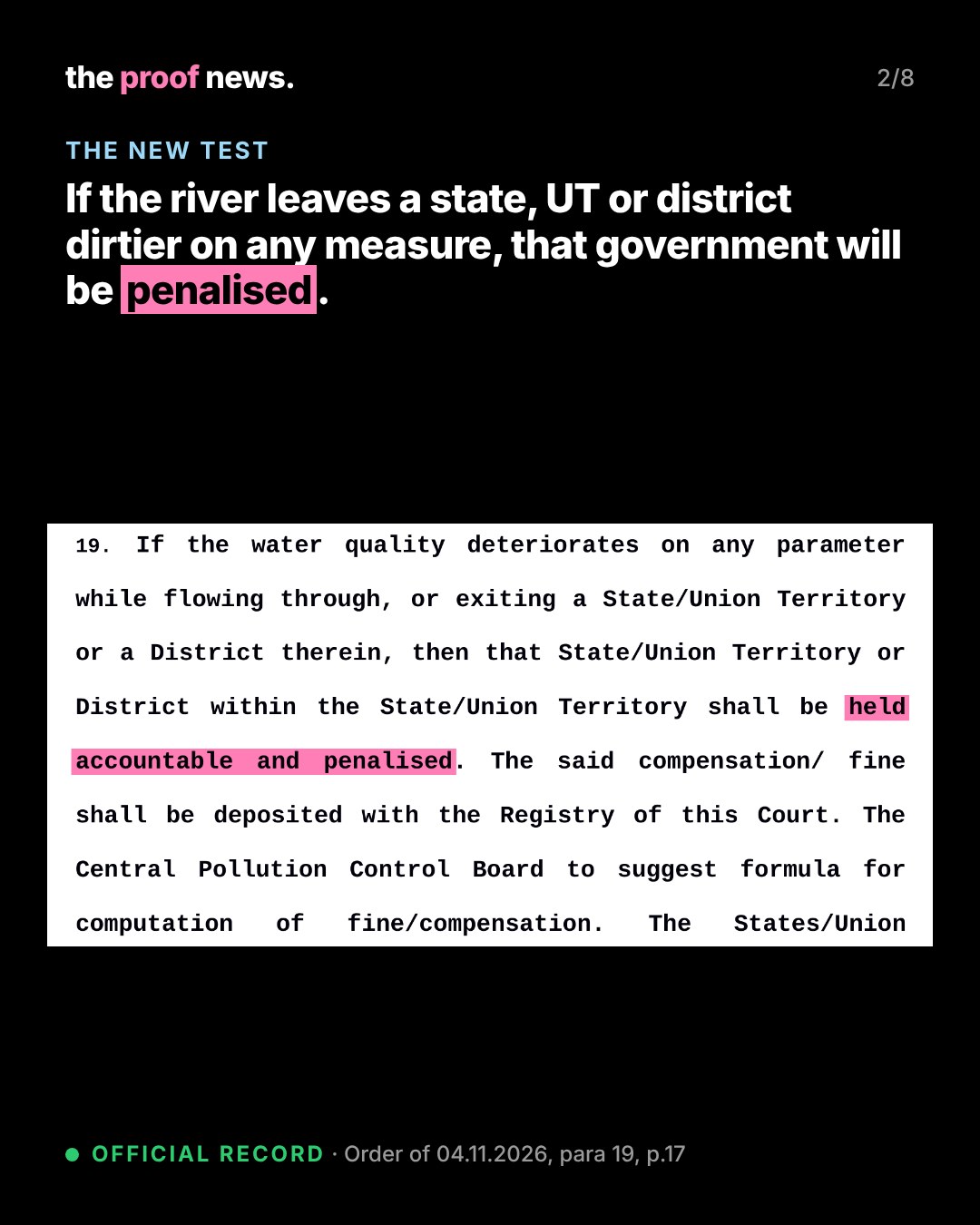
Official recordThe test: "If the water quality deteriorates on any parameter while flowing through, or exiting a State/Union Territory or a District therein, then that State/Union Territory or District within the State/Union Territory shall be held accountable and penalised." The fine is to be deposited with the court's registry; the Central Pollution Control Board (CPCB) is to suggest how to compute it; and states and UTs may recover it, after an inquiry, "from the polluter as well as officials who were remiss in performing their duties" (para 19). The court said it would levy fines on states and UTs that fail "whether through inefficiency or for lack of the political will to take hard decisions" (para 16).
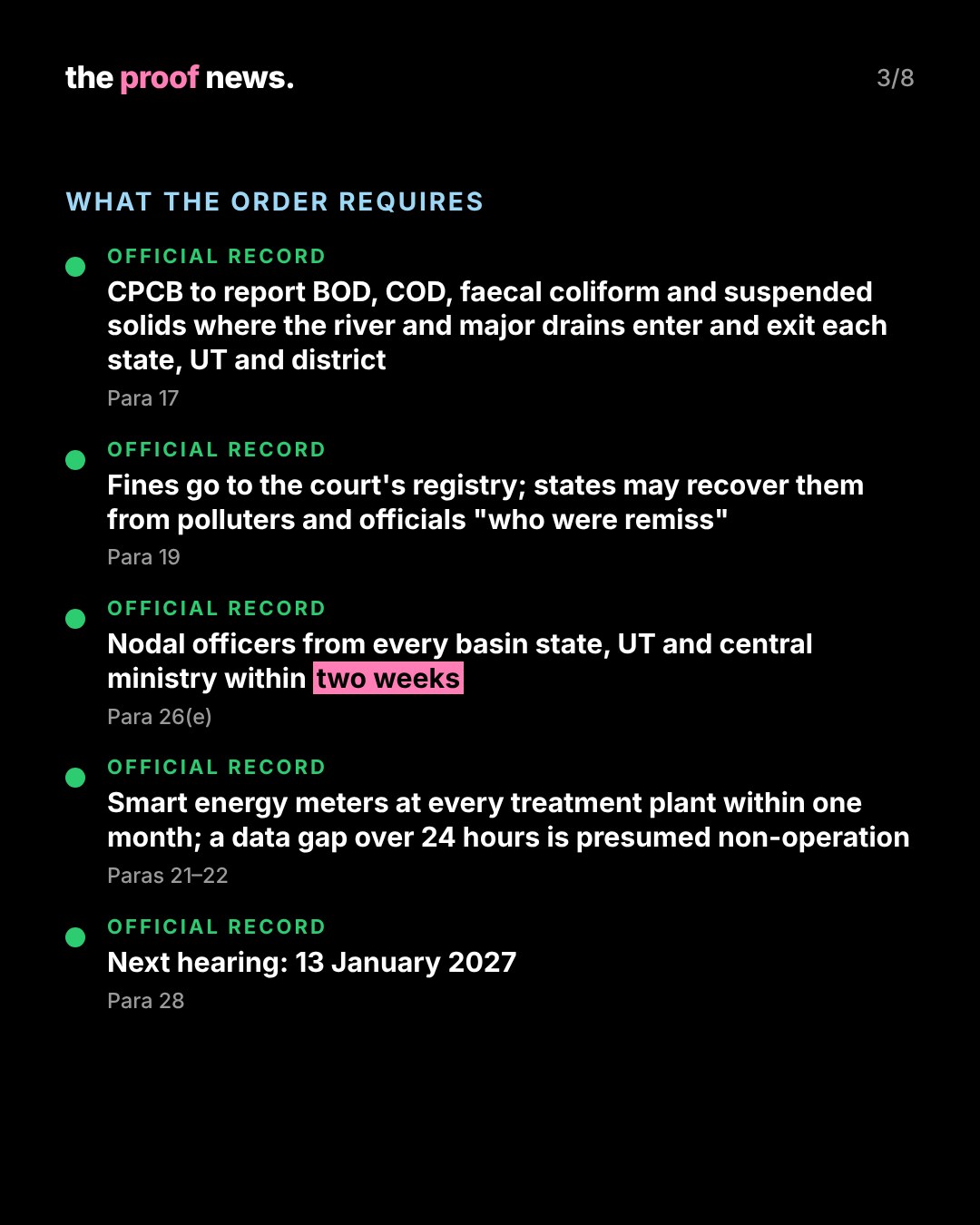
Official recordHow it will be measured: the CPCB is to place before the court the BOD, COD, faecal coliform and total suspended solids where the river and major drains enter and exit each state, UT and district (para 17). It already monitors entry and exit points quarterly, the court was told (para 18). It must also arrange unannounced sampling of every sewage treatment plant of 5 MLD or more and every common effluent treatment plant at least once a quarter, and recover compensation from operators for each day of non-compliance (para 24).
Official recordDeadlines: the chief secretaries of the Yamuna basin states and UTs, and the secretaries of the central ministries concerned, must each nominate a nodal officer not below Special Secretary "within two (02) weeks" of 4 November (para 26(e)). Every STP, CETP and government biogas plant must install tamper-proof smart energy meters within one month, with live plant-wise readings online; a gap in the data feed of more than 24 hours is presumed to mean the plant was not operating (paras 21–22). The officer in charge of each plant and major drain must file a monthly compliance affidavit (para 27). The matter returns on 13 January 2027 (para 28).
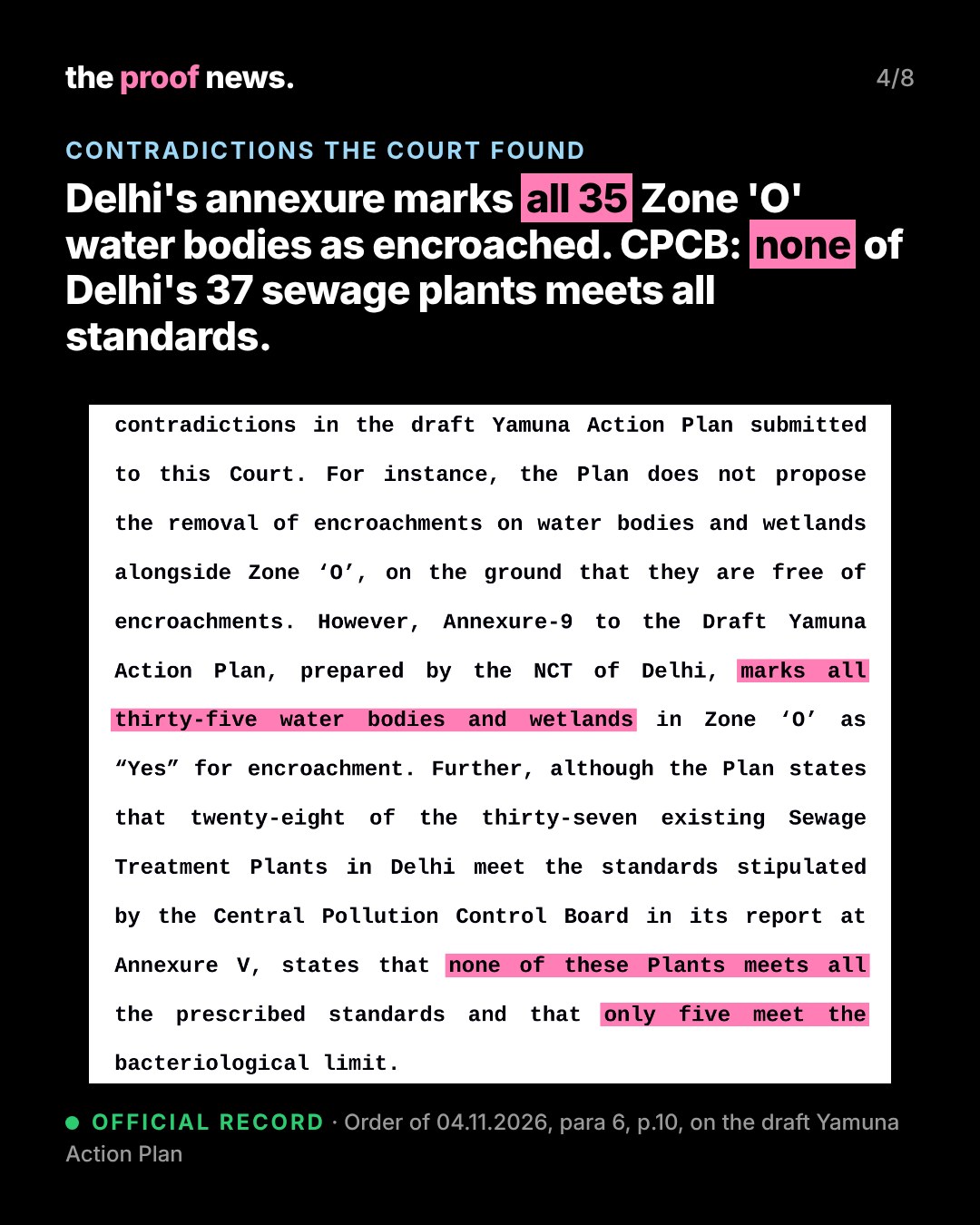
Official recordContradictions the court found in the draft Yamuna Action Plan: the plan proposes no removal of encroachments on water bodies and wetlands alongside Zone 'O' on the ground that they are free of encroachment, but Annexure-9, prepared by the Delhi government, "marks all thirty-five water bodies and wetlands in Zone ‘O’ as “Yes” for encroachment". The plan says 28 of Delhi's 37 sewage treatment plants meet CPCB standards, while CPCB's report at Annexure V "states that none of these Plants meets all the prescribed standards and that only five meet the bacteriological limit" (para 6).
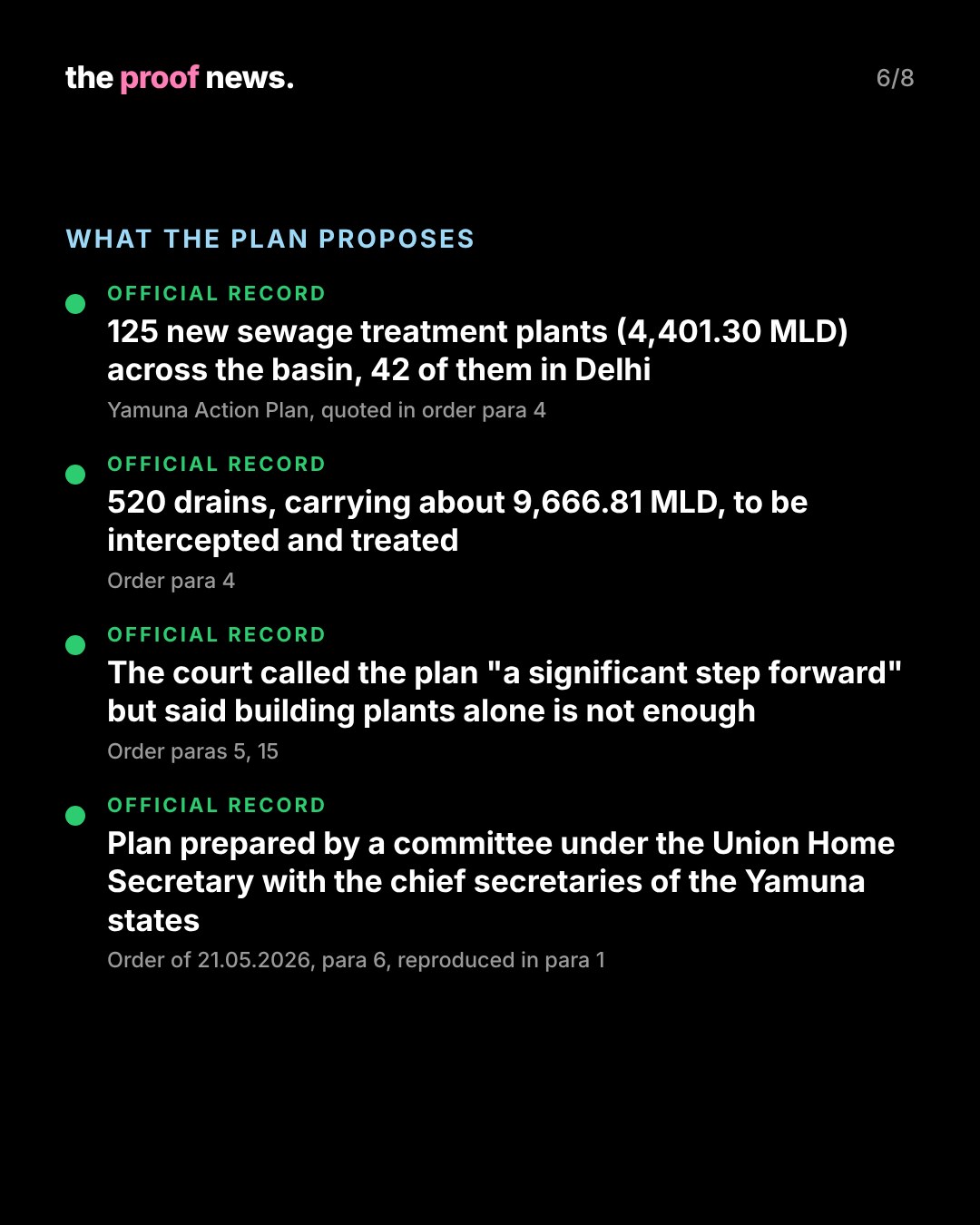
Official recordWhat the plan proposes, as quoted in the order: 125 new STPs with 4,401.30 MLD of capacity across the basin (42 in Delhi, 47 in Uttar Pradesh, 18 in Haryana, 18 in Uttarakhand), upgrades of 20 existing plants, and interception of 520 drains carrying about 9,666.81 MLD (para 4). The court called it "a significant step forward" (para 5) but said an approach limited to building plants would not be enough; it called for Zone 'O' to be kept green, and for structures there to be removed under the law after accommodating occupants who are entitled (paras 9, 11, 15).
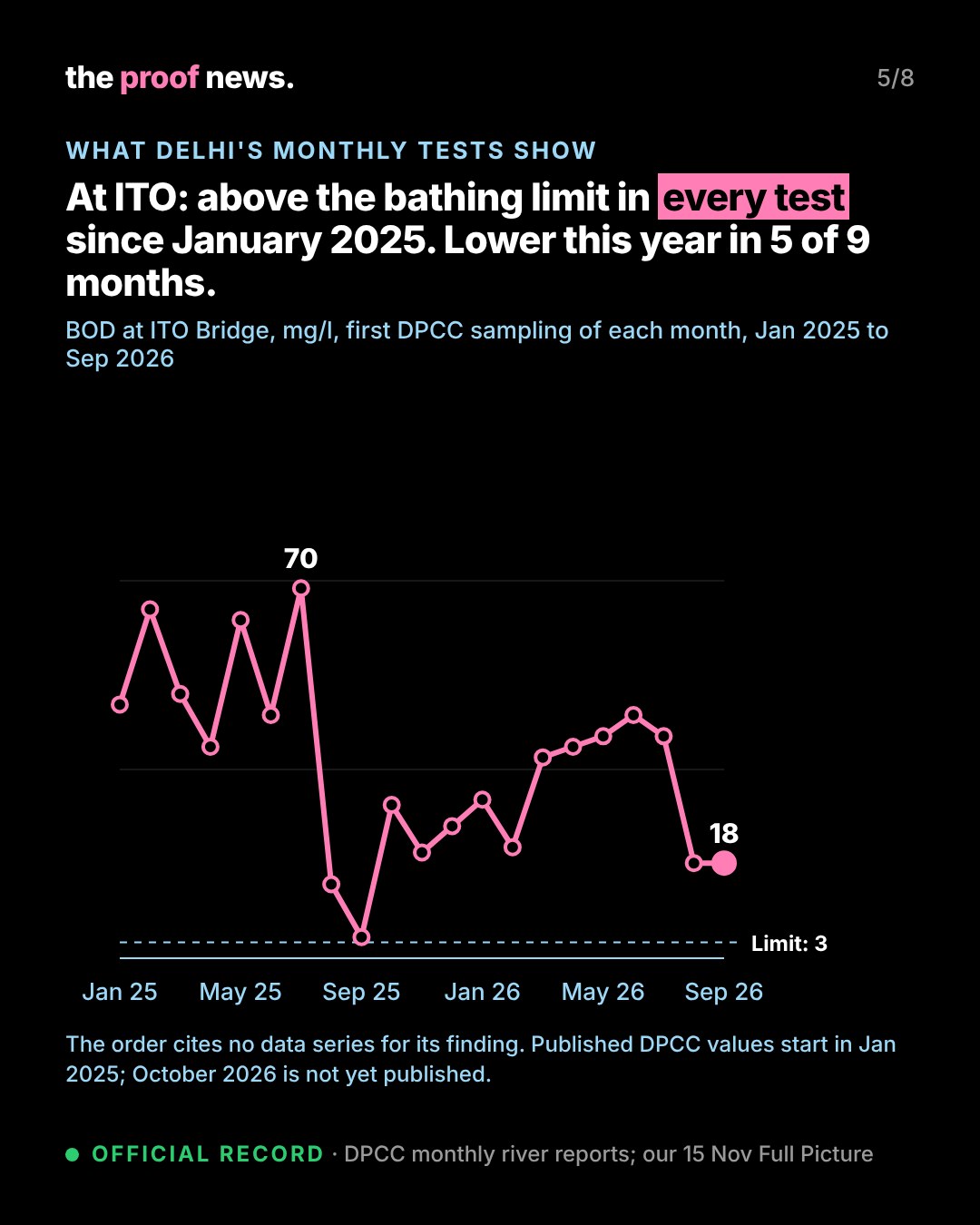
Official recordWhat Delhi's monthly tests show (our 15 November Full Picture, from DPCC's reports): at ITO Bridge, BOD was above the bathing limit of 3 mg/l in every monthly test from January 2025 to September 2026. In 2026 it was lower than in the same month of 2025 in five of nine months, equal in two and higher in two. The last published test (7 September 2026) found 18 mg/l. DPCC's published values begin in January 2025, so they cannot test a longer-term claim either way.
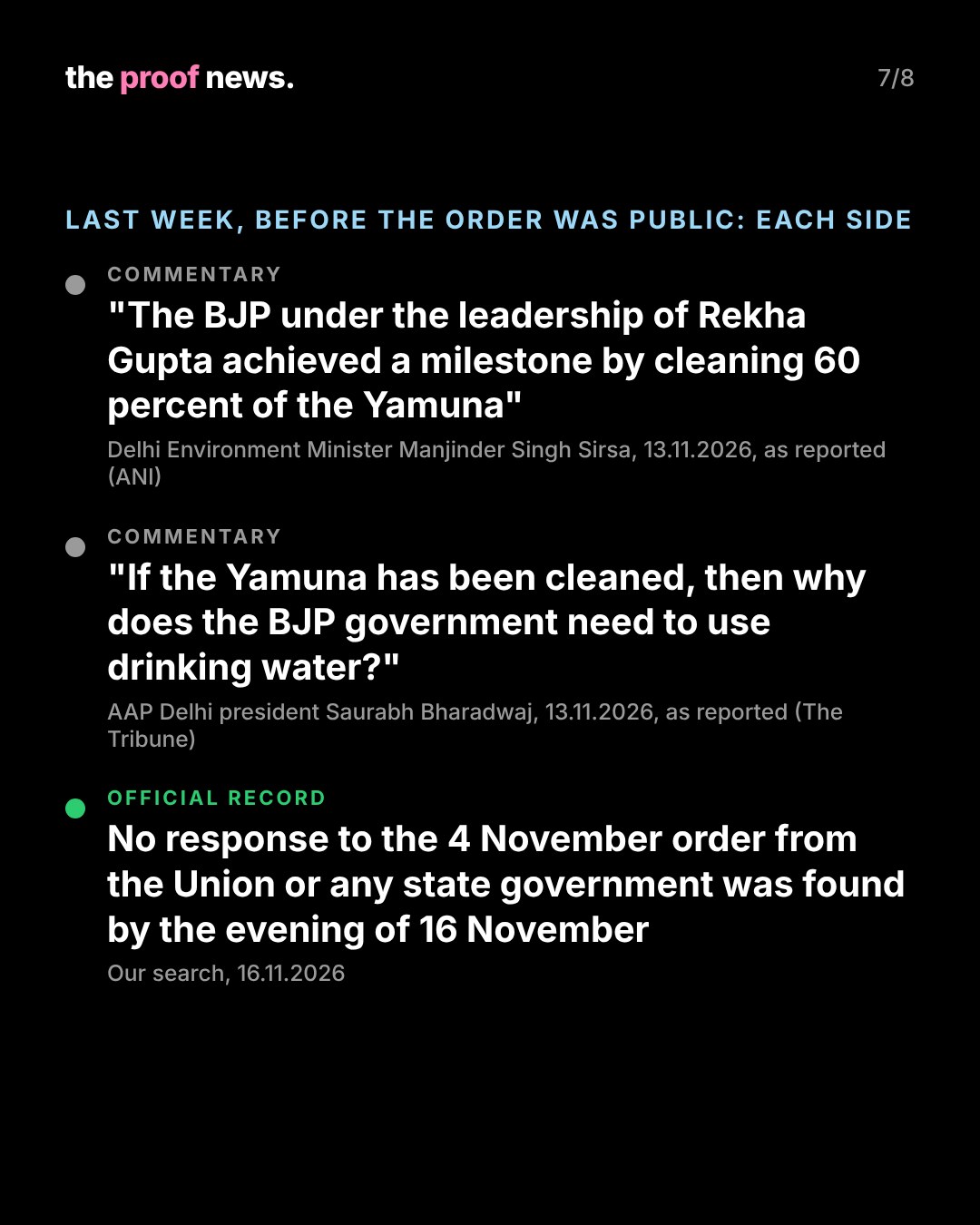
CommentaryEach side, before the order was public: on 13 November, Delhi Environment Minister Manjinder Singh Sirsa (BJP) said the government had cleaned "60 percent of the Yamuna"; AAP's Delhi president Saurabh Bharadwaj asked why, if so, a ghat was being filled with drinking water (both as reported). DPCC's data has no "percent cleaned" measure.
Official recordResponses: we found no response to the 4 November order from the Union government or any state or UT government by the evening of 16 November. We will add any response.
The proof.
Every quotation is verbatim from the Supreme Court's order of 4 November 2026, with paragraph and page, and is machine-checked against the order text; the copies on sci.gov.in and LiveLaw are byte-identical. The ITO chart is the DPCC series from our 15 November Full Picture, re-checked (proofs/e16-yamuna-sc-penalties/check.py).
- Supreme Court of India, C.A. Nos. 8547-8548/2022, order of 04.11.2026 (PDF, sci.gov.in)
- Same order, second copy (byte-identical)
- The Full Picture: Chhath in the Yamuna (15.11.2026), with DPCC data
- DPCC, analysis reports (monthly river reports)
- Sirsa statement, as reported (ANI via MENAFN, 13.11.2026)
- Bharadwaj statement, The Tribune, 14.11.2026