Government health spending per person, 2023-24: Bihar lowest at ₹1,126; India ₹2,959
The National Health Accounts for 2023-24 put government health spending at ₹1,126 per person in Bihar, the lowest of any state, against ₹2,959 for India. As a share of its economy, Bihar's spending (1.6% of GSDP) is higher than that of several larger states. All-India government health spending was ₹4,14,196 crore, 1.43% of GDP.
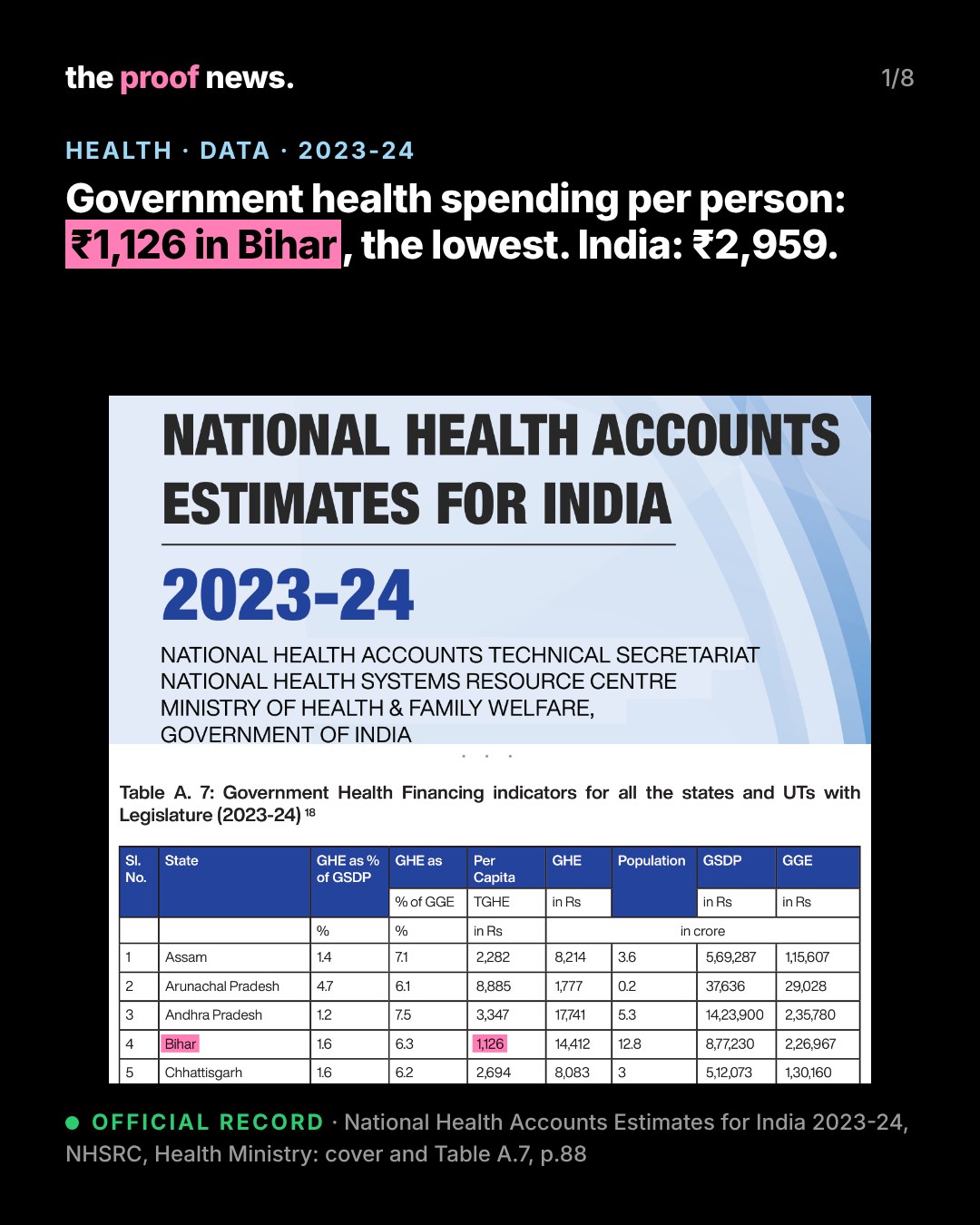
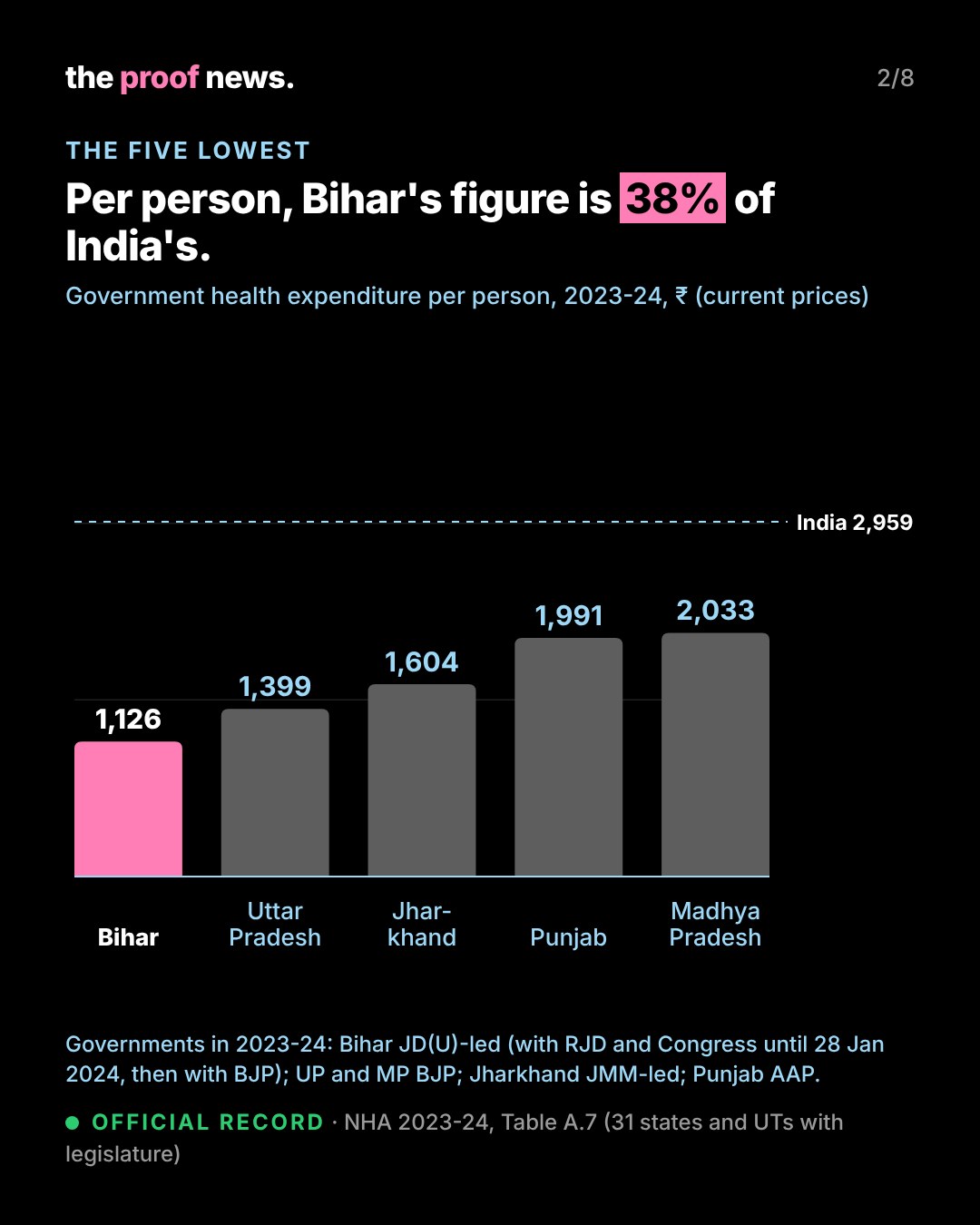
Official recordThe National Health Accounts (NHA) Estimates for India 2023-24, prepared by the National Health Accounts Technical Secretariat at the Health Ministry's National Health Systems Resource Centre (NHSRC) and posted on its website this month, give government health expenditure (GHE) for every state and Union Territory with a legislature (Table A.7). Per person, Bihar's figure is ₹1,126, the lowest of the 31: ₹14,412 crore for a population of 12.8 crore. The next lowest are Uttar Pradesh (₹1,399), Jharkhand (₹1,604), Punjab (₹1,991) and Madhya Pradesh (₹2,033). The all-India figure is ₹2,959.
Verified factGovernments in 2023-24 (April 2023 to March 2024): in Bihar, Chief Minister Nitish Kumar's JD(U) led the government throughout, in alliance with the RJD and Congress until 28 January 2024 and with the BJP after that. Uttar Pradesh and Madhya Pradesh were BJP-run, Jharkhand had a JMM-led government and Punjab an AAP government. Health is a State subject under the Constitution.
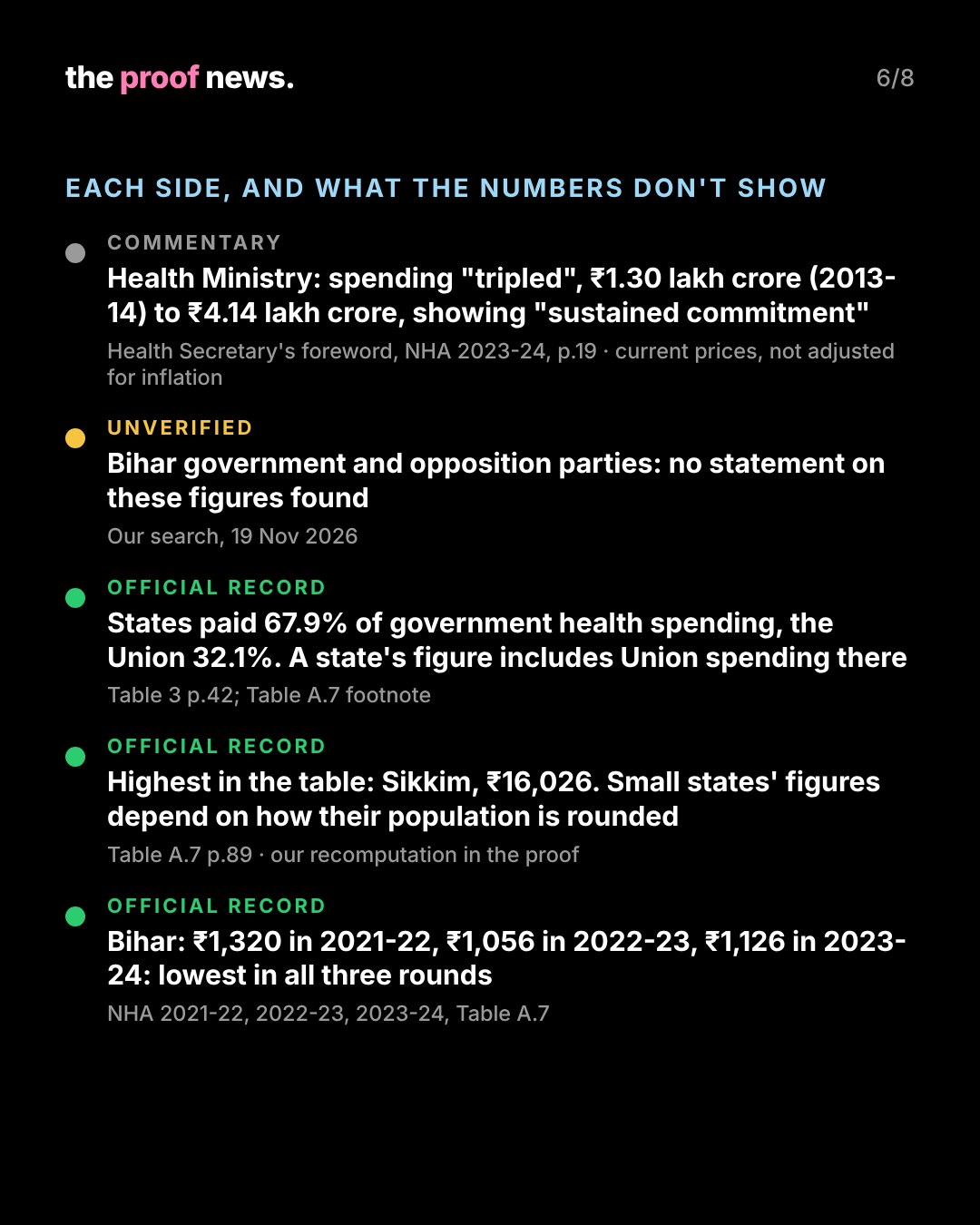
Official recordAt the other end, the highest figure in the table is Sikkim's, ₹16,026, followed by Puducherry (₹11,165), Mizoram (₹9,320), Goa (₹9,120) and Arunachal Pradesh (₹8,885). Among Union Territories without a legislature (Table A.8), Chandigarh's figure is ₹24,187.
Verified factA caveat on small states, from our recomputation of the table: dividing each state's GHE by its per-person figure gives the population used. For Sikkim this is about 6.9 lakh; for Mizoram it is exactly 10 lakh and for Goa, Arunachal Pradesh, Puducherry and Nagaland exactly 20 lakh, which suggests those populations were rounded to 0.1 crore. Divided by 10 lakh, Sikkim's figure would be ₹11,090. The order at the top of the table therefore depends on the population used, and Sikkim's earlier figures (₹7,800 in 2021-22, ₹7,400 in 2022-23, both computed on 0.1 crore) cannot be compared with this year's. Bihar's figure is not affected by this: 14,412 ÷ 12.8 = 1,126.
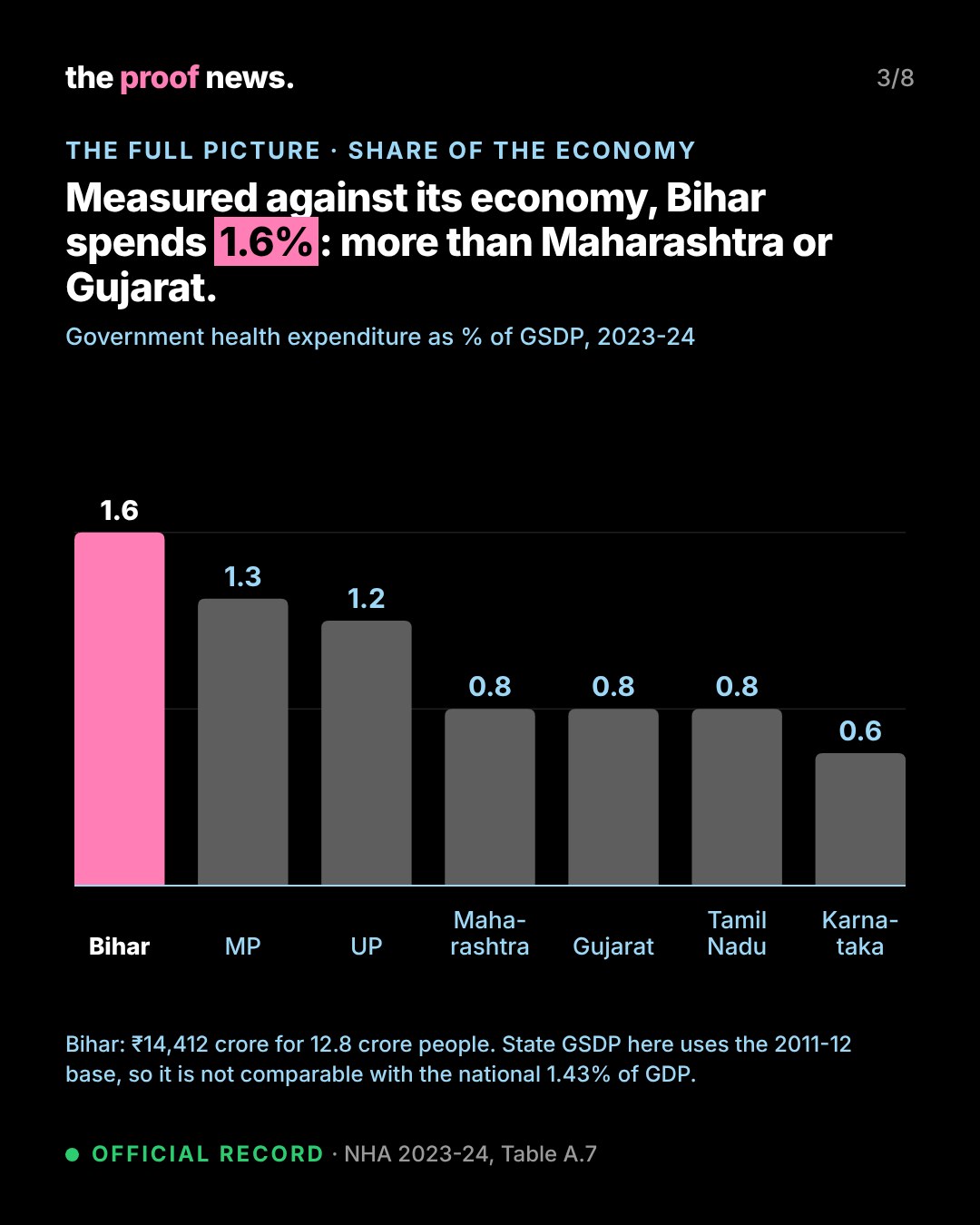
Official recordThe full picture: measured against the size of its economy, Bihar's government health spending is 1.6% of GSDP. That is higher than Maharashtra, Gujarat and Tamil Nadu (0.8% each) and Karnataka (0.6%), and above Uttar Pradesh (1.2%) and Madhya Pradesh (1.3%). These state ratios use GSDP on the 2011-12 base, so they cannot be compared with the national ratio, which uses the new 2022-23 GDP series. A state's GHE also includes spending by the Union government in that state, not only the state's own budget.
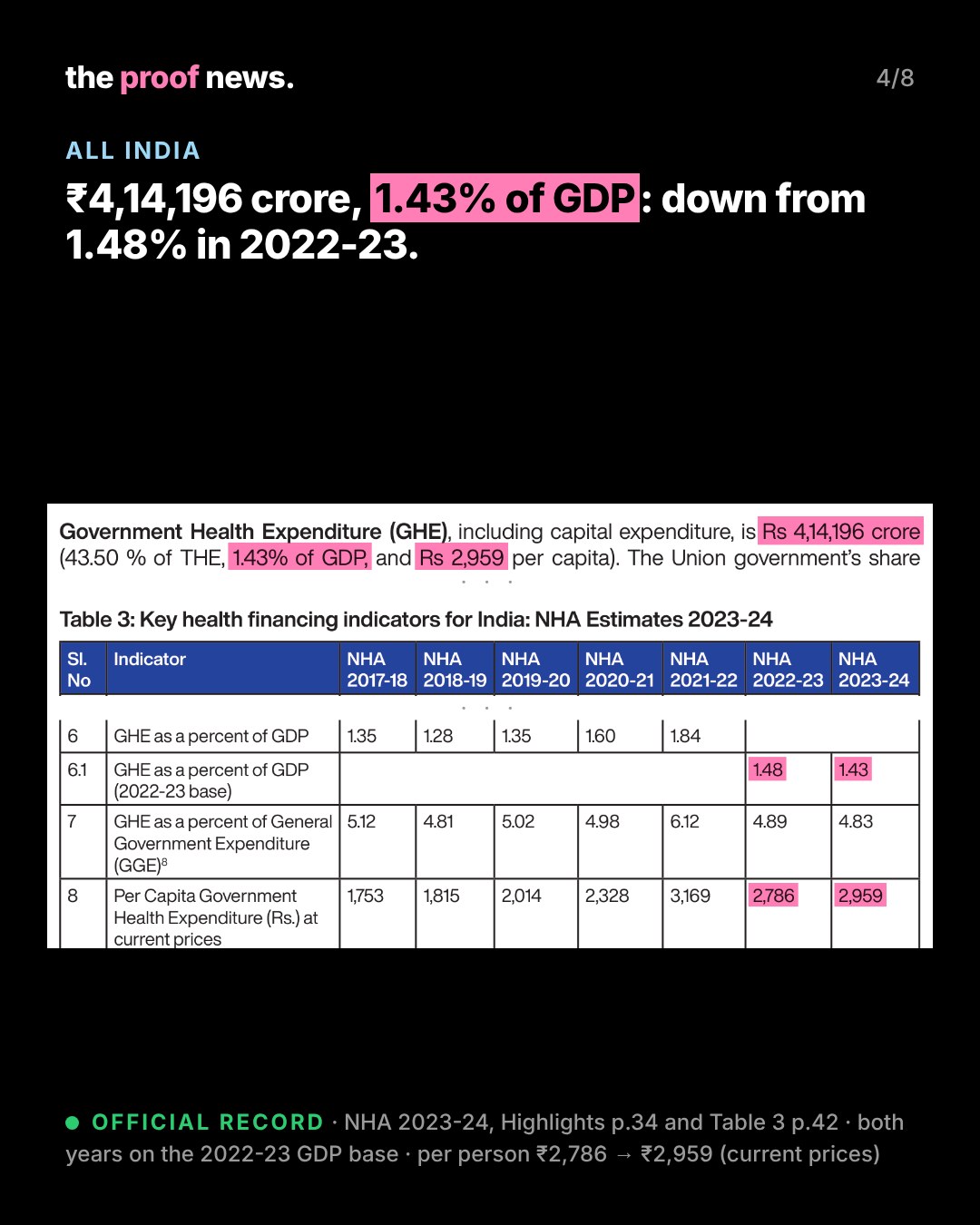
Official recordAll India: government health expenditure in 2023-24 was ₹4,14,196 crore, 43.50% of total health expenditure, 1.43% of GDP and ₹2,959 per person (p.34). On the same GDP base, the share was 1.48% in 2022-23 (Table 3). Per person, it rose from ₹2,786 to ₹2,959 in current prices. State governments accounted for 67.9% of GHE and the Union government for 32.1%.
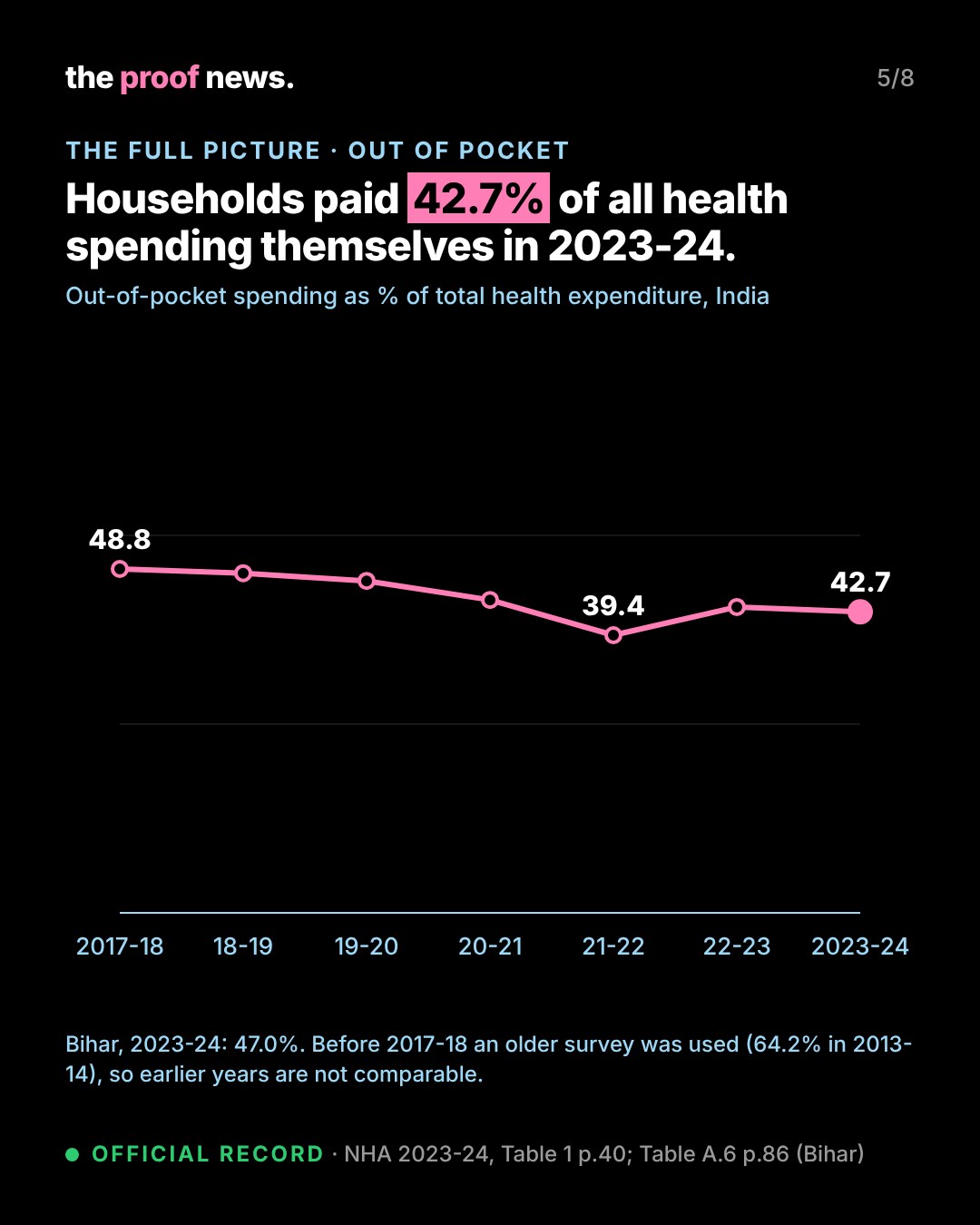
Official recordOut-of-pocket spending, money households pay at the point of care, was 42.7% of total health expenditure in 2023-24, down from 48.8% in 2017-18; it was lowest, 39.4%, in 2021-22 (Table 1). The report notes that estimates before 2017-18 used an older survey (NSS 71st round, 2014) and later ones the NSS 75th round (2017-18), so the earlier and higher figures, such as 64.2% in 2013-14, are not directly comparable. In Bihar, out-of-pocket spending was 47.0% of total health expenditure, above the national share; several states were higher, including Uttar Pradesh (67.1%), Kerala (65.2%) and West Bengal (63.0%) (Table A.6). Bihar's out-of-pocket spending per person, ₹1,099, and its total health spending per person, ₹2,338, were the lowest of the 21 states in that table.
Official recordBihar's per-person figure over the last three rounds: ₹1,320 in 2021-22, ₹1,056 in 2022-23 and ₹1,126 in 2023-24. It was the lowest in each round.
CommentaryThe Union Health Secretary's foreword to the report says government health expenditure "has tripled from Rs 1.30 lakh crore in 2013-14 to Rs 4.14 lakh crore in 2023-24" and per person rose "from Rs 1,042 to Rs 2,959", "reflecting the Government's sustained commitment to strengthening the healthcare sector" (p.19). These are current prices, not adjusted for inflation or population growth in the total. We found no statement from the Bihar government or from opposition parties on the 2023-24 state figures.
Official recordWhat the figures do not show: they are for 2023-24, not today; they are in current prices with no adjustment for prices or costs between states; out-of-pocket estimates rest on a 2017-18 household survey projected forward, and the report says state-level survey components are not significant for small and North-Eastern states. The NHA measures money spent, not the quality or outcomes of care. What to watch: the NHA 2024-25 round, and new population figures, which would change every per-person number.
The proof.
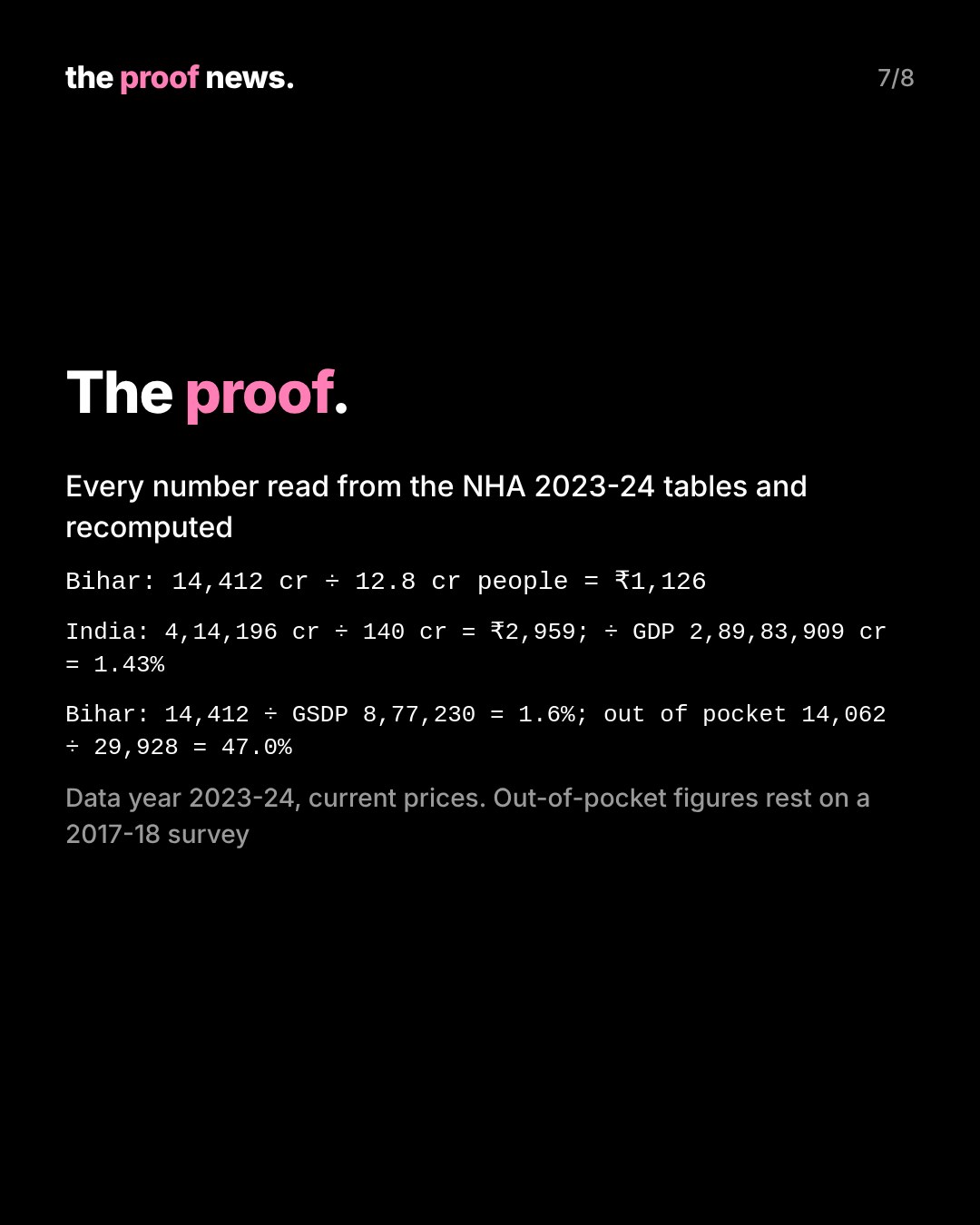
Every figure is read from the NHA 2023-24 tables (Highlights p.34; Tables 1, 3, A.6, A.7, A.8) and recomputed in check.py (all pass): Bihar 14,412 crore ÷ 12.8 crore = ₹1,126; India 4,14,196 crore ÷ 140 crore = ₹2,959 and ÷ GDP ₹2,89,83,909 crore = 1.43%; Bihar 14,412 ÷ GSDP 8,77,230 = 1.6%; Bihar out-of-pocket 14,062 ÷ 29,928 = 47.0%. We chart national out-of-pocket shares only from 2017-18, when the survey base changed, and never chart GHE as a share of GDP across the GDP base change. The small-state population rounding is our own finding from the table and is flagged, not corrected.