High Court stays Punjab civil services recruitment after candidates allege irregularities
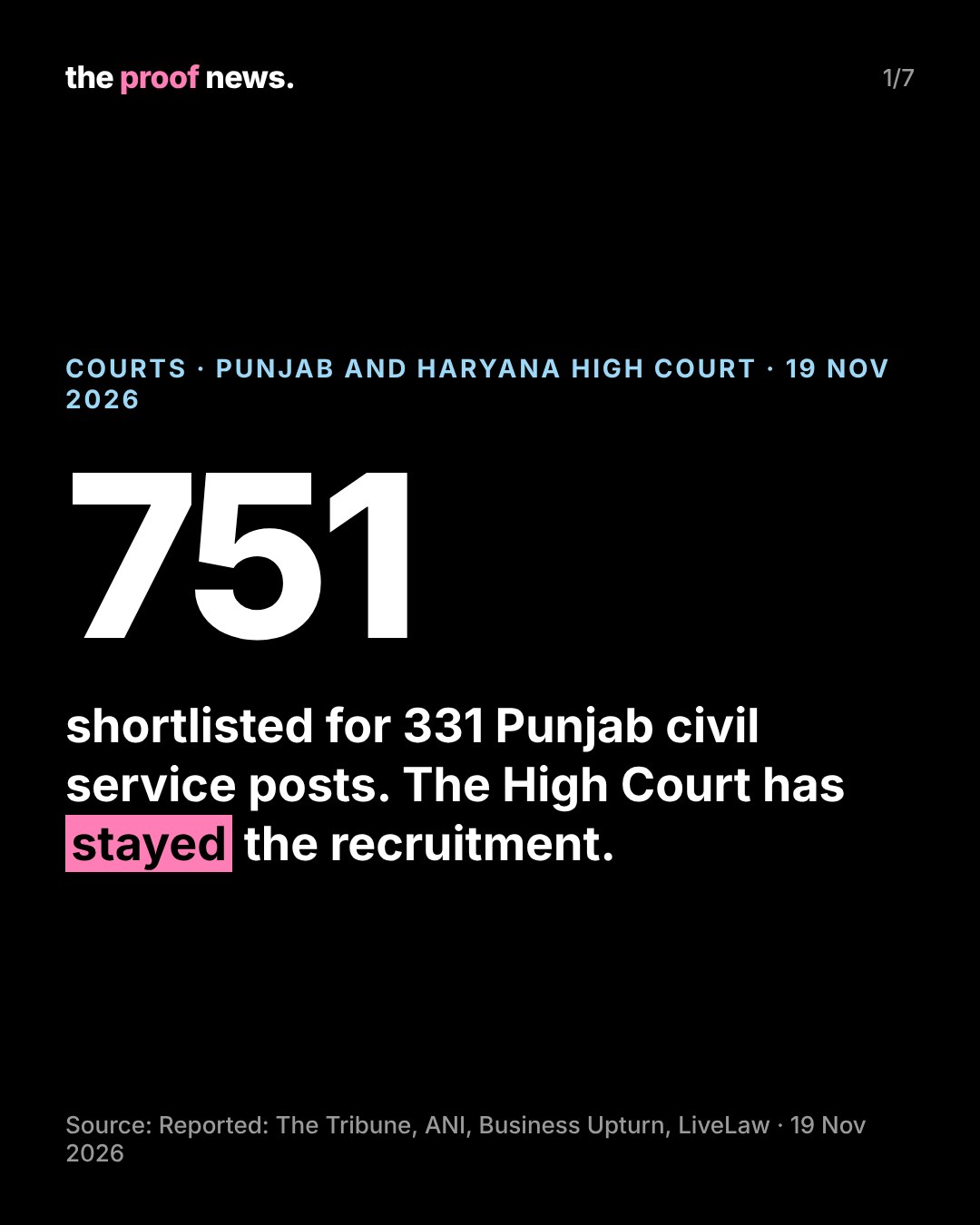
The Punjab and Haryana High Court on 19 November stayed the Punjab Public Service Commission's recruitment for the Punjab Civil Services (Executive Branch) and allied services, as reported, on petitions alleging mid-way changes to eligibility rules, multiple roll numbers and clusters of consecutive roll numbers among the 751 shortlisted for 331 posts. The commission has said the exam was fair. The next hearing is on 16 December; the written order is not yet public.
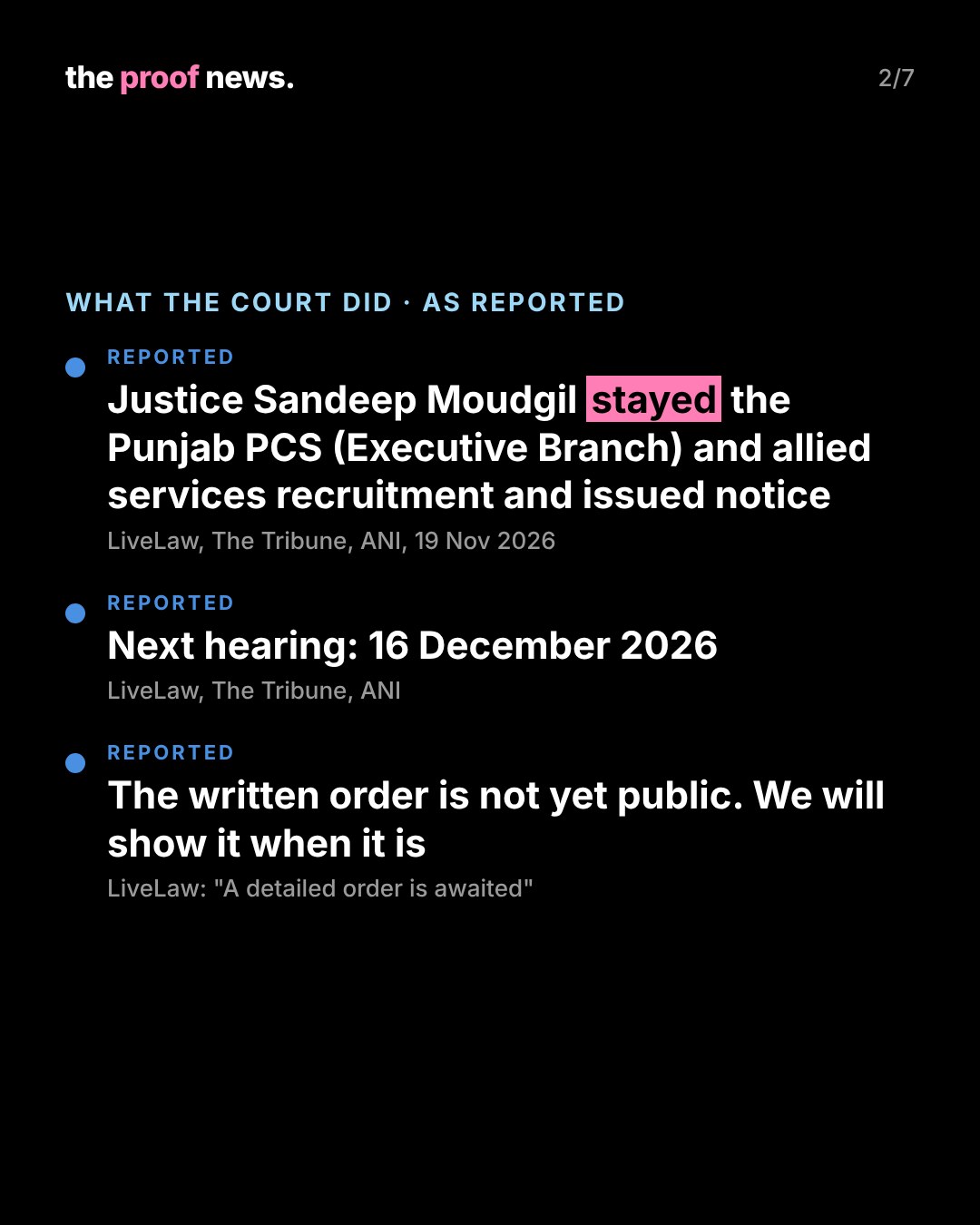
ReportedOn Thursday 19 November 2026 Justice Sandeep Moudgil of the Punjab and Haryana High Court stayed the recruitment process for the Punjab Civil Services (Executive Branch) and allied services, conducted by the Punjab Public Service Commission (PPSC), and issued notice on a batch of petitions by candidates, according to reports by LiveLaw, The Tribune, ANI, Business Upturn and KollegeApply. LiveLaw reports that the court "stayed the further recruitment proceeding"; other reports say the selection process or the result was stayed and interviews halted. The next hearing is on 16 December 2026. LiveLaw reports that "a detailed order is awaited"; we could not open the High Court's website, so we have not seen the order and label the stay as reported. LiveLaw lists the petitions as CWP-37954-2026, CWP-37966-2026 and CWP-37357-2026, with Additional Advocate General TPS Walia appearing for Punjab.
ReportedThe recruitment was advertised on 3 January 2025. The Main examination result of 4 November 2026 shortlisted 751 candidates for interview against 331 posts, according to several reports and the PPSC's own figures as reported. According to Business Upturn, the preliminary exam was held in December 2025 and the Main exam from 1 to 10 April 2026.
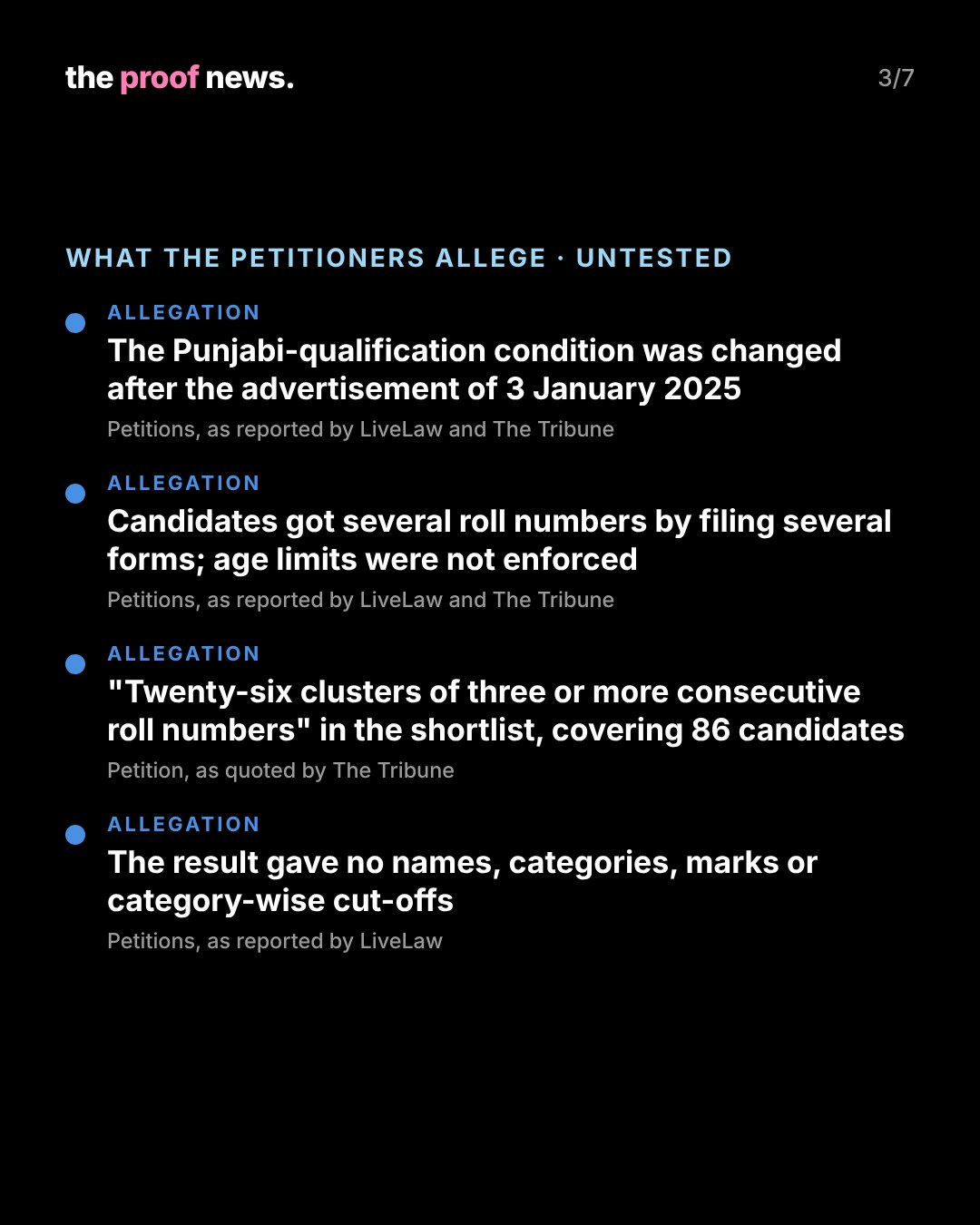
AllegationWhat the petitioners allege, as reported (untested in court): that the condition requiring Matriculation with Punjabi was changed after the advertisement (LiveLaw reports it was relaxed so that candidates could obtain the qualification before the preliminary exam; The Tribune reports a later public notice allowing Punjabi studied at graduation level as an equivalent, which the petitioners say only the government could specify); that candidates were allowed to file several forms and obtain several roll numbers, in breach of a one-category clause (The Tribune quotes the amended condition: "However, in case a candidate fills multiple forms, he/she shall be issued multiple roll nos."); that candidates below the minimum and above the maximum age took part without any order relaxing the limit; that "Twenty-six clusters of three or more consecutive roll numbers appear in the selection list, accounting for 86 shortlisted candidates"; that question-paper packets reached some rooms "in an unsealed or broken condition"; and that the 4 November result does not disclose the names, categories or marks of those shortlisted, or category-wise cut-offs. They seek the quashing of the whole selection process and an investigation by the CBI, a special investigation team or another independent agency, and say the process violates Articles 14 and 16 of the Constitution.
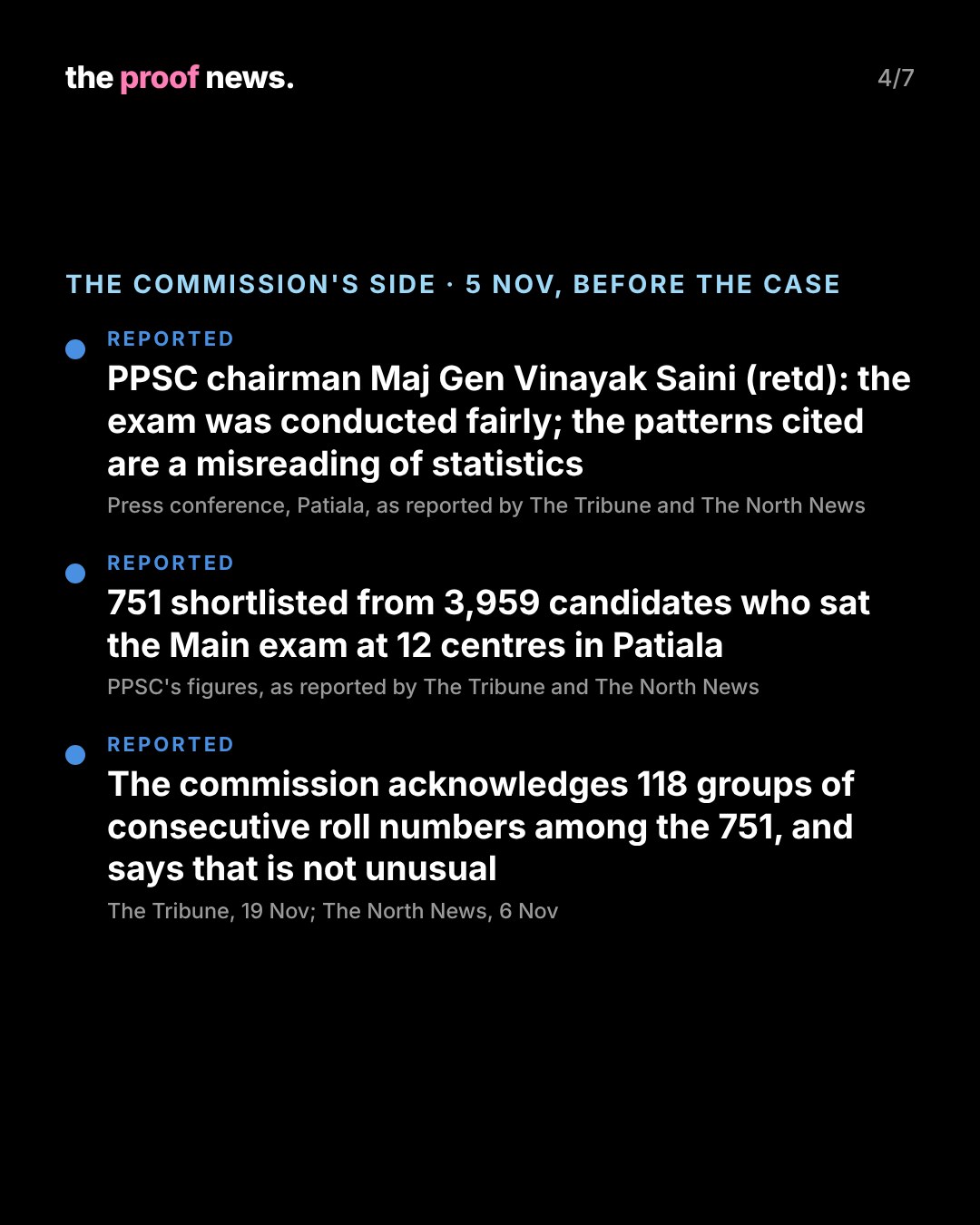
ReportedThe commission's side, given before the case was heard: at a press conference in Patiala on 5 November, PPSC chairman Maj Gen Vinayak Saini (retd) said the examination was conducted fairly and transparently, as reported by The Tribune and The North News. He said 751 candidates were shortlisted from 3,959 who sat the Main exam at 12 centres in Patiala. According to The North News, he said the claims came from "an incorrect interpretation of statistics"; that the most from any one centre was 106, or 14.1% of the 751; that there were 118 groups of consecutive roll numbers among the 751, against 26 among 153 shortlisted in 2018 and 28 among 177 in 2020, which he called not unusual; that no absent candidate was shortlisted; and that CCTV, biometric attendance and jammers were used. The Tribune reports that the petitioners' note also counts 118 clusters, which the commission has acknowledged.
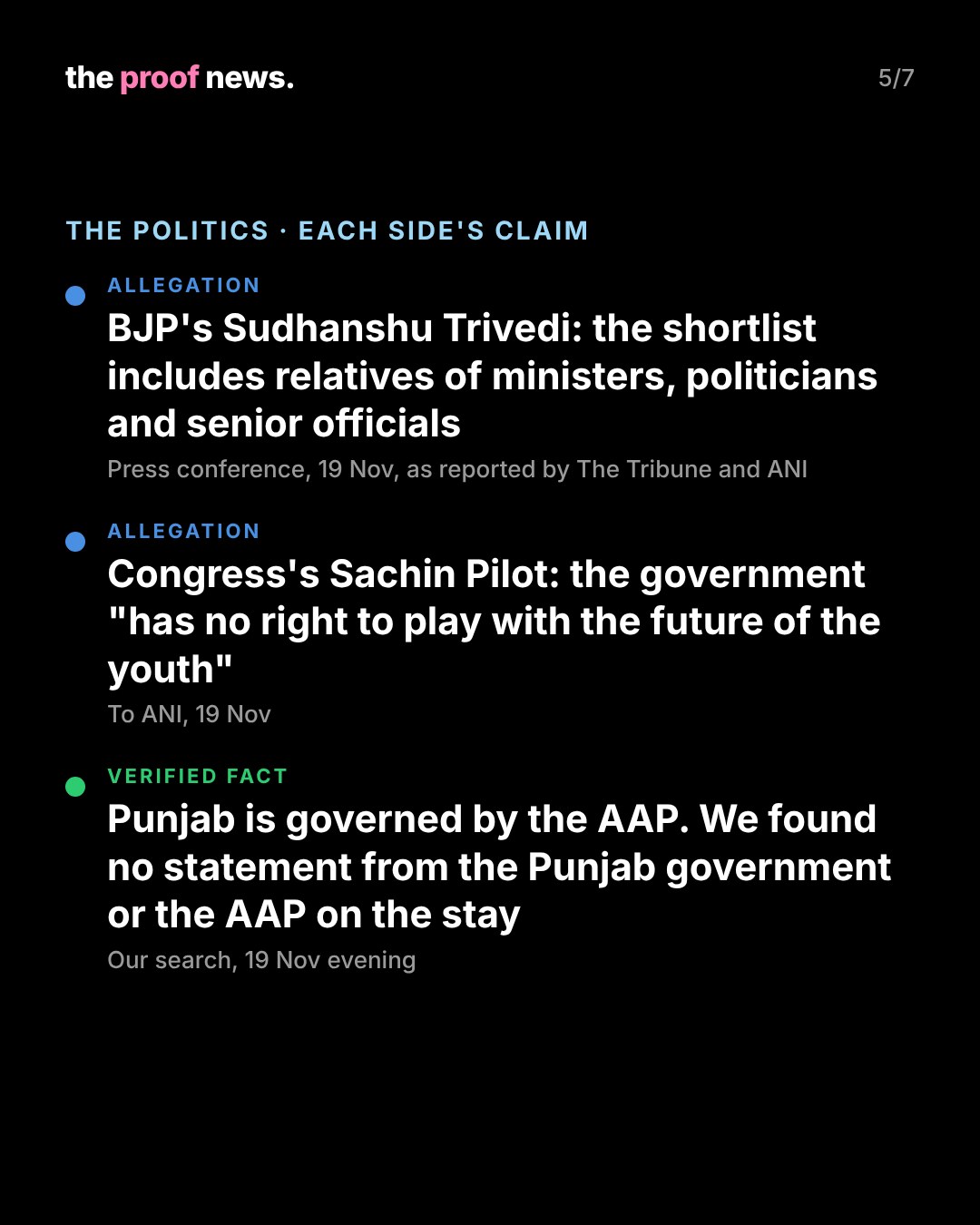
AllegationThe politics, each side's claim: BJP national spokesperson Sudhanshu Trivedi alleged at a press conference that the shortlist includes relatives of ministers, politicians, senior government officials and people facing corruption-related allegations, as well as families of people who had donated to the AAP, and said the stay "reinforced the seriousness of the questions being raised" (The Tribune, ANI). Congress's Punjab in-charge Sachin Pilot told ANI the government "has no right to play with the future of the youth". On 6 November The Tribune reported that the Shiromani Akali Dal's Bikram Singh Majithia had sought a high court-monitored inquiry or a CBI probe. These are political allegations; no court has found any of them.
CommentaryPunjab is governed by the AAP. We found no statement from the Punjab government or the AAP on the stay. Two reports say the court called for the complete recruitment record; The Tribune reports that the petitioners asked for it, so we leave that open until the order is public. A stay is interim and is not a finding that the exam was compromised. We will add the order, the advertisement and the result notice once we can open them.
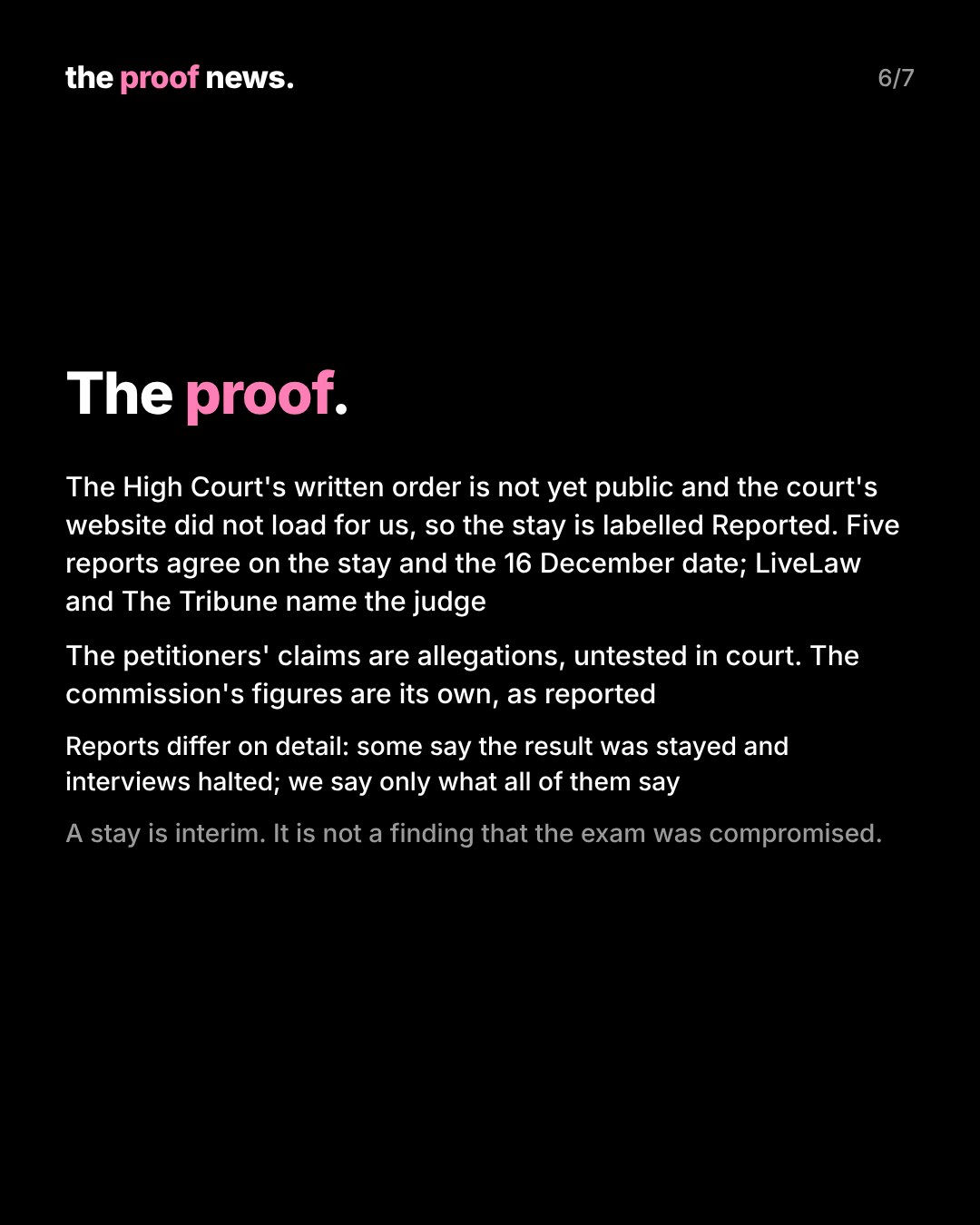
The proof.
We could not obtain the High Court's order (not yet public; the court's website did not load for us) or the commission's advertisement and result notice, so this story rests on reports and is labelled accordingly: the stay, the judge and the next date are Reported in several reports that agree; the petitioners' grounds are Allegations as reported; the commission's figures are its own, as reported. Every quote and number is checked against the saved reports (check.py, all pass). Where reports differ (what exactly was stayed; how the Punjabi rule changed; who asked for the records) we say so. Labels will be upgraded when the order is on record.
- LiveLaw, 19 Nov 2026: High Court stays Punjab PCS, allied services recruitment process
- The Tribune, 19 Nov 2026: High Court stays Punjab PCS, Allied Services recruitment process
- The Tribune, 19 Nov 2026: BJP press conference on the PCS results
- The Tribune, 6 Nov 2026: PCS Mains results row; PPSC's response
- The North News, 6 Nov 2026: PPSC rejects allegations
- Business Upturn, 19 Nov 2026
- ANI via Asianet Newsable, 19 Nov 2026