Supreme Court sets aside Odisha's land acquisition for a Dalmia mining project in Sundargarh
The court held that in a Fifth Schedule area the gram sabha's prior consent is mandatory, and that here there was "not even paper consent": both gram sabhas had rejected the proposal. It also found no material showing the consent of 80% of affected families or that a public hearing took place. The State may start afresh in accordance with the law.
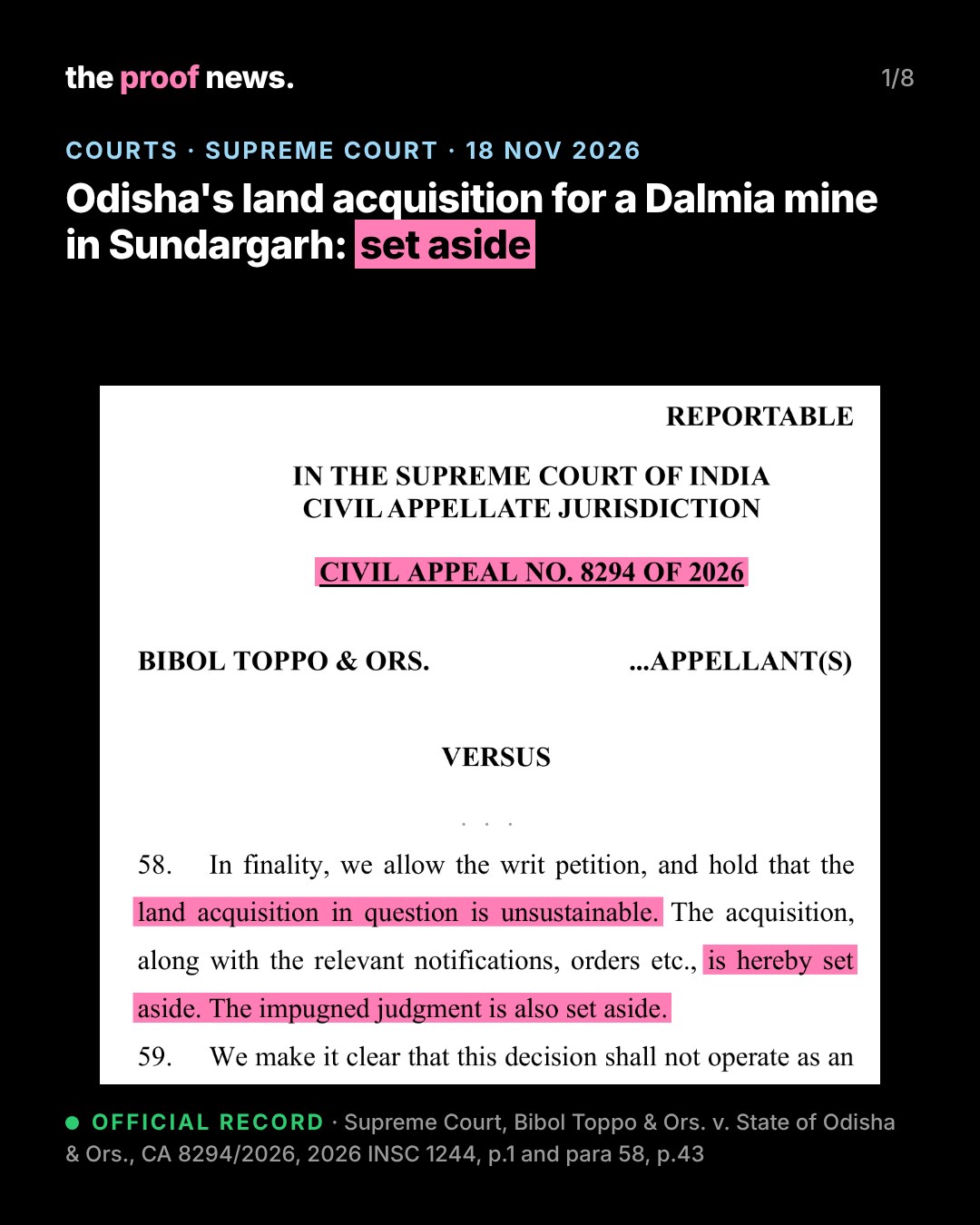
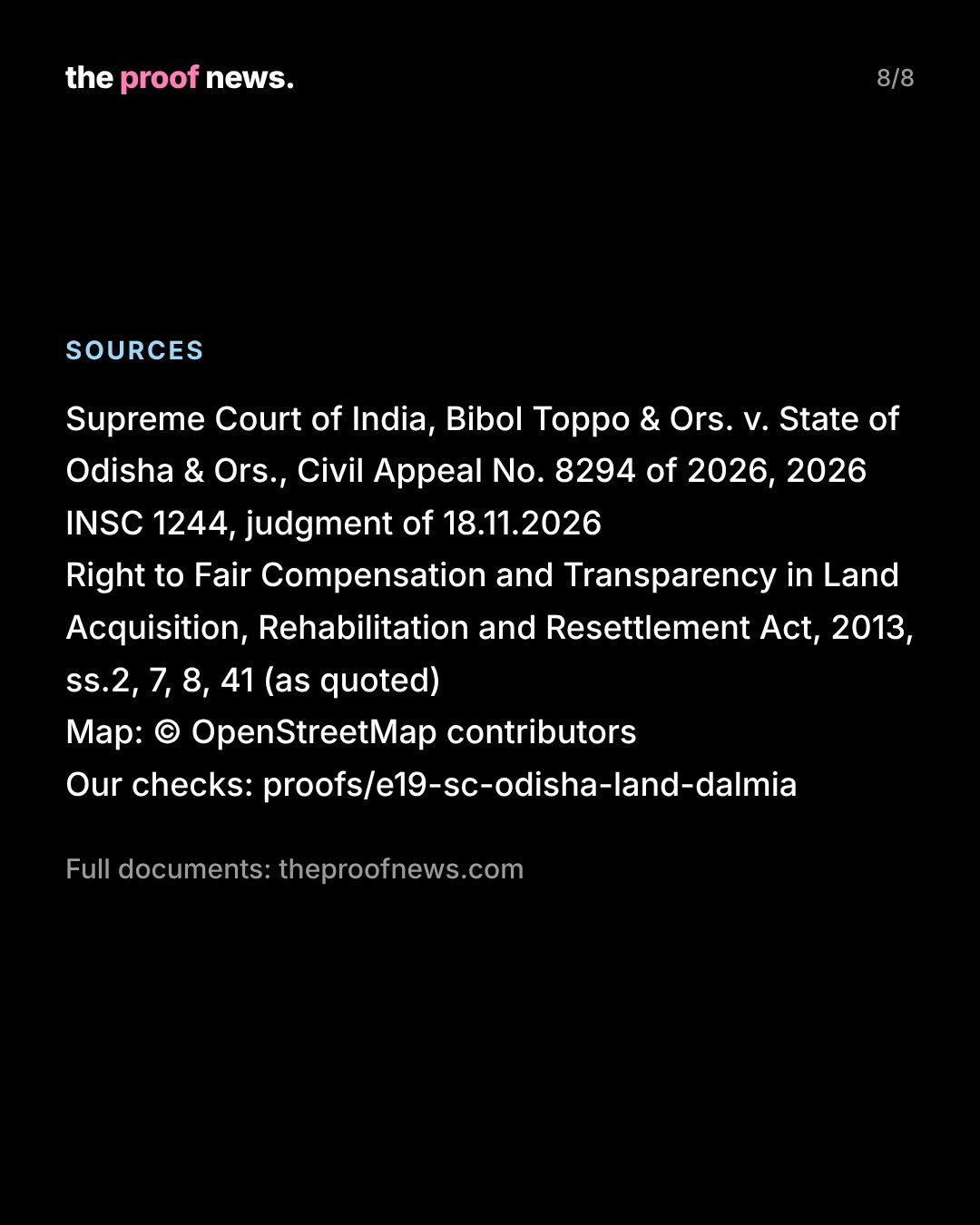
Official recordOn 18 November 2026 the Supreme Court (Justices Dipankar Datta and Satish Chandra Sharma) allowed the appeal in Bibol Toppo & Ors. v. State of Odisha & Ors. (Civil Appeal No. 8294 of 2026, 2026 INSC 1244). It held "the land acquisition in question is unsustainable" and set aside the acquisition "along with the relevant notifications, orders etc.", and the Orissa High Court's judgment of 6 September 2024 that had upheld it (para 58).
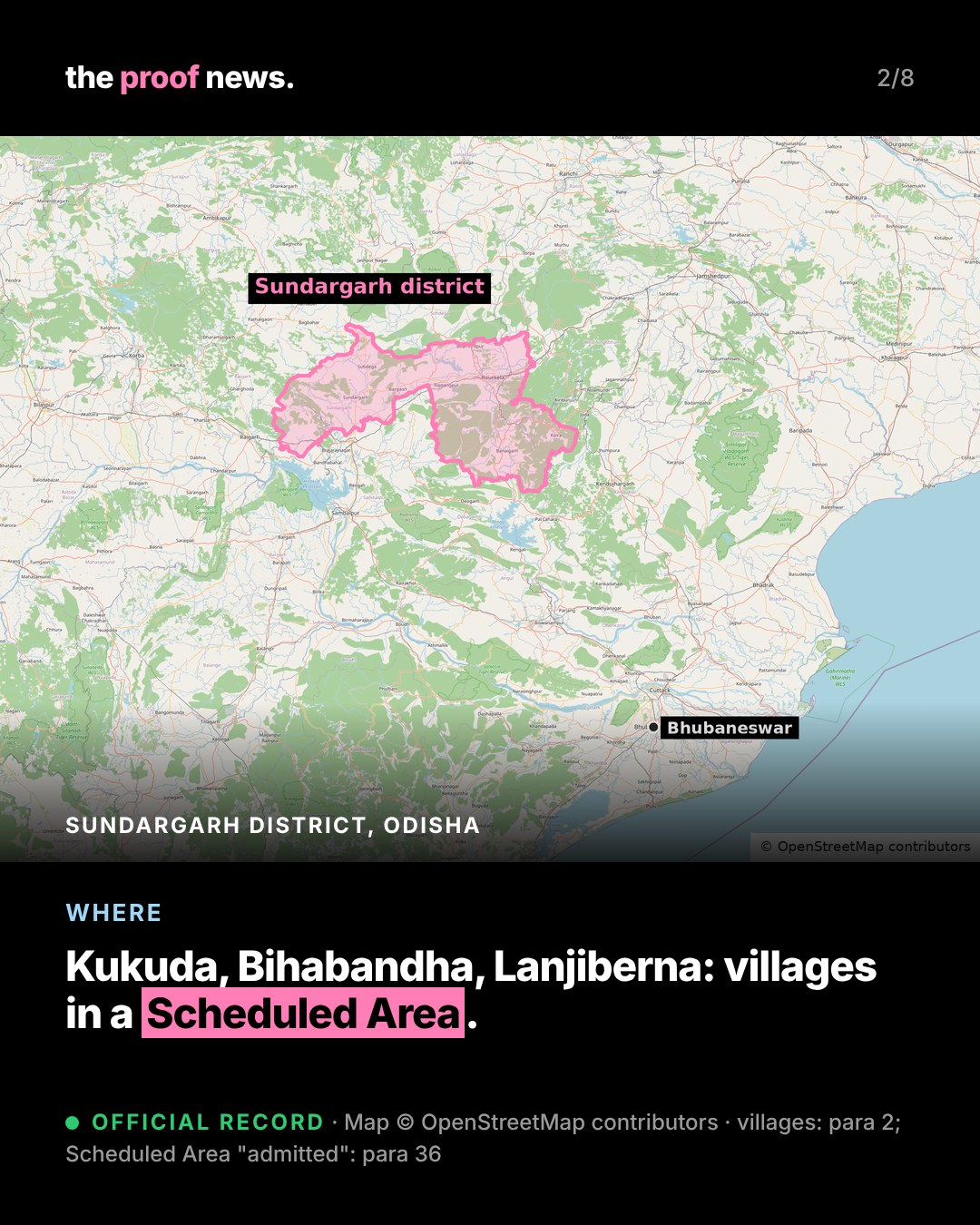
Official recordThe appellants are residents of Kukuda, Bihabandha and Lanjiberna villages in Sundargarh district (para 2). The land was acquired for mining by Dalmia Cements Bharat Limited, as the judgment names the company, which already held a mining lease over the area, extended in 2016 till 29 February 2040, but needed surface rights (paras 2, 22). The company applied in December 2015; the State gave administrative approval on 23 August 2017, on condition that the 2013 Act's prior-consent provisions would apply (para 3). Gram sabha meetings on 26 January 2020 rejected the proposal (paras 4, 41). Preliminary notifications followed on 6 July 2021 and the final declaration under section 19 on 3 November 2021 (paras 8-9).
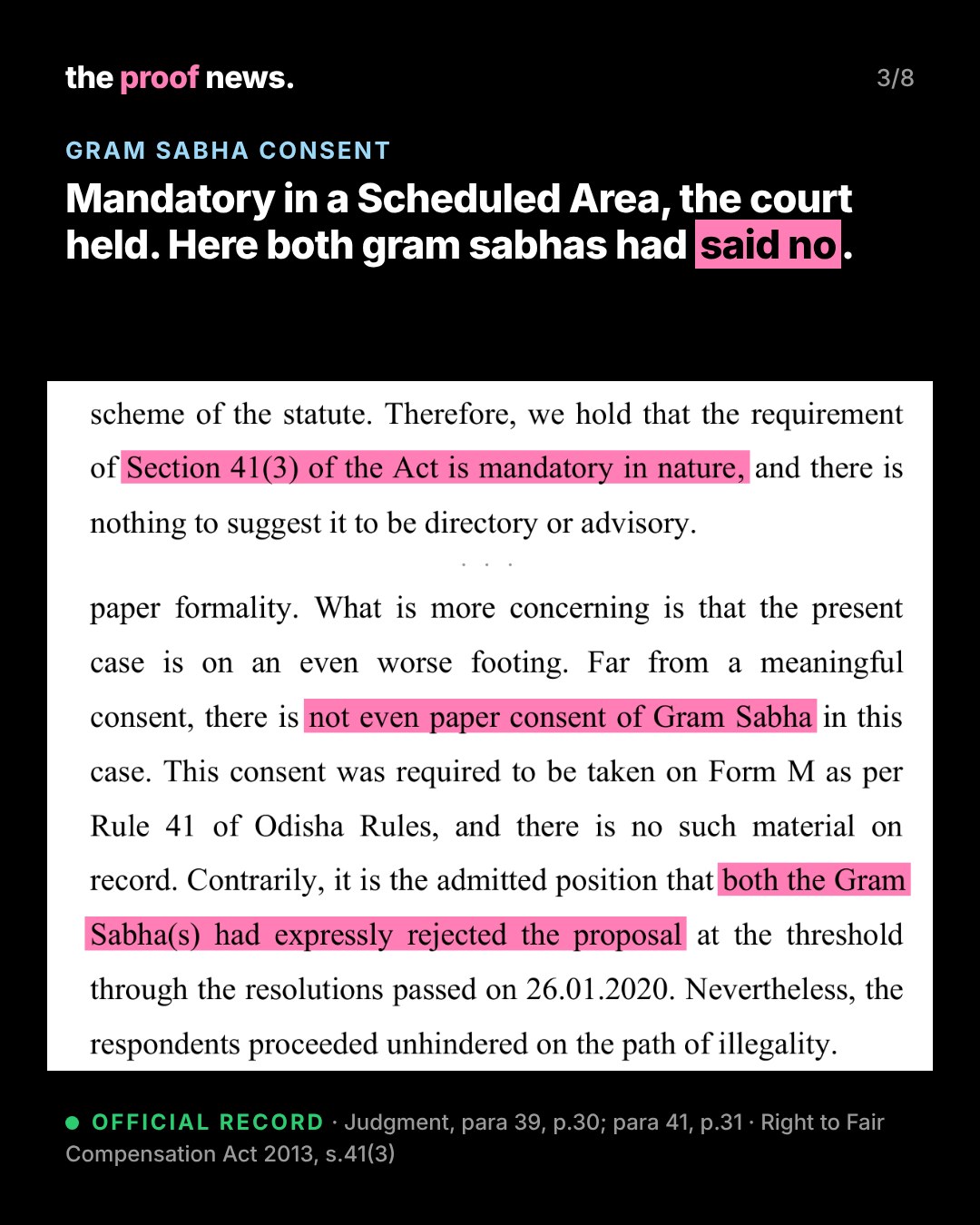
Official recordGram sabha consent. It was admitted that the land is in a Scheduled Area under the Fifth Schedule (para 36). Section 41(3) of the Right to Fair Compensation and Transparency in Land Acquisition, Rehabilitation and Resettlement Act, 2013 requires the gram sabha's prior consent "in all cases" there. The High Court had read it as directory; the Supreme Court held that "the requirement of Section 41(3) of the Act is mandatory in nature, and there is nothing to suggest it to be directory or advisory" (para 39). "Far from a meaningful consent, there is not even paper consent of Gram Sabha in this case"; "both the Gram Sabha(s) had expressly rejected the proposal at the threshold through the resolutions passed on 26.01.2020. Nevertheless, the respondents proceeded unhindered on the path of illegality" (para 41).
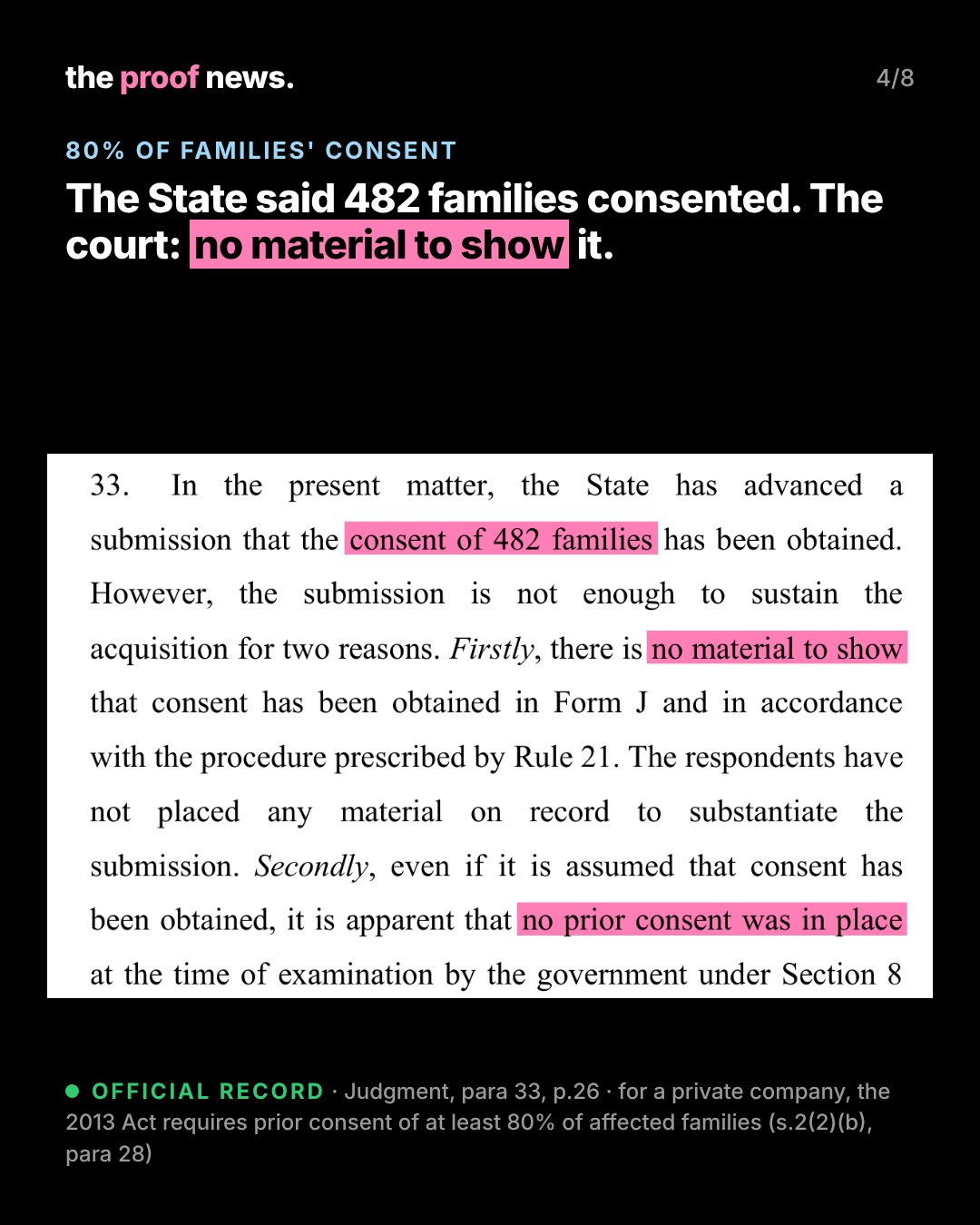
Official recordConsent of families. Because the land was acquired for a private company, the court held the case falls under section 2(2)(b), which requires the prior consent of at least 80% of affected families, taken along with the social impact study (paras 27-29). The State said 482 families had consented; the court found "no material to show that consent has been obtained in Form J", and that in any case "no prior consent was in place at the time of examination by the government under Section 8 of the Act" (para 33). The State's own 2017 approval had recorded that the prior-consent provisions applied (para 35).
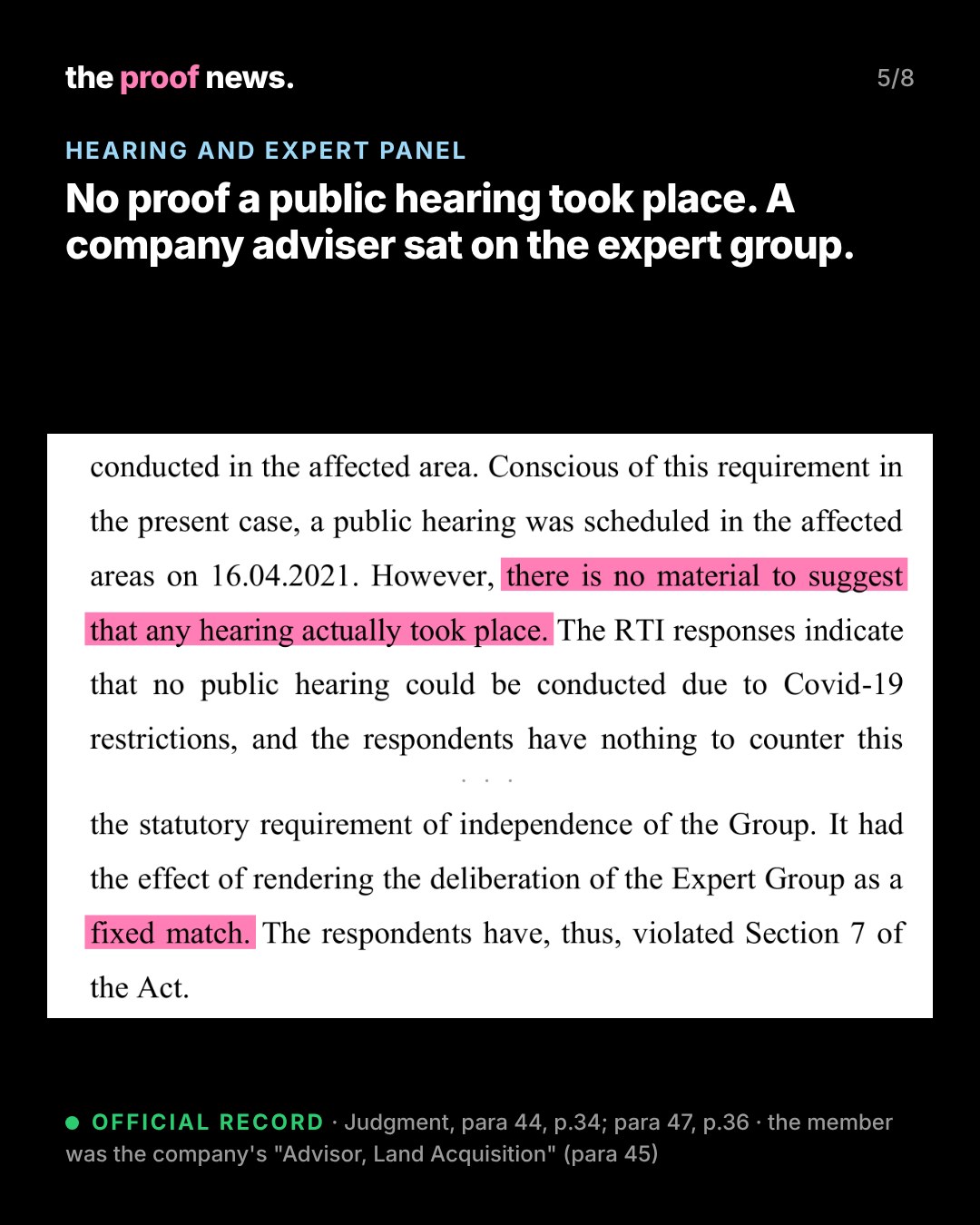
Official recordHearing and expert group. A public hearing on the draft social impact report was scheduled for 16 April 2021, but "there is no material to suggest that any hearing actually took place"; RTI replies said none could be held because of Covid-19 restrictions (para 44). One member of the expert group that appraised the report was connected to the company as its "Advisor, Land Acquisition" (para 45); the court said this "had the effect of rendering the deliberation of the Expert Group as a fixed match" and violated section 7 (para 47). It also rejected the argument that a mining lease and compensation under section 24A of the MMDR Act made acquisition unnecessary: the respondents, having chosen the 2013 Act, had to follow it (paras 49-56).
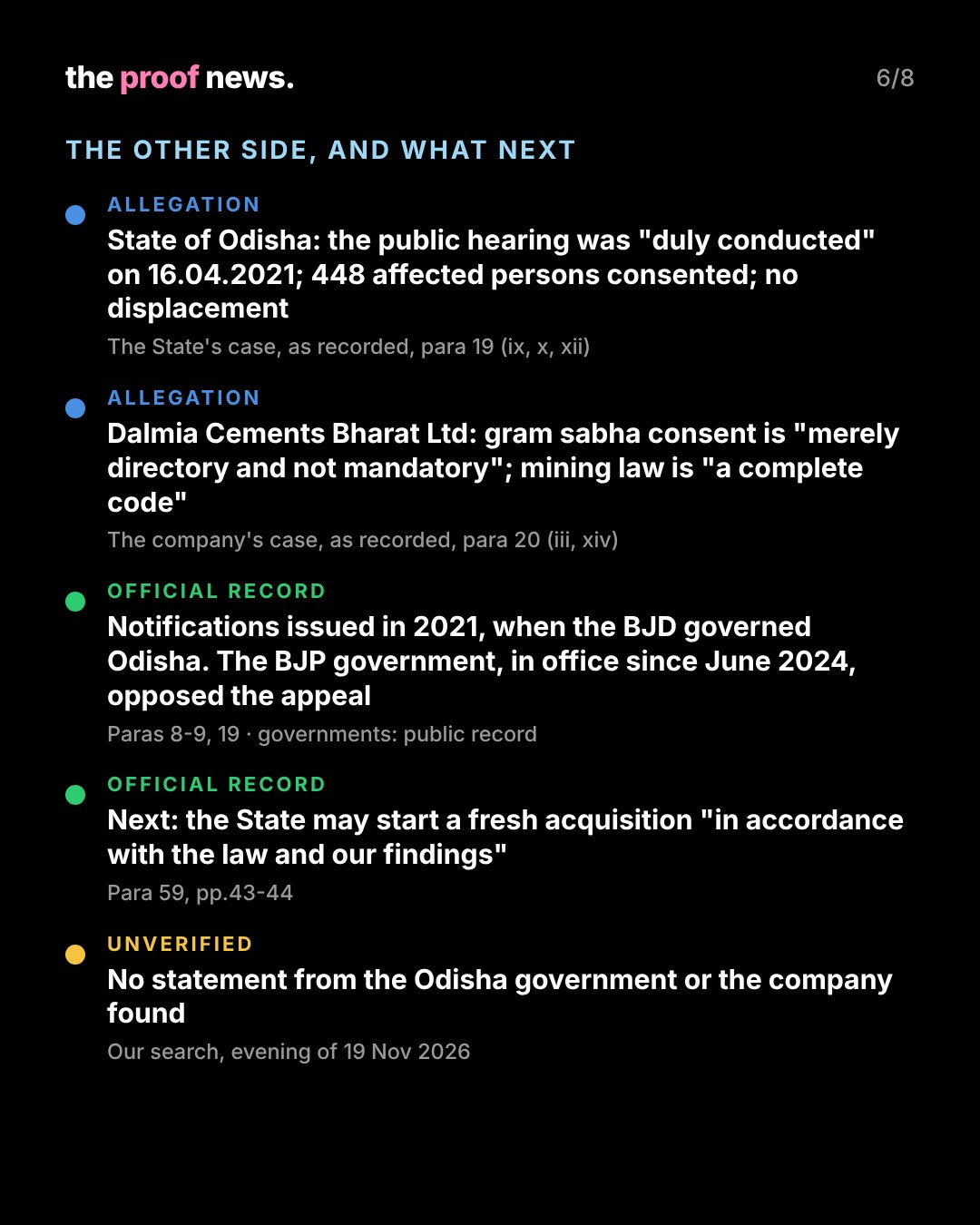
AllegationThe State's case, as the judgment records it (para 19): the appellants lack standing and are not landowners; the public hearing "was duly conducted on 16.04.2021 as per schedule in the presence of concerned Sub Collector, Tehsildar and BDO", though videography failed because of "nuisance and non-cooperation"; the project caused no displacement; "448 affected persons gave their consent"; and the acquisition was by the State for a public purpose, not for a private company. (The High Court had relied on 535 consents as on 22 January 2024; the judgment records three different counts.)
AllegationThe company's case, as recorded (para 20): the Mines and Minerals (Development and Regulation) Act is "a complete code" for mining and gives a lessee the right to enter the land; incorrect references to provisions do not vitiate the acquisition; and section 41(3) is "merely directory and not mandatory, as the Gram Sabha cannot be a body to override the consent of the land owners". The court said it could not examine the company's objection to the desirability of gram sabha consent, as that would question "the wisdom of the legislature" (para 42).
Verified factGovernments: the proposal, the 2017 approval and the 2021 notifications came while the BJD government of Naveen Patnaik was in office. The BJP government of Mohan Charan Majhi took office in June 2024; the State, as respondents 1 to 5, opposed the appeal in the Supreme Court (para 19).
Official recordWhat next: the judgment "shall not operate as an embargo in initiating fresh land acquisition process in accordance with the law and our findings in this judgment. The respondents shall be at liberty to do so" (para 59).
UnverifiedWe found no statement from the Odisha government, the company or the appellants on the judgment by the evening of 19 November 2026.
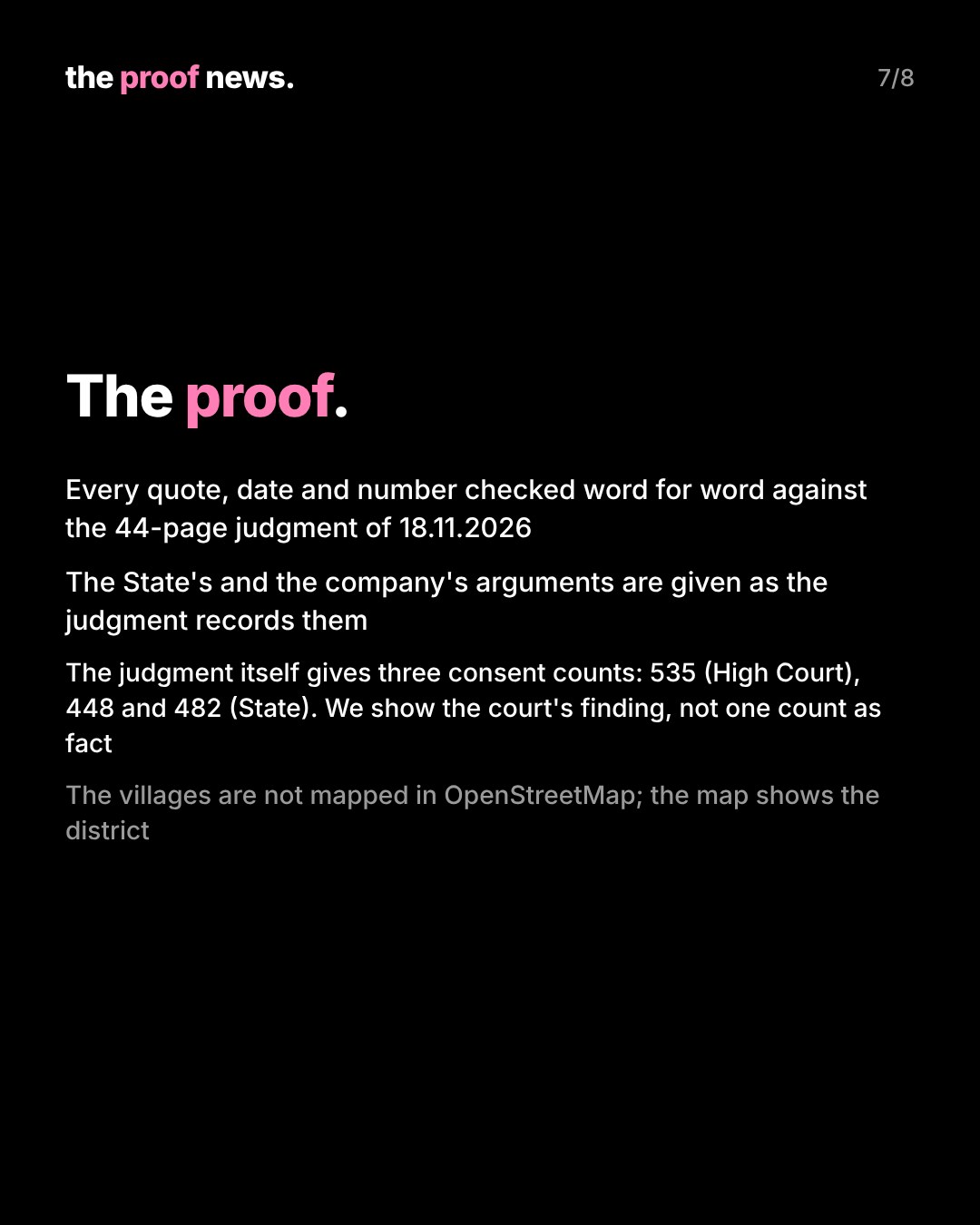
The proof.
Every quotation, date, case number and count is checked word for word against the 44-page judgment of 18 November 2026 (check.py, all pass). The State's and the company's arguments are quoted as the judgment records them and labelled as their case. Inconsistencies in the judgment are flagged rather than repeated: it gives three consent counts (535, 448, 482) and gives the area sought as 273.57 hectares in one paragraph and 273.57 acres in the next, so we put no area on screen. The three villages are not mapped in OpenStreetMap, so the map shows the district only.