Supreme Court dismisses Karnataka's appeal; High Court ruling allowing bike taxis stands
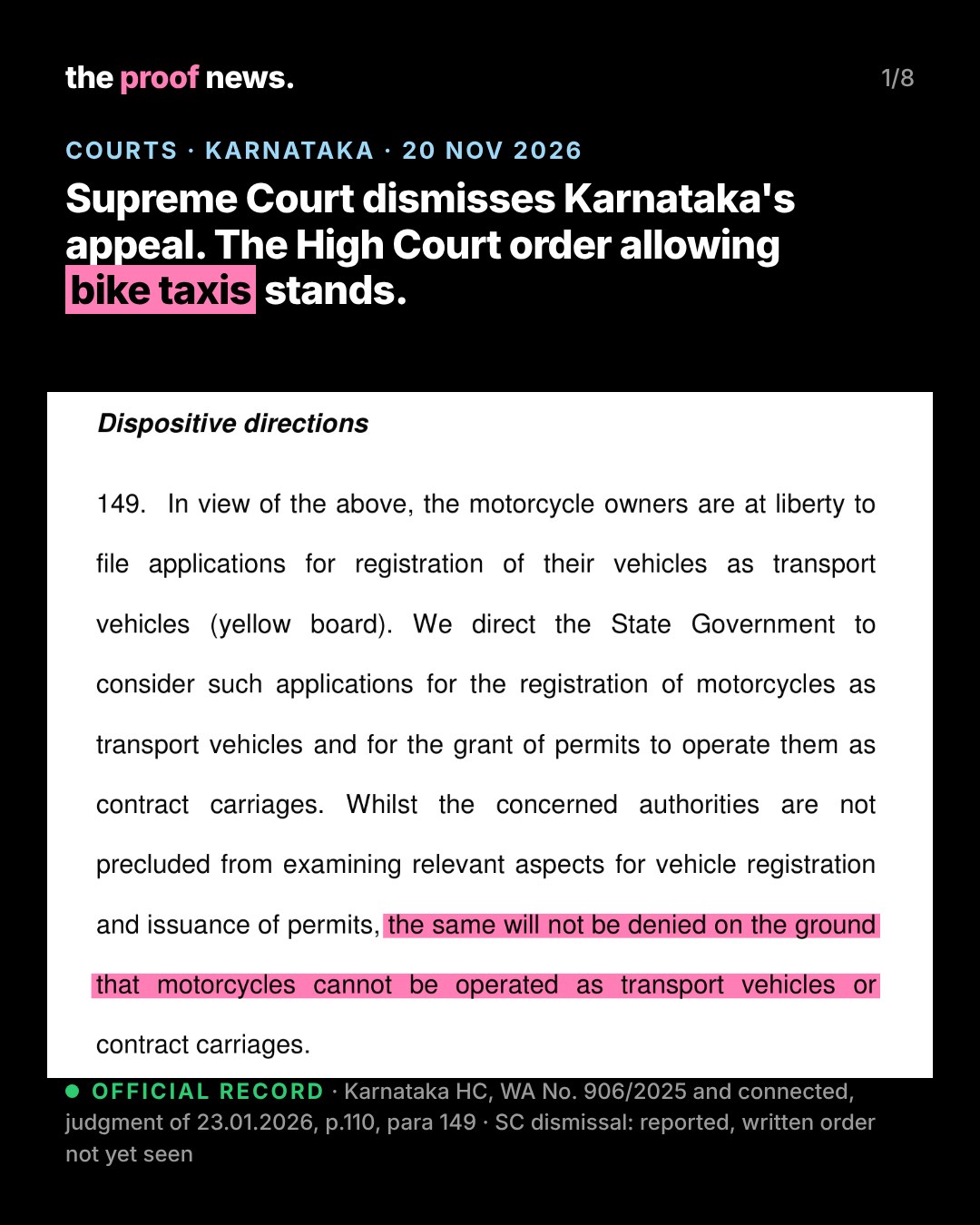
The Supreme Court on 20 November 2026 dismissed the Karnataka government's appeal against the High Court judgment that ended the State's ban on bike taxis, according to courtroom reports. The High Court had held that a blanket refusal of permits to motorcycles is not a reasonable restriction and told the State to consider applications. The State had cited safety and pollution; auto and taxi unions say existing operators will be hurt.
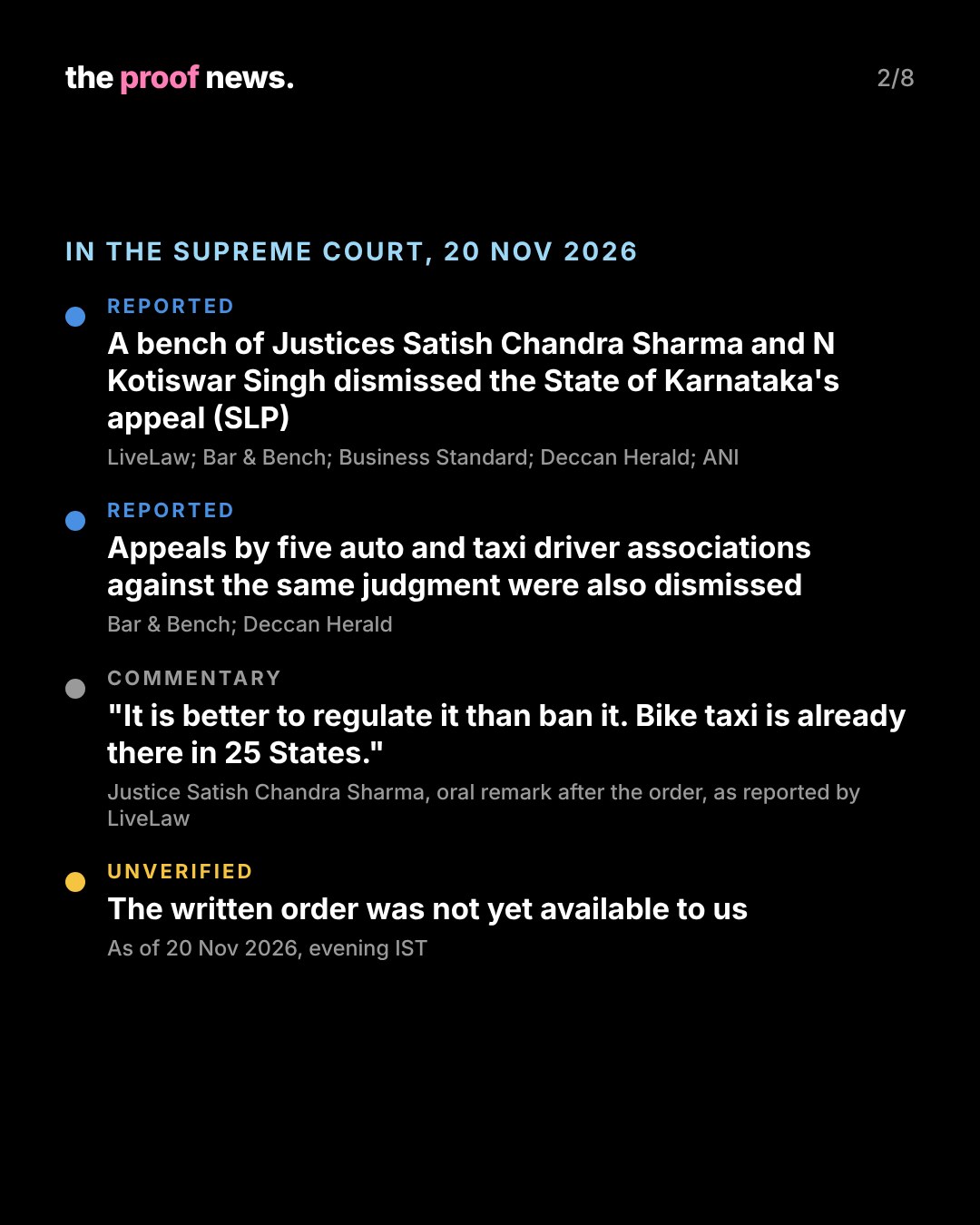
ReportedOn 20 November 2026 a Supreme Court bench of Justices Satish Chandra Sharma and N Kotiswar Singh dismissed the special leave petition filed by the State of Karnataka against the Karnataka High Court's judgment of 23 January 2026 (LiveLaw; Bar & Bench; Business Standard; ANI; Deccan Herald). The appeals of five auto and taxi driver associations against the same judgment were also dismissed (Bar & Bench; Deccan Herald). Karnataka is governed by the Congress.
UnverifiedWe have not yet seen the Supreme Court's written order; it was not available to us on the evening of 20 November. We will add it, with any reasons it gives, when it is published. One report gives the day as Thursday; 20 November 2026 was a Friday, as the other reports say.
CommentaryAfter the order, Justice Sharma remarked in court: "Bike taxi is safer for young girls as it has GPS as well. It is better to regulate it than ban it. Bike taxi is already there in 25 States. I asked young girls in my office how they come to office, they said bike taxis. They said auto is five times the cost. And the auto unions don't allow anyone except Namma auto" (as reported by LiveLaw). These are oral remarks, not part of a written order.
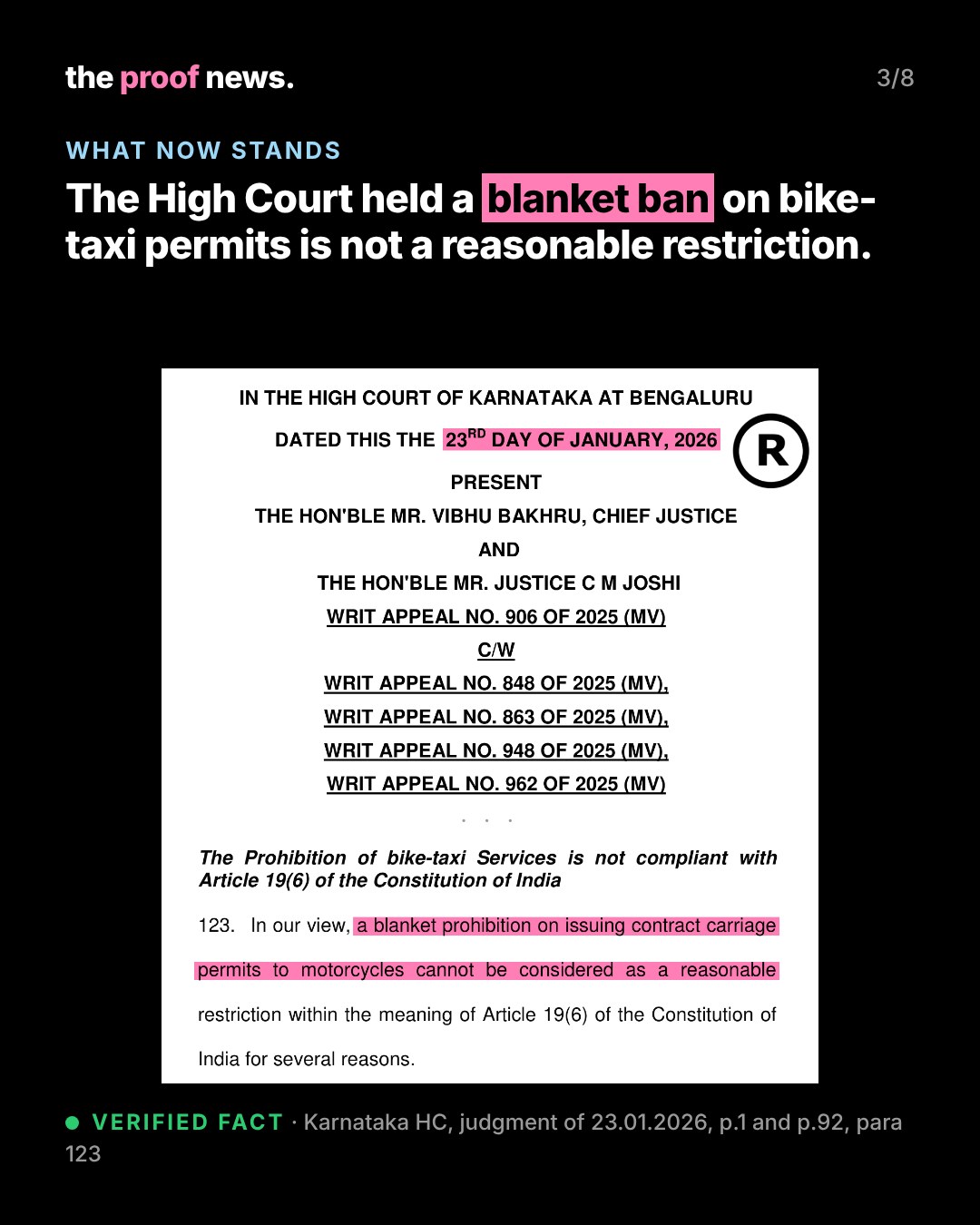
Verified factWhat now stands is the judgment of a Division Bench of the Karnataka High Court (Chief Justice Vibhu Bakhru and Justice C M Joshi) in Writ Appeal No. 906 of 2025 and connected appeals (848, 863, 948 and 962 of 2025), dated 23 January 2026. The appellants were Uber, Ola (ANI Technologies), Rapido, motorcycle owners and the Bike Taxi Welfare Association. The court held: "a blanket prohibition on issuing contract carriage permits to motorcycles cannot be considered as a reasonable restriction within the meaning of Article 19(6) of the Constitution of India" (p.92, para 123).
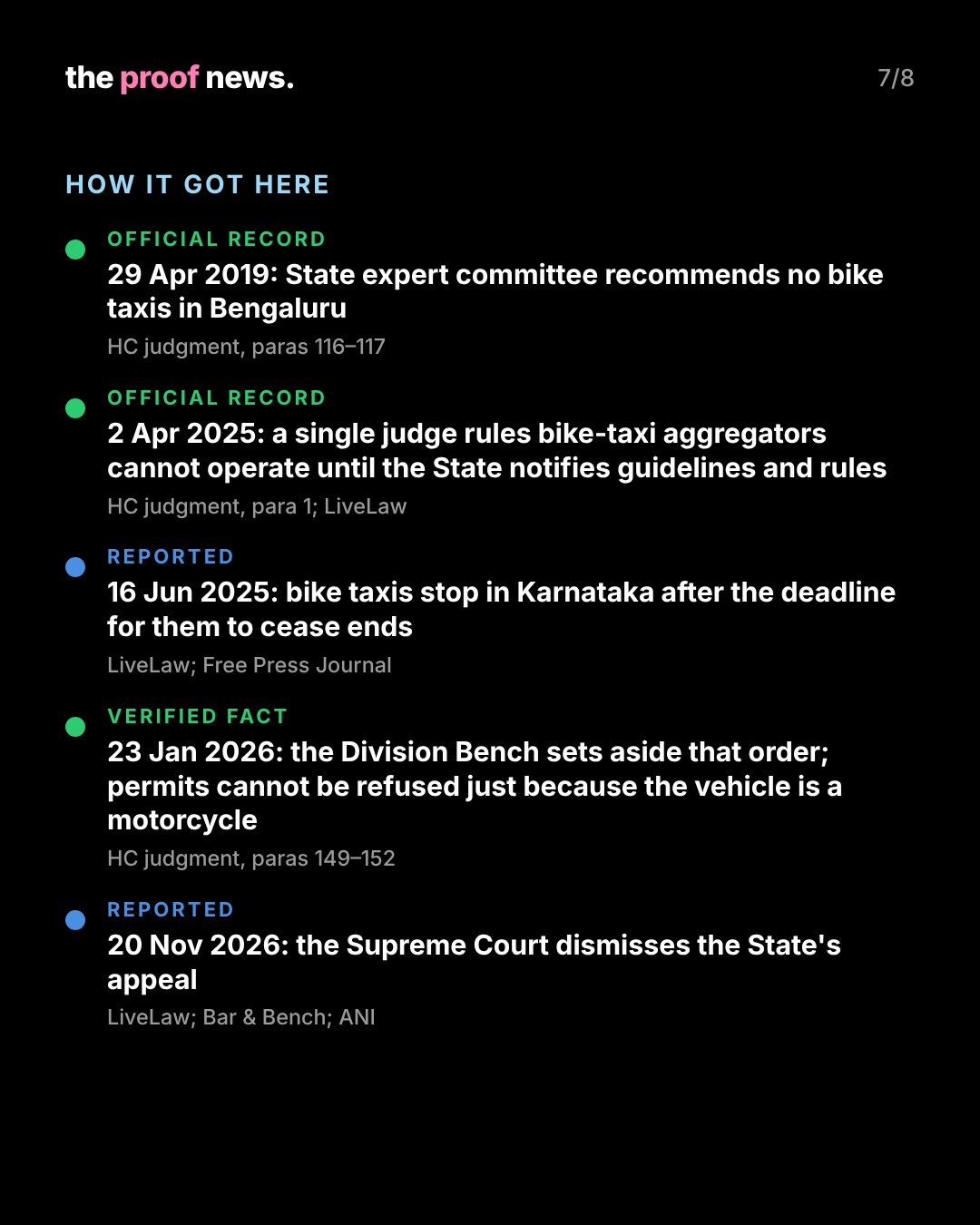
Verified factIts directions (pp.110–111, paras 149–152): motorcycle owners may apply to register their vehicles as transport vehicles (yellow board); the State must consider those applications and permits to operate them as contract carriages, and "the same will not be denied on the ground that motorcycles cannot be operated as transport vehicles or contract carriages"; the Regional Transport Authority "may also impose such conditions as it considers necessary" under Section 74(2) of the Motor Vehicles Act; pending aggregator applications must be decided, and aggregators may file fresh ones. The single judge's order of 2 April 2025 was set aside.
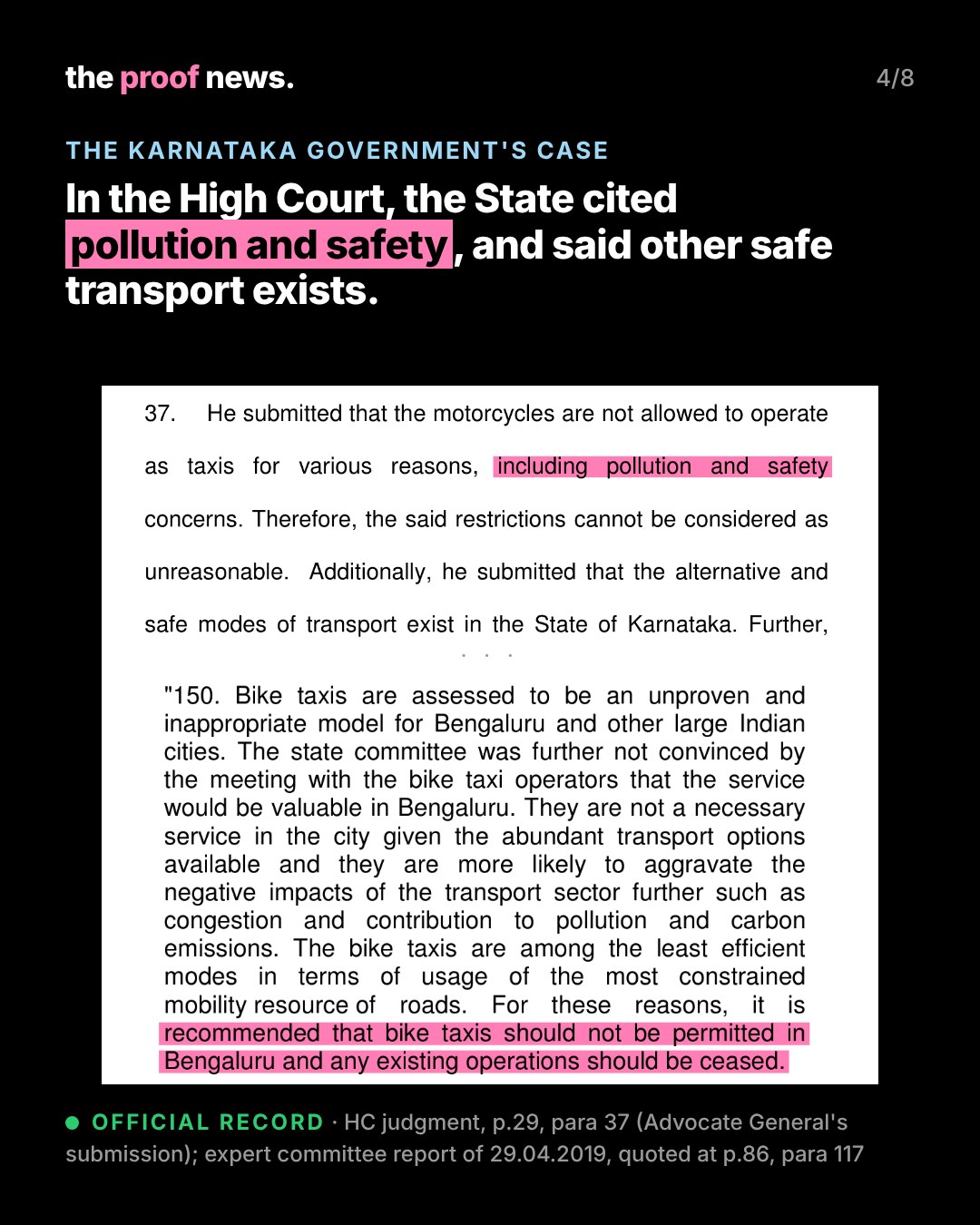
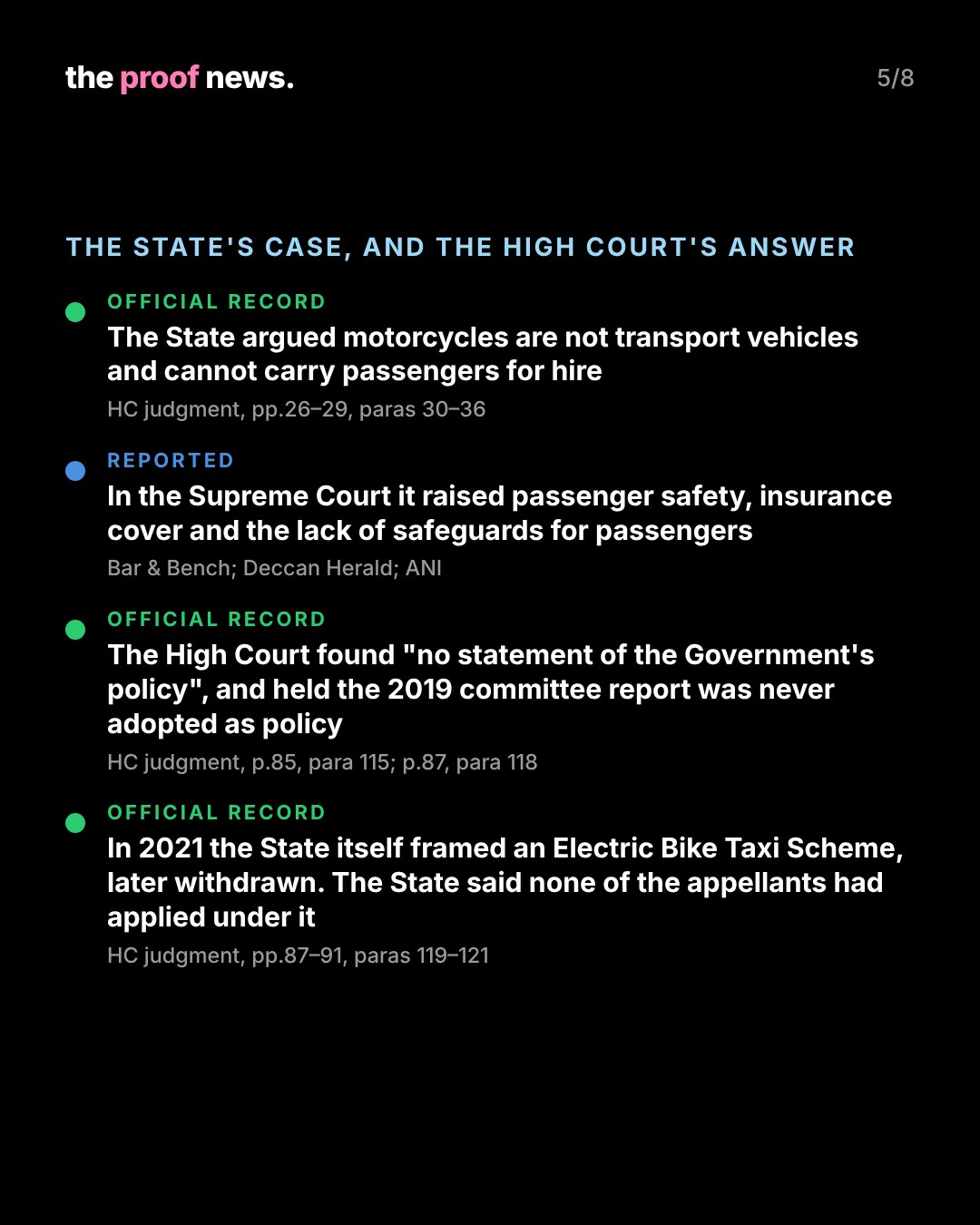
Official recordThe State's case in the High Court, as recorded in the judgment: the Advocate General argued that motorcycles are not transport vehicles; that the State's aggregator rules cover only motor cabs; that the State has power under the Motor Vehicles Act to modify permits; and that motorcycles "are not allowed to operate as taxis for various reasons, including pollution and safety concerns", that "alternative and safe modes of transport exist in the State of Karnataka", and that motorcycle owners can earn through delivery work instead (pp.26–30, paras 30–37).
Official recordThe State also relied on a 2019 expert committee report, which recommended "that bike taxis should not be permitted in Bengaluru and any existing operations should be ceased", citing congestion and pollution (quoted at p.86, para 117). The High Court found "no statement of the Government's policy" banning bike taxis (p.85, para 115) and held the report had not been adopted as policy; it noted that in July 2021 the State had itself framed a Karnataka Electric Bike Taxi Scheme, later withdrawn, which the Advocate General said happened because none of the appellants applied under it (pp.87–91, paras 118–121).
ReportedIn the Supreme Court, the State raised passenger safety, insurance cover and the absence of adequate safeguards for bike-taxi passengers (Bar & Bench; Deccan Herald; ANI). It argued that motorcycles and motor cabs are separately defined under the Motor Vehicles Act and that its aggregator rules did not envisage bike taxis, citing the 2019 committee report (Bar & Bench).
UnverifiedBar & Bench also reported that the State told the Supreme Court it was willing to consider bike taxis elsewhere in Karnataka but opposed them in Bengaluru; that the aggregators said about 4.5 lakh passengers benefited from bike taxis in the State; and that the Centre, asked by the bench, confirmed that motorcycles can be used as taxis under its notifications. We found these points in one outlet's report only.
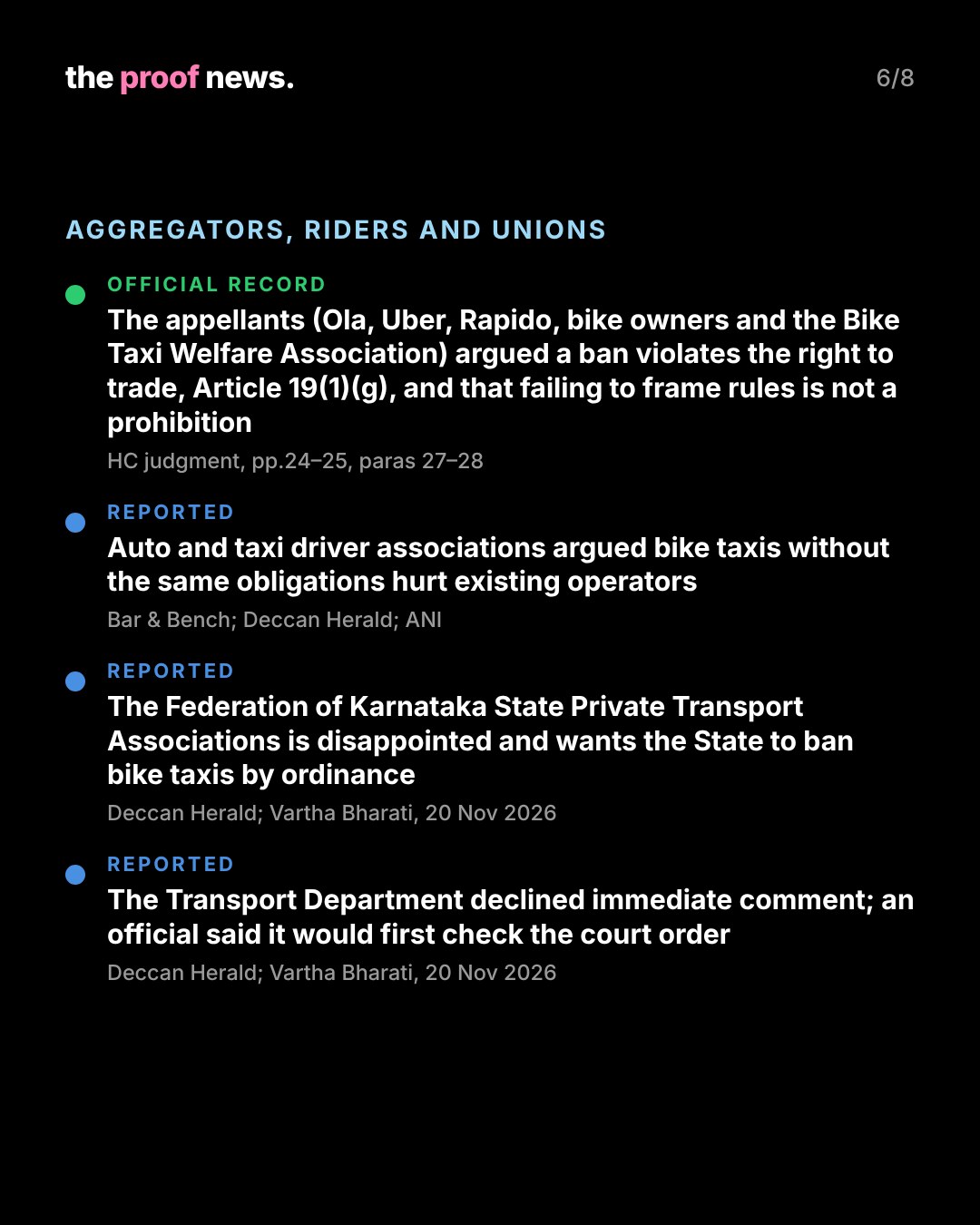
Official recordThe aggregators' case, as recorded by the High Court: the business of carrying passengers is protected by the right to trade under Article 19(1)(g); the State may regulate it but "the failure to frame any regulations cannot be inferred as a prohibition" (pp.24–25, paras 27–28).
ReportedAuto and taxi driver associations argued that permitting bike taxis without comparable regulatory obligations would adversely affect existing transport operators (Bar & Bench; Deccan Herald; ANI). After the verdict, the Federation of Karnataka State Private Transport Associations expressed disappointment and urged the State government to issue an ordinance banning bike-taxi services offered by ride-hailing firms. The Transport Department declined immediate comment; a senior official said it first needed to check the court order (Deccan Herald; Vartha Bharati).
Official recordThe Full Picture. The High Court noted that Haryana, Punjab, Rajasthan, Uttar Pradesh, West Bengal and Mizoram have notifications permitting bike taxis under contract carriage permits, and that Bihar, Jharkhand, Gujarat and Telangana provide for commercial registration and permits for motorcycles (p.96, para 128). It said Karnataka's own 2021 scheme had recognised the need for affordable first- and last-mile connectivity (paras 119–120).
ReportedHow it got here: the single judge ruled on 2 April 2025 that bike-taxi aggregators could not operate until the State notified guidelines and rules under the Motor Vehicles Act, and ordered operations to stop; after an extension, bike taxis stopped from 16 June 2025 (LiveLaw; Free Press Journal). The Division Bench reversed that on 23 January 2026; the Supreme Court dismissed the State's appeal on 20 November 2026.
UnverifiedWhat to watch: the written order; whether the State issues bike-taxi permits and on what conditions under Section 74(2); whether it pursues an ordinance or new rules, as the transport associations ask; and the aggregators' licence applications.
The proof.
The High Court judgment (111 pages, digitally signed court copy) is quoted word for word, with page and paragraph, and checked by check.py. The Supreme Court's dismissal and the bench are labelled Reported: five outlets agree on the outcome and on Justices Satish Chandra Sharma and N Kotiswar Singh, but we have not yet seen the written order. Points found in only one outlet are labelled Unverified.
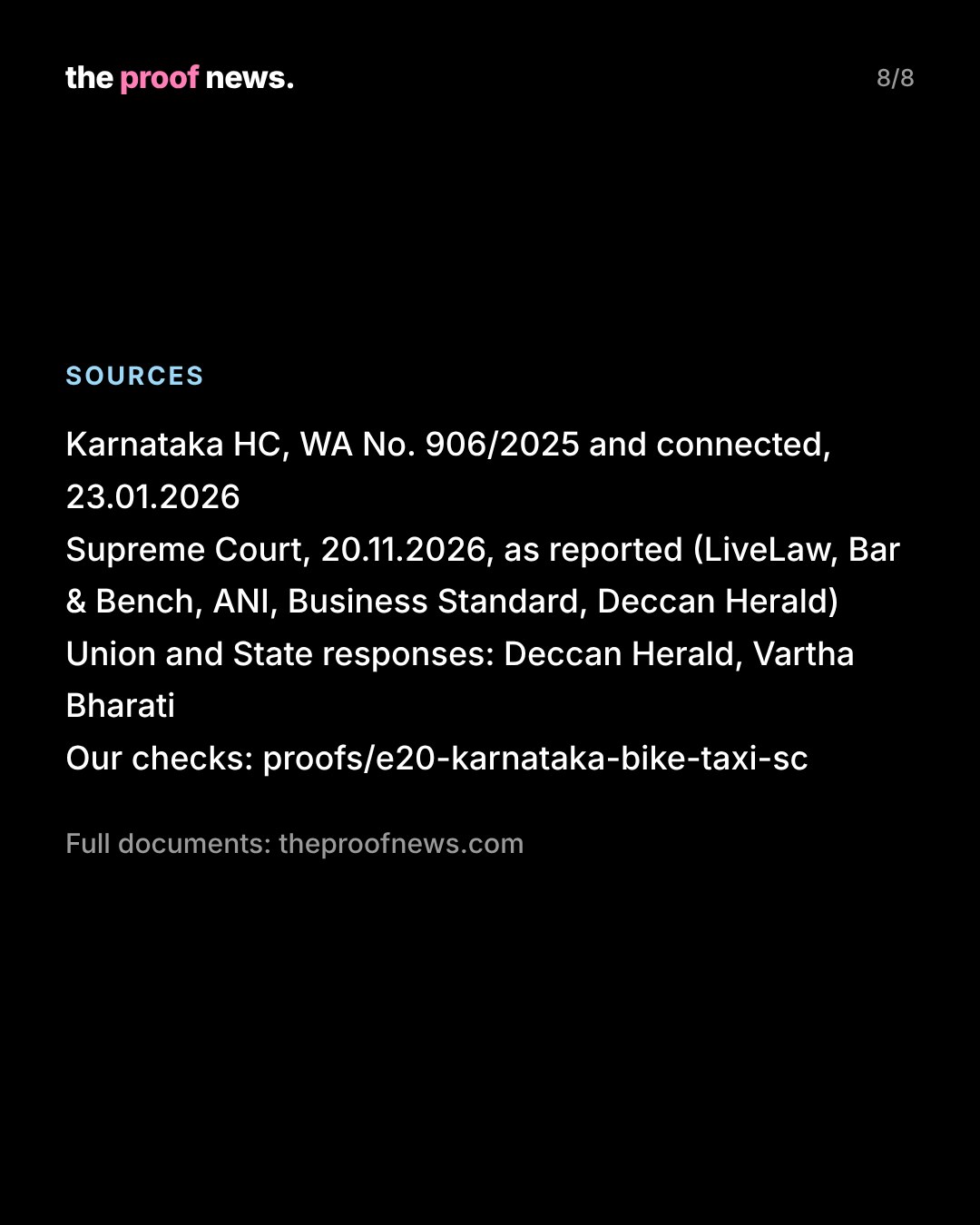
- Karnataka High Court, WA No. 906/2025 and connected, judgment of 23.01.2026 (PDF, 111 pp., via LiveLaw)
- LiveLaw, 20.11.2026: Supreme Court dismisses Karnataka's plea
- Bar & Bench, 20.11.2026
- ANI, 20.11.2026
- Business Standard, 20.11.2026
- Deccan Herald, 20.11.2026: reactions
- Deccan Herald, 20.11.2026
- Vartha Bharati, 20.11.2026
- Free Press Journal, 20.11.2026