Asia Power Index 2026: India third at 40.5 points, its gap to China the narrowest since 2018; experts rate Modi second among regional leaders
The Lowy Institute's annual index, published on 22 November, puts India alone in its "major power" band. The same report says India's economic capability score dipped and that views of Prime Minister Modi's global leadership weakened.
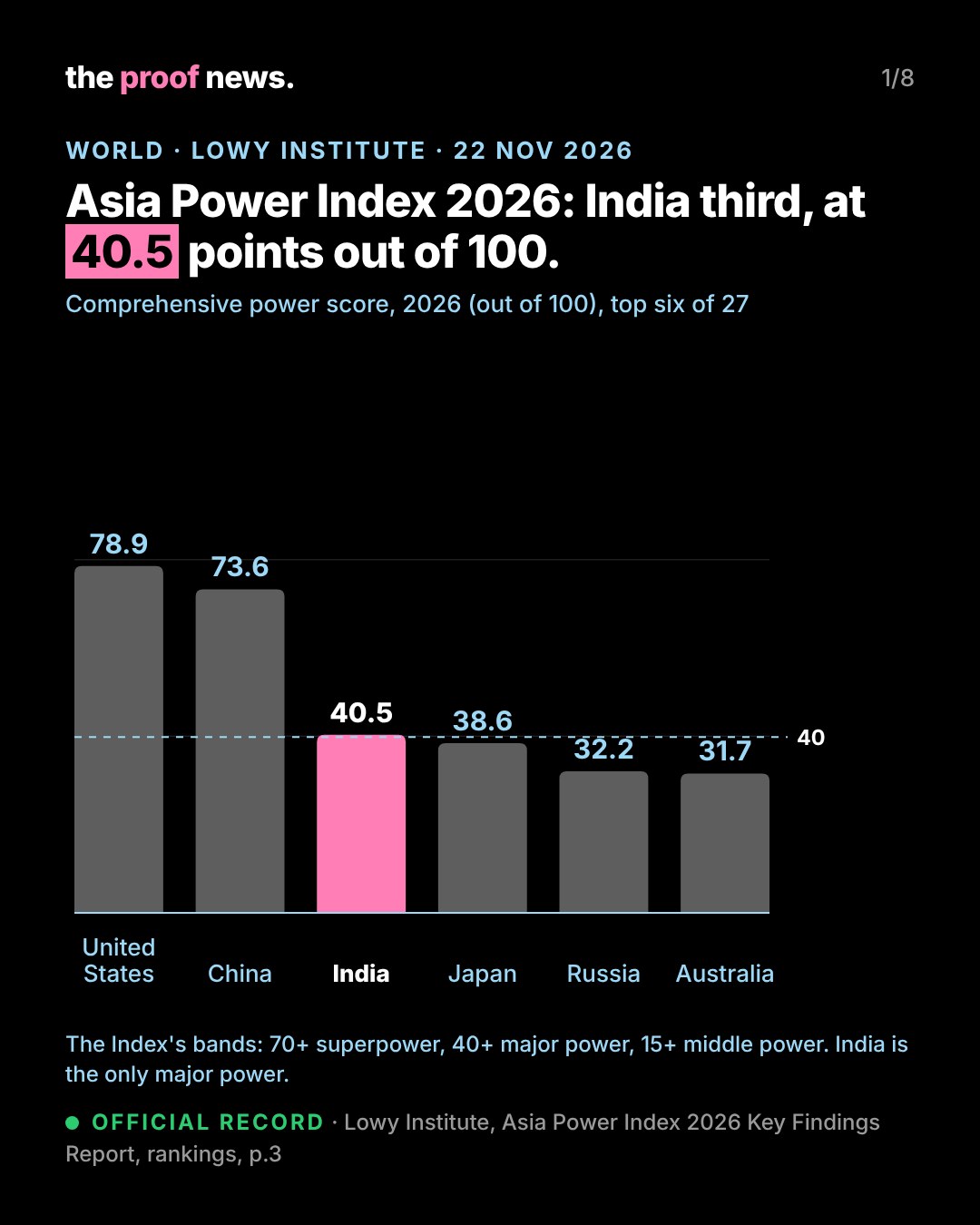
Official recordThe Lowy Institute, an Australian think tank, published its Asia Power Index 2026 on 22 November. It ranks 27 countries and territories by "comprehensive power", a weighted average of eight measures built from 131 indicators; more than half the data points are the Institute's own research, the rest from public national and international sources.
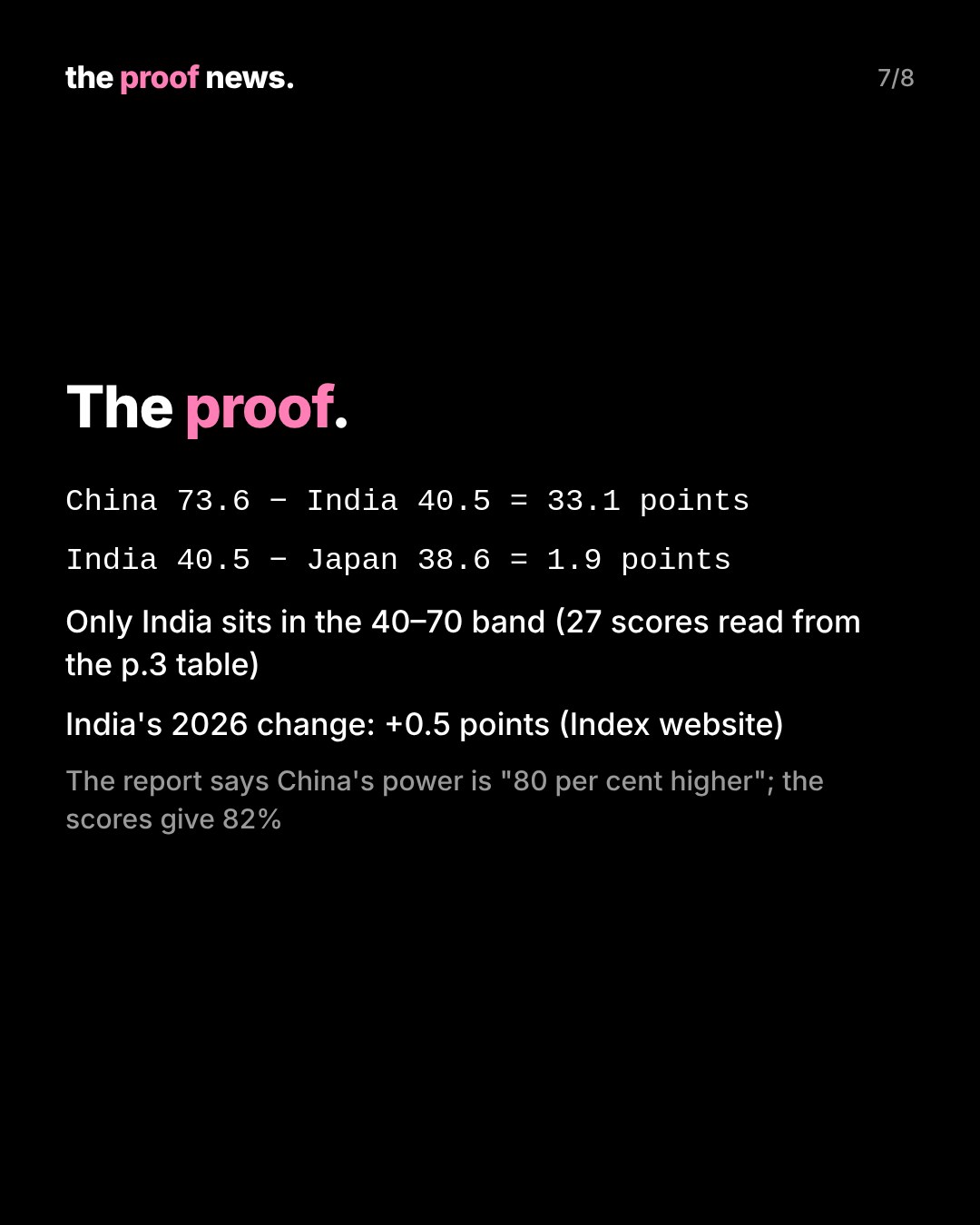
Official recordIndia is third with 40.5 of 100 points, behind the United States (78.9) and China (73.6) and ahead of Japan (38.6), Russia (32.2) and Australia (31.7). Pakistan is 16th with 15.0. The Index's bands are 70 points or more for a superpower, 40 or more for a major power and 15 or more for a middle power; India is the only country in the major-power band. The Index's website shows India's score up 0.5 points on 2025.
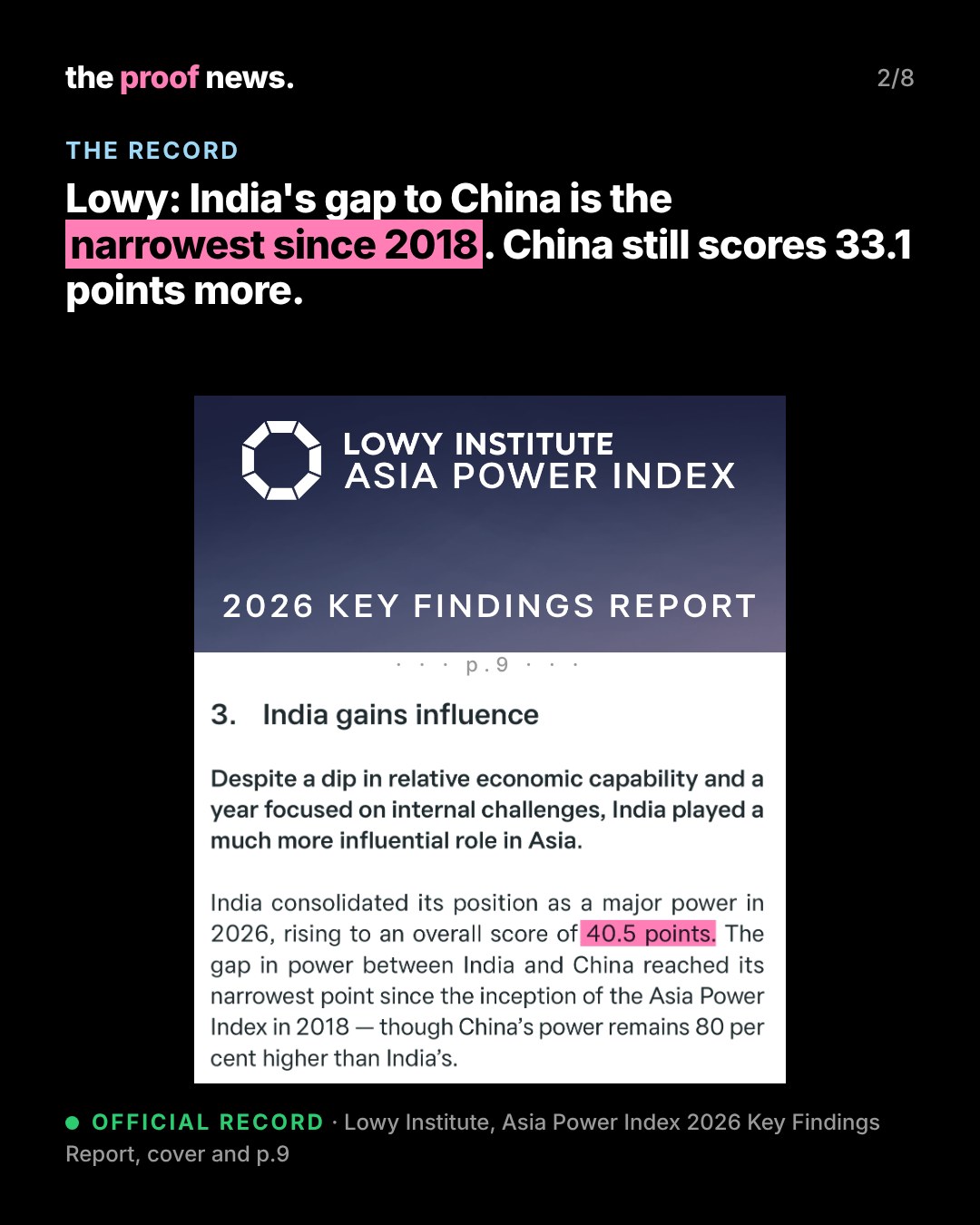
Official recordThe report says "the gap in power between India and China reached its narrowest point since the inception of the Asia Power Index in 2018", though China still scores 33.1 points more by our arithmetic (the report describes China's power as "80 per cent higher"; the two scores give 82%).
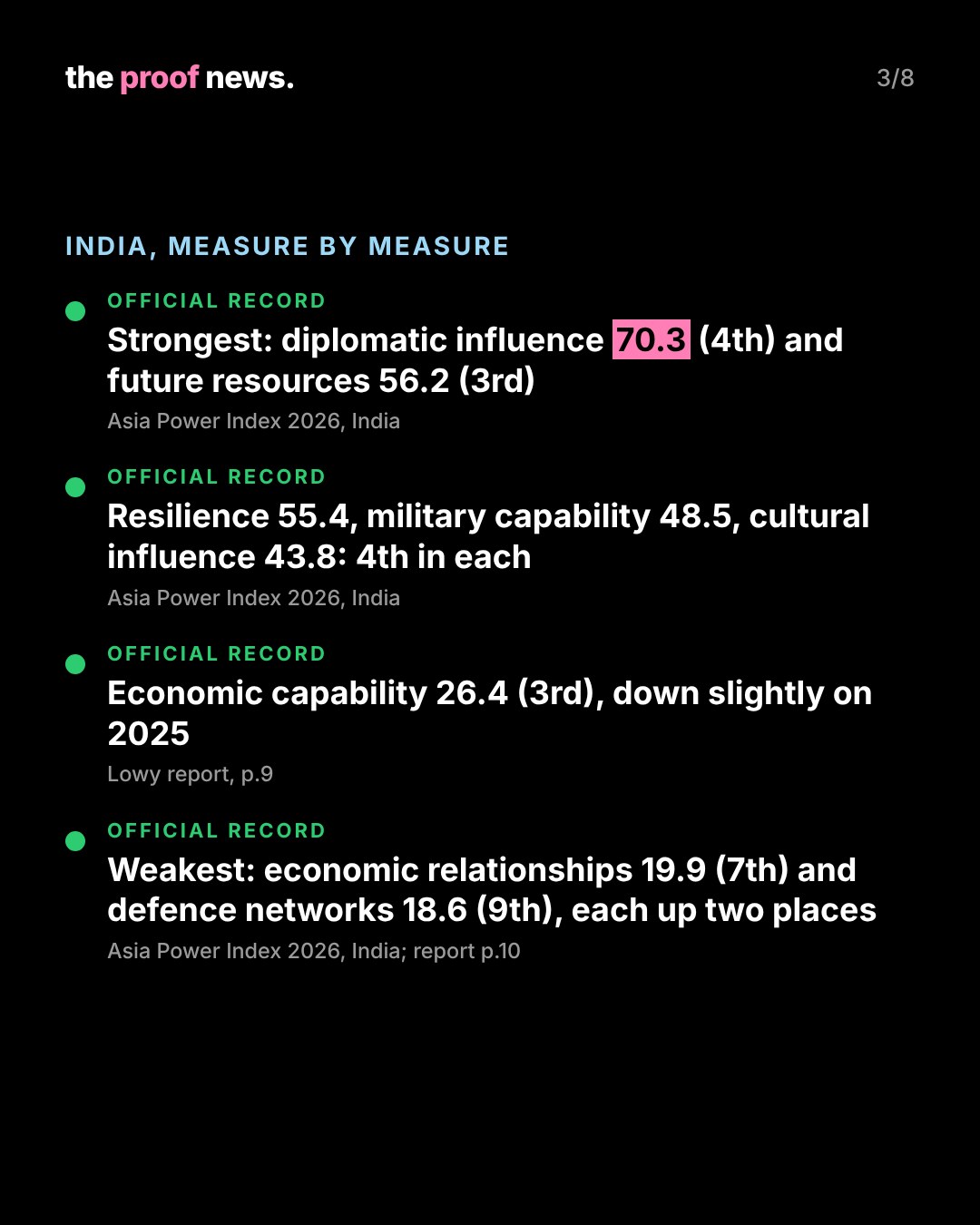
Official recordIndia's measure scores and ranks in 2026: diplomatic influence 70.3 (4th), future resources 56.2 (3rd), resilience 55.4 (4th), military capability 48.5 (4th), cultural influence 43.8 (4th), economic capability 26.4 (3rd), economic relationships 19.9 (7th, up two places) and defence networks 18.6 (9th, up two places).
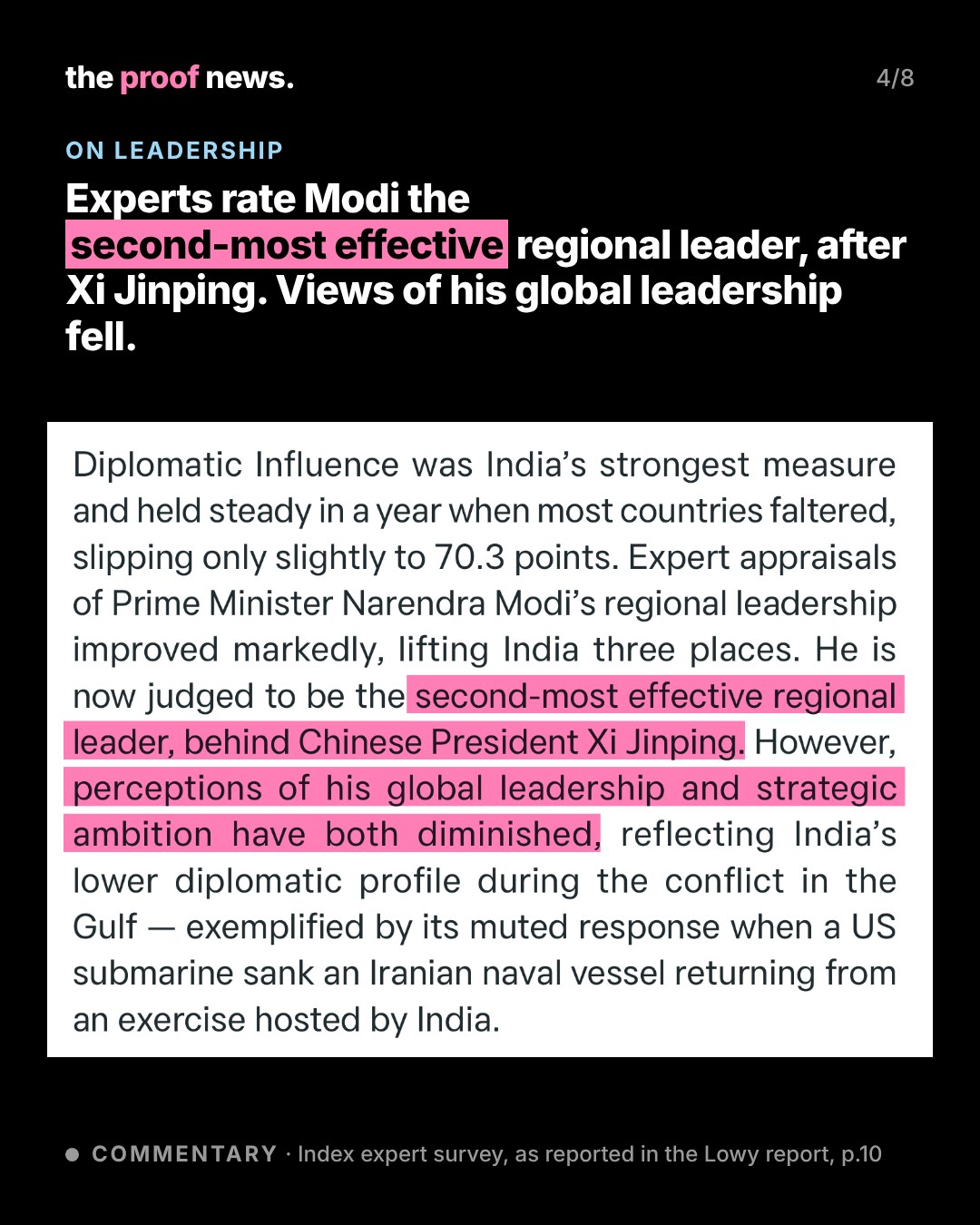
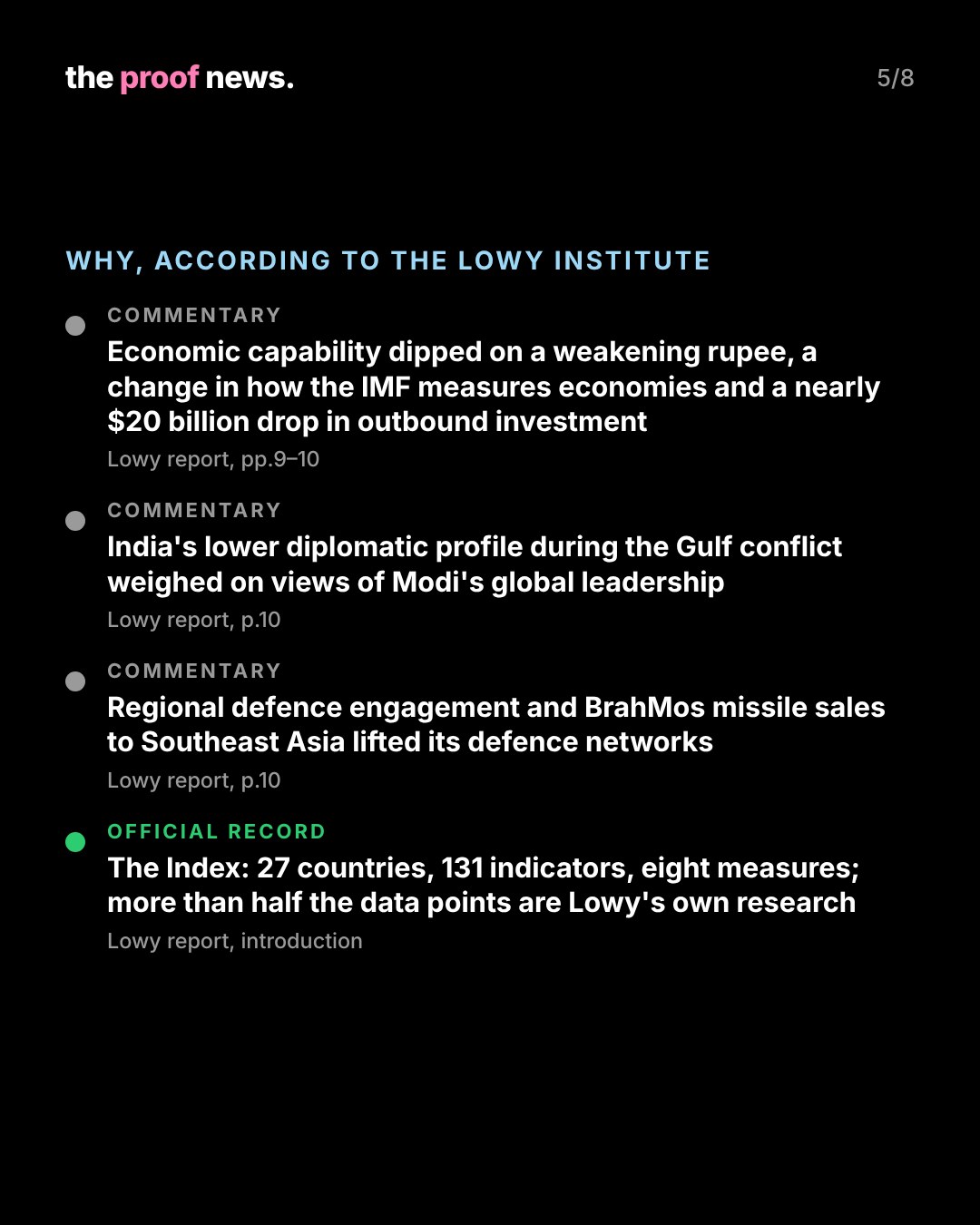
CommentaryFrom the Index's survey of experts, the report says appraisals of Prime Minister Narendra Modi's regional leadership "improved markedly" and that he "is now judged to be the second-most effective regional leader, behind Chinese President Xi Jinping". It adds: "However, perceptions of his global leadership and strategic ambition have both diminished, reflecting India's lower diplomatic profile during the conflict in the Gulf — exemplified by its muted response when a US submarine sank an Iranian naval vessel returning from an exercise hosted by India."
CommentaryThe report attributes the dip in India's economic capability score to "a weakening rupee and a structural change in how the International Monetary Fund measures economies", compounded by a drop of nearly $20 billion in outbound investment. It credits greater regional defence engagement and BrahMos missile sales to Southeast Asia for the rise in India's defence networks score.
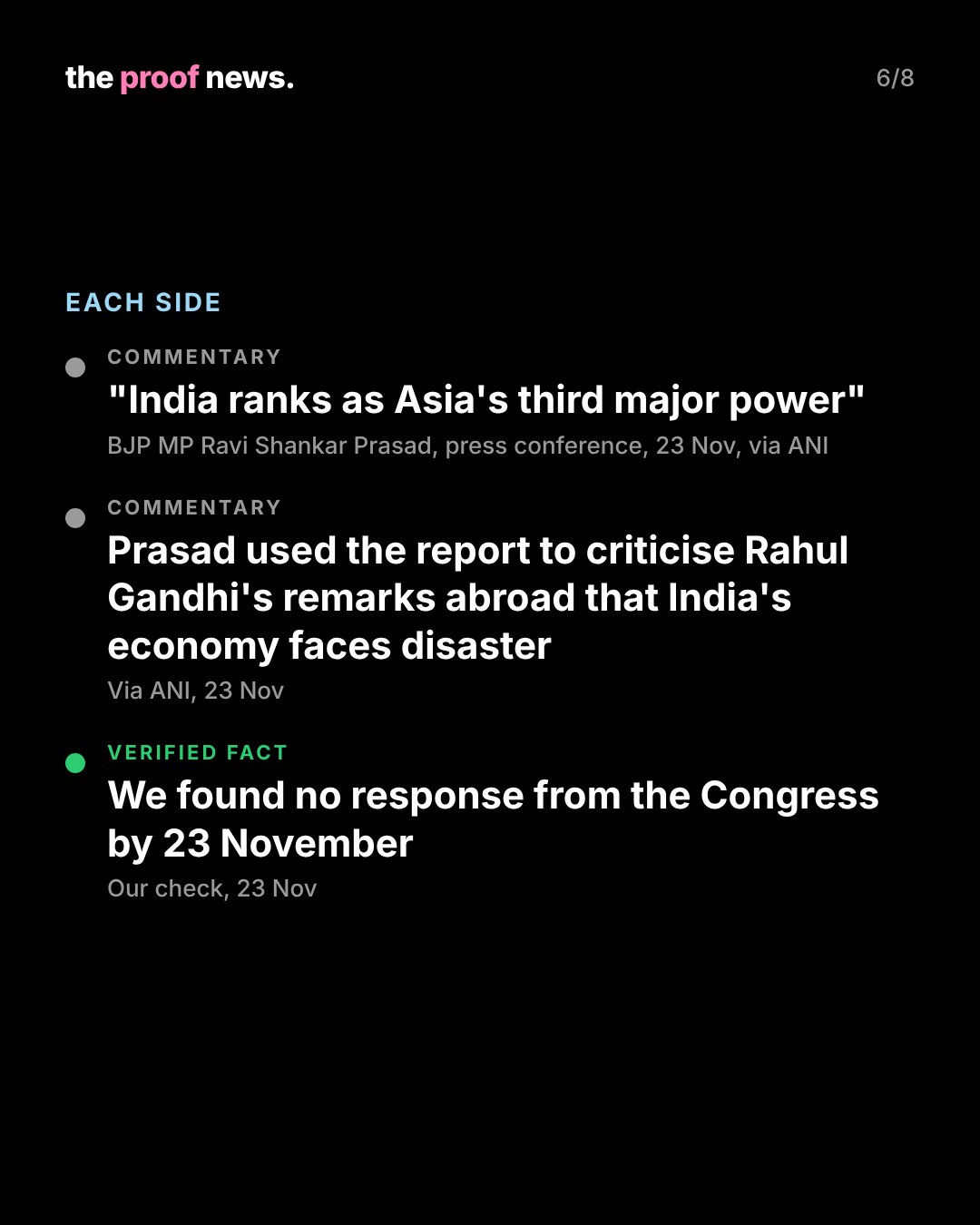
CommentaryBJP MP Ravi Shankar Prasad cited the report at a press conference in Delhi on 23 November, according to ANI: "India ranks as Asia's third major power, which serves as an indicator of its growing political and economic influence." He used it to criticise Congress leader Rahul Gandhi's remarks at Columbia University, asking: "on what basis do you claim while abroad that India's economy is extremely weak and that its future is bleak?"
Verified factWe found no response from the Congress to the report or to Prasad's remarks by 23 November. The Index is one institution's assessment; its weights and expert-survey results are its own judgements.
The proof.
All 27 scores are read from the rankings table in the Lowy Institute's report PDF, and our script checks the ranks, the bands and the differences we state. India's measure scores and ranks are read from the Index's India page and cross-checked against its key-findings page and the report text. The leadership ranking comes from the Index's expert survey, so it carries the Commentary label. We do not show year-on-year changes for individual measures: the Institute's report chart, key-findings page and India page round some of them differently.