HPV vaccination passes 1 crore doses; six states report 100% coverage, 20 states and UTs have no published figure
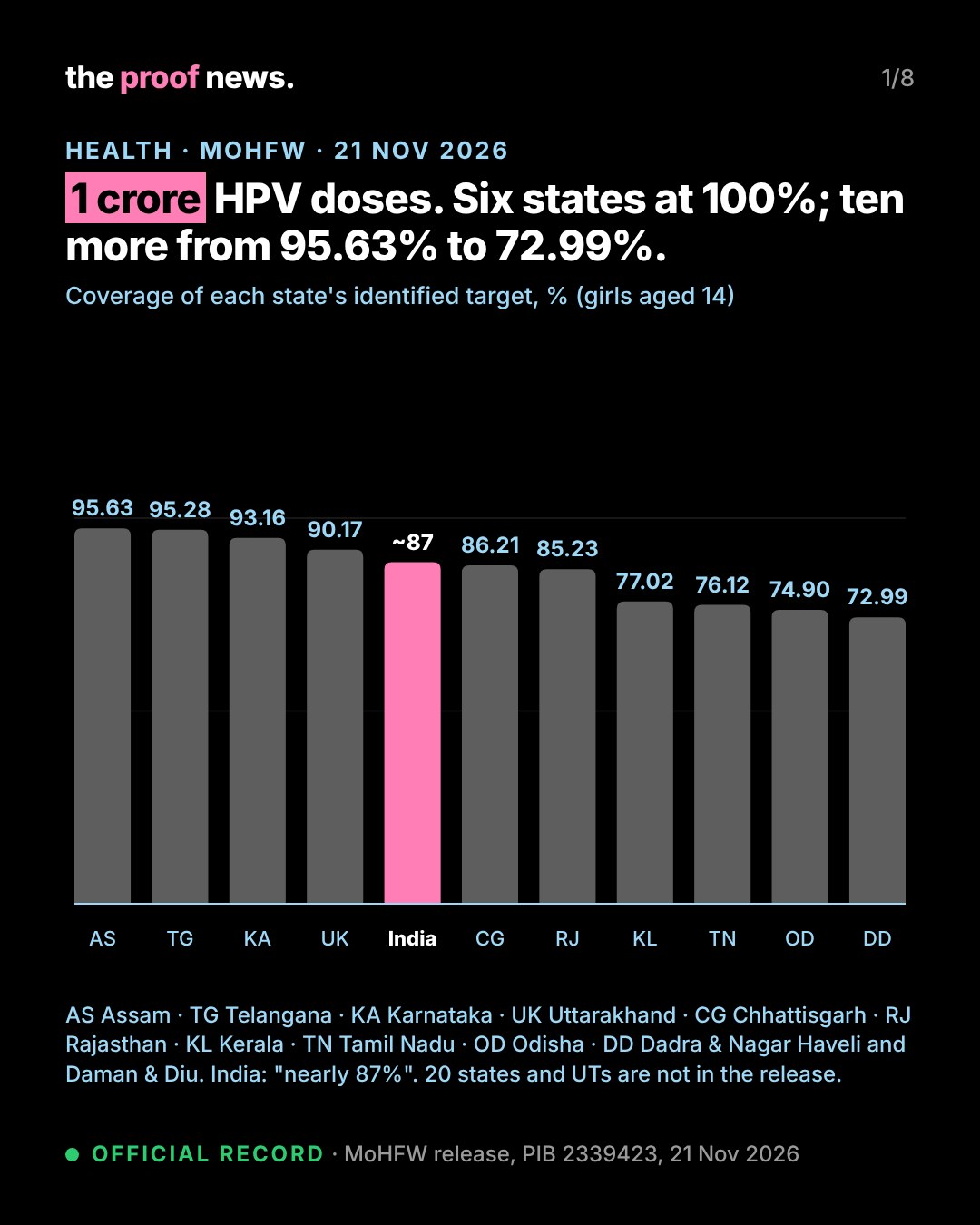
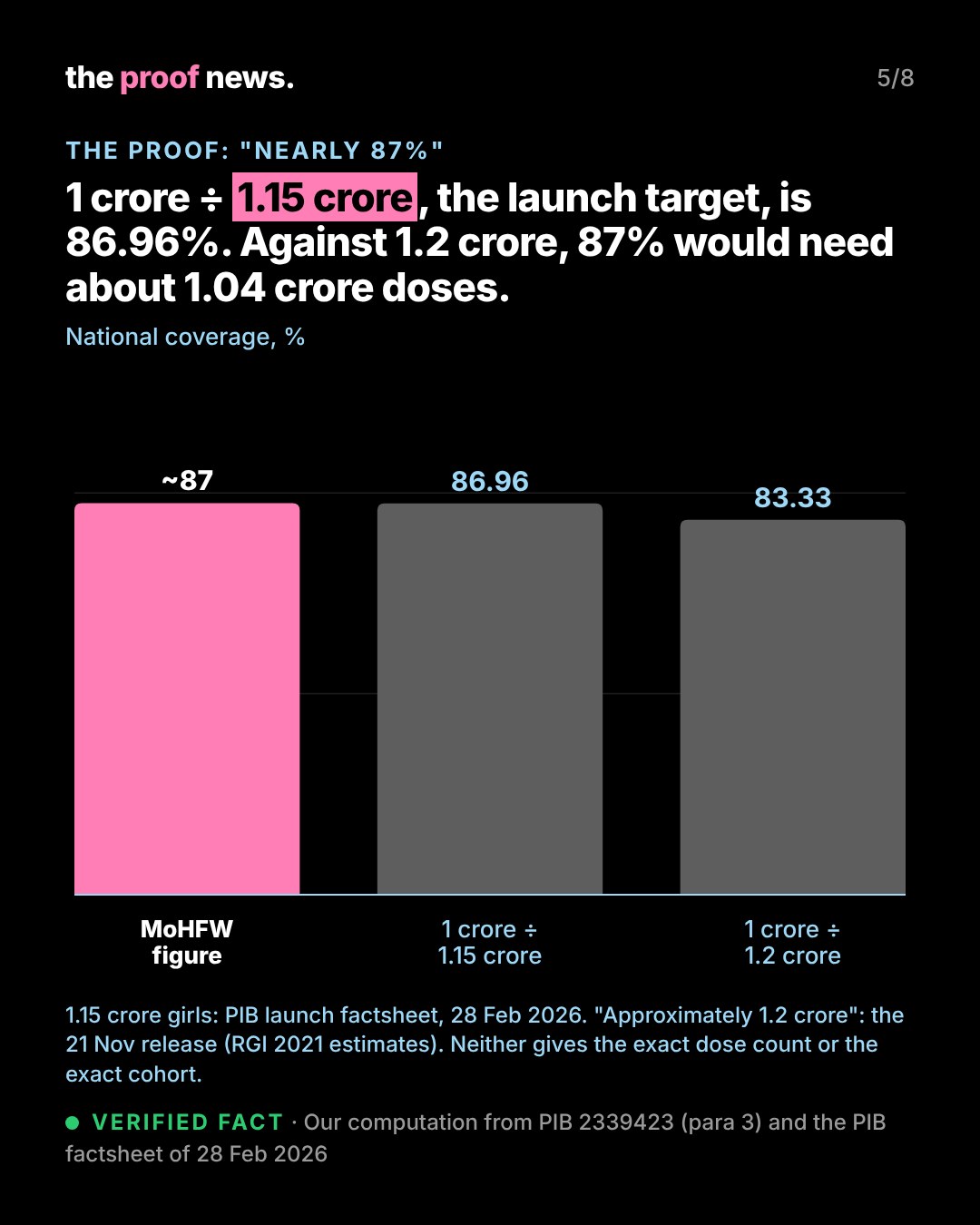
The Union Health Ministry puts national coverage at "nearly 87%" of about 1.2 crore girls aged 14. 1 crore doses over the launch target of 1.15 crore girls gives 86.96%; over 1.2 crore, 83.33%. The release gives state figures for 16 states and UTs, and none for the rest.
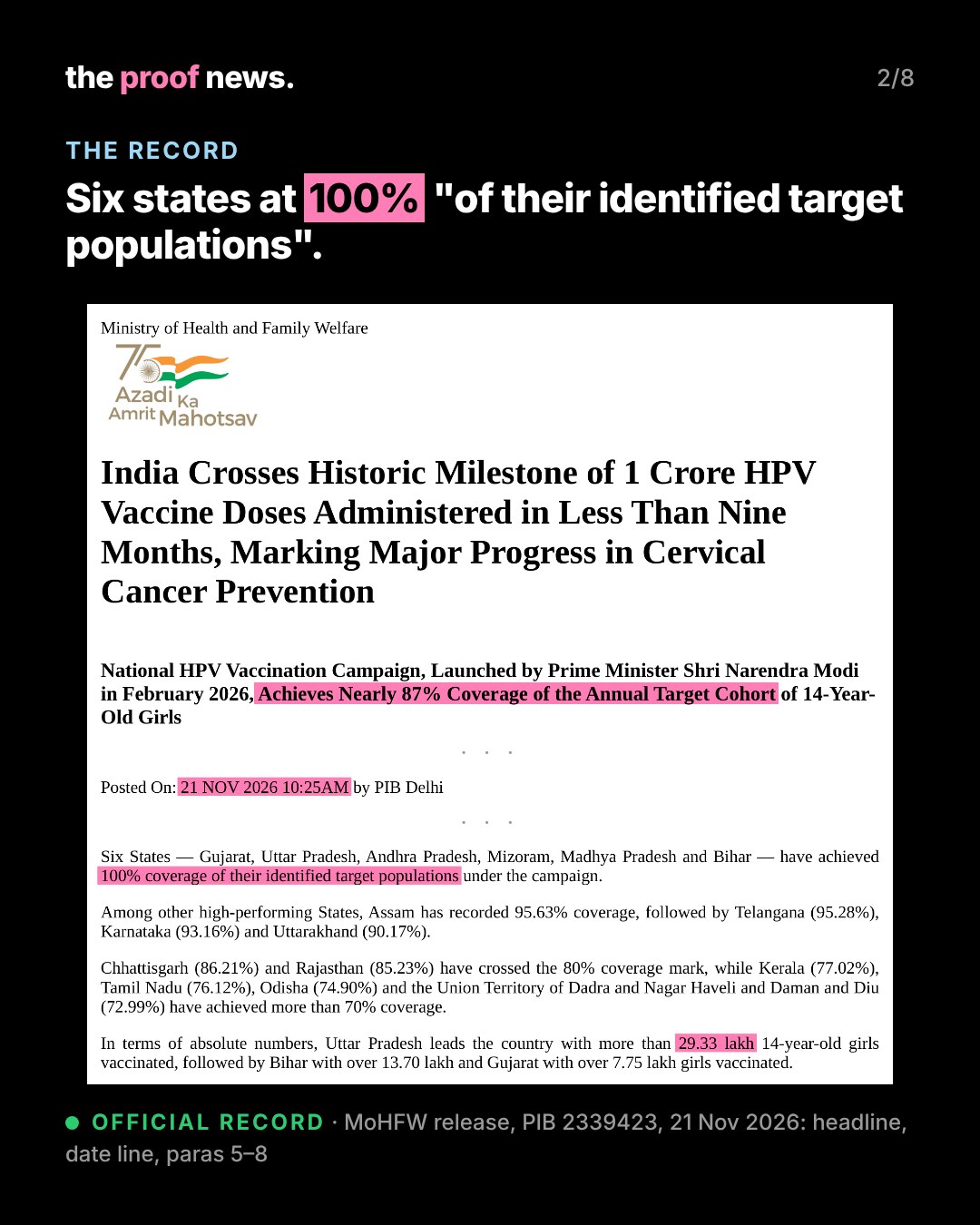
Official recordMore than 1 crore doses of the human papillomavirus (HPV) vaccine have been given under the National HPV Vaccination Campaign since its launch, the Ministry of Health and Family Welfare said in a release posted by PIB on 21 November 2026 (release ID 2339423). The ministry calls it a "historic milestone".
Official recordThe campaign gives one free dose of the vaccine, with parental consent, to 14-year-old girls at government health facilities. Prime Minister Narendra Modi launched it at Ajmer, Rajasthan, on 28 February 2026. The vaccine is Gardasil-4, a quadrivalent vaccine against HPV types 6, 11, 16 and 18; types 16 and 18 cause most cervical cancer. Girls who turned 15 within 90 days of the launch were also eligible during the first three-month drive; after that the vaccine is offered on routine immunisation days (PIB factsheet, 28 February 2026).
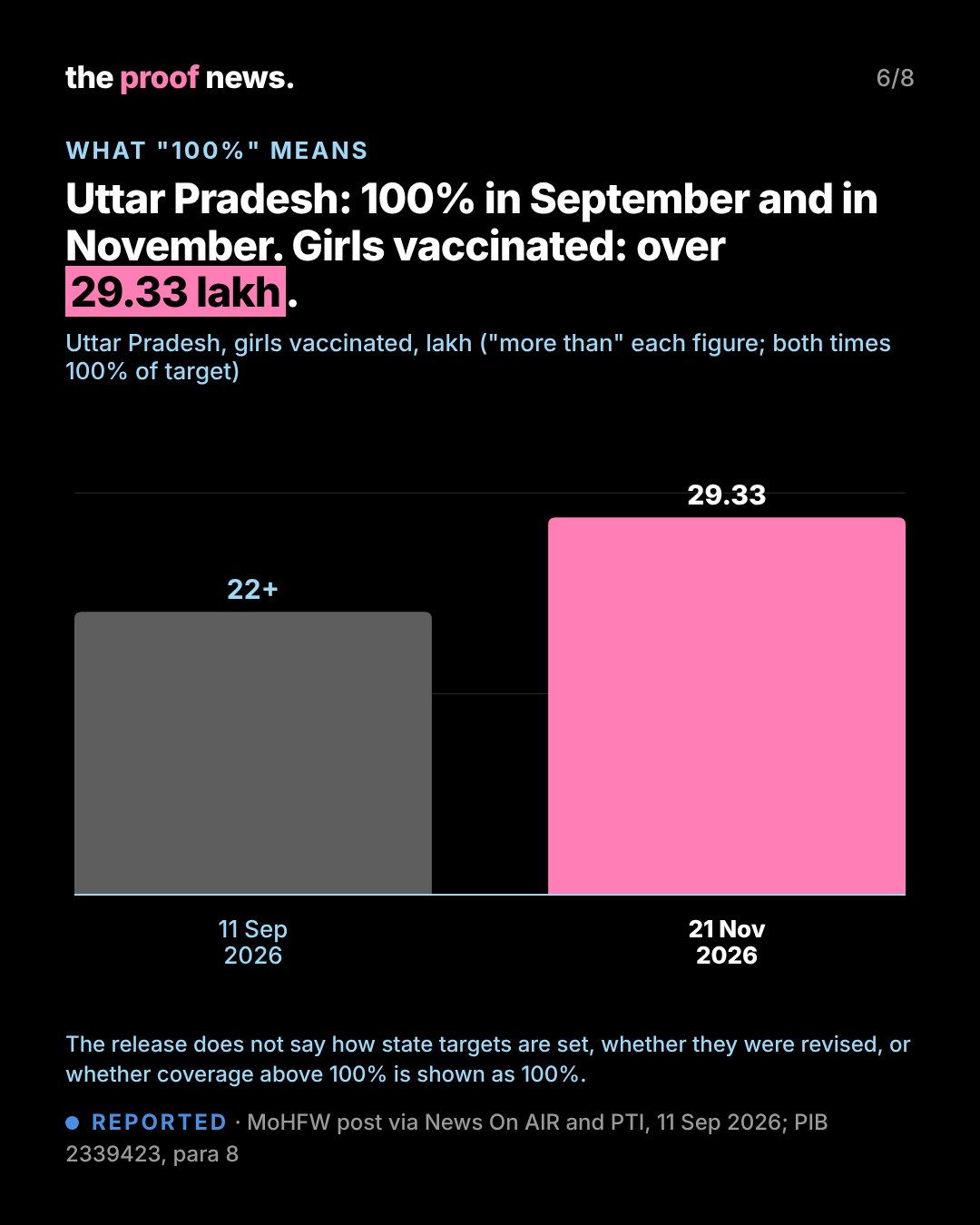
Official recordThe release gives coverage for 16 states and UTs, each measured against its "identified target population". Six states report 100%: Gujarat, Uttar Pradesh, Andhra Pradesh, Mizoram, Madhya Pradesh and Bihar. Then Assam 95.63%, Telangana 95.28%, Karnataka 93.16%, Uttarakhand 90.17%, Chhattisgarh 86.21%, Rajasthan 85.23%, Kerala 77.02%, Tamil Nadu 76.12%, Odisha 74.90% and Dadra and Nagar Haveli and Daman and Diu 72.99%. In absolute numbers, Uttar Pradesh has vaccinated more than 29.33 lakh girls, Bihar over 13.70 lakh and Gujarat over 7.75 lakh.
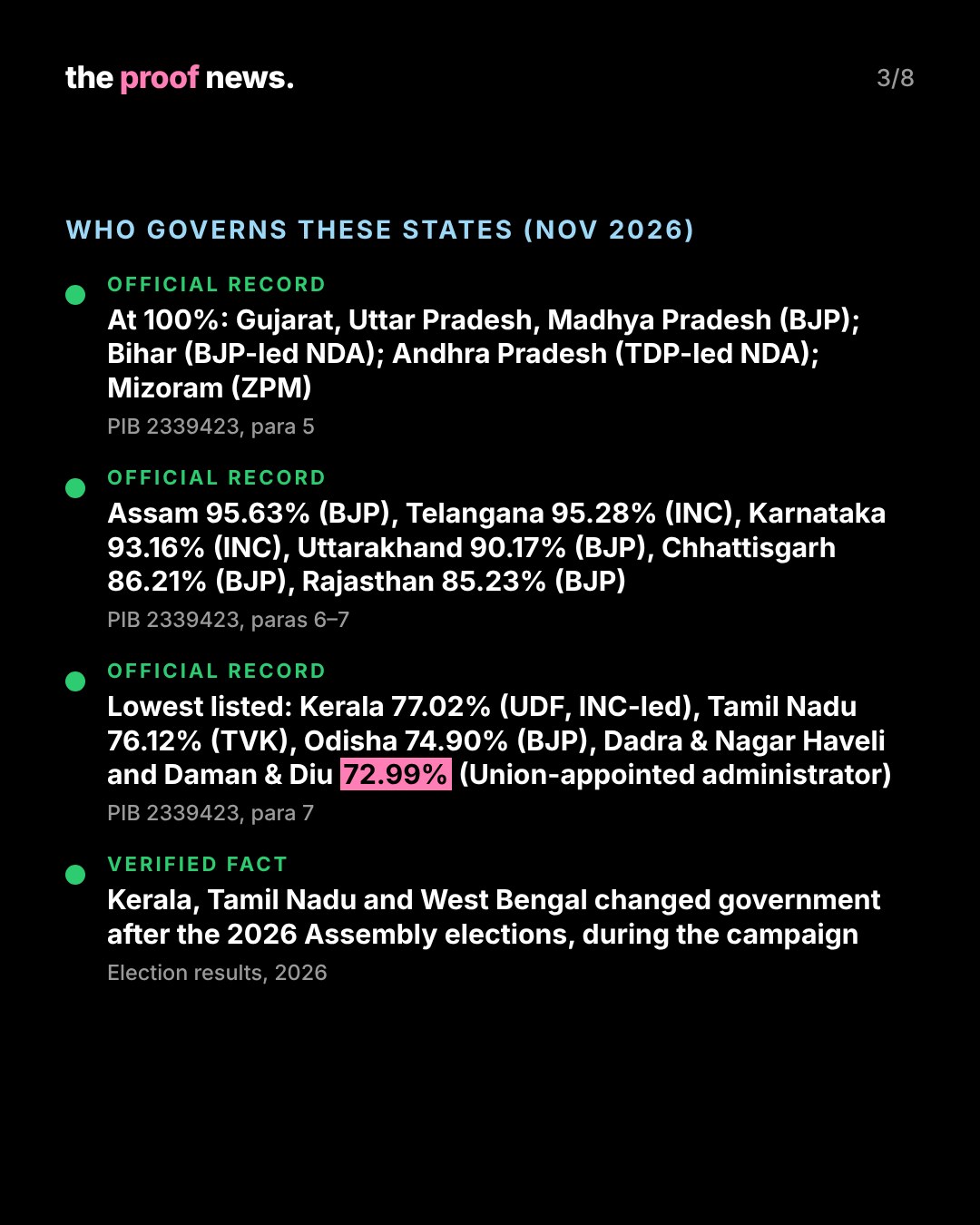
Verified factGoverning parties as of November 2026. At 100%: Gujarat, Uttar Pradesh and Madhya Pradesh (BJP), Bihar (BJP-led NDA), Andhra Pradesh (TDP-led NDA) and Mizoram (ZPM). In between: Assam (BJP), Telangana (INC), Karnataka (INC), Uttarakhand (BJP), Chhattisgarh (BJP) and Rajasthan (BJP). The four lowest listed: Kerala (UDF, INC-led), Tamil Nadu (TVK), Odisha (BJP) and Dadra and Nagar Haveli and Daman and Diu, a Union Territory run by an administrator appointed by the Union. Kerala, Tamil Nadu and West Bengal changed government after the 2026 Assembly elections, during the campaign.
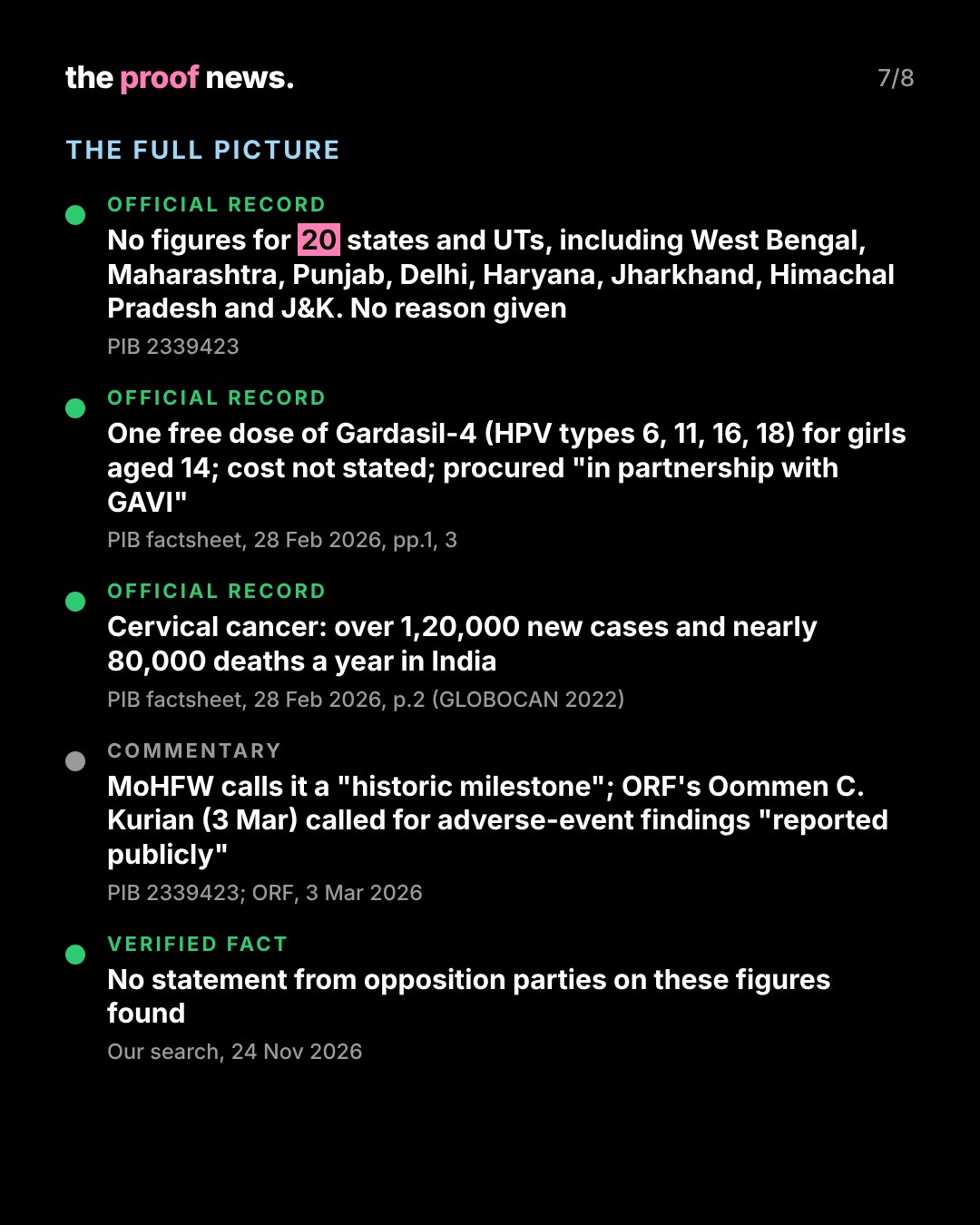
Official recordThe release has no coverage figure for the other 20 states and UTs: West Bengal, Maharashtra, Punjab, Haryana, Jharkhand, Himachal Pradesh, Goa, Sikkim, Arunachal Pradesh, Manipur, Meghalaya, Nagaland and Tripura, and the UTs of Delhi, Jammu and Kashmir, Ladakh, Chandigarh, Puducherry, Andaman and Nicobar Islands and Lakshadweep. It does not say why. Sikkim is mentioned only for a state-led initiative integrated with the campaign, alongside Bihar and Tamil Nadu.
Official recordThe release puts national coverage at "nearly 87%" of "the identified annual target cohort of approximately 1.2 crore girls, based on the Registrar General of India (RGI) 2021 population estimates".
Verified factOur check: 1 crore ÷ 1.2 crore = 83.33%. The PIB factsheet at the launch gave the target as about 1.15 crore girls; 1 crore ÷ 1.15 crore = 86.96%, which rounds to 87%. So 87% follows from 1 crore doses and the launch target; with a cohort of 1.2 crore, 87% would need about 1.04 crore doses. Neither document gives the exact number of doses (only "more than 1 crore") or the exact cohort, so the figure cannot be recomputed more precisely.
Verified factThe coverage counts doses given since the launch, which included girls who turned 15 within 90 days of it, against a cohort of girls aged 14. Each state's figure is against its own "identified target population"; the release does not say how those targets were set.
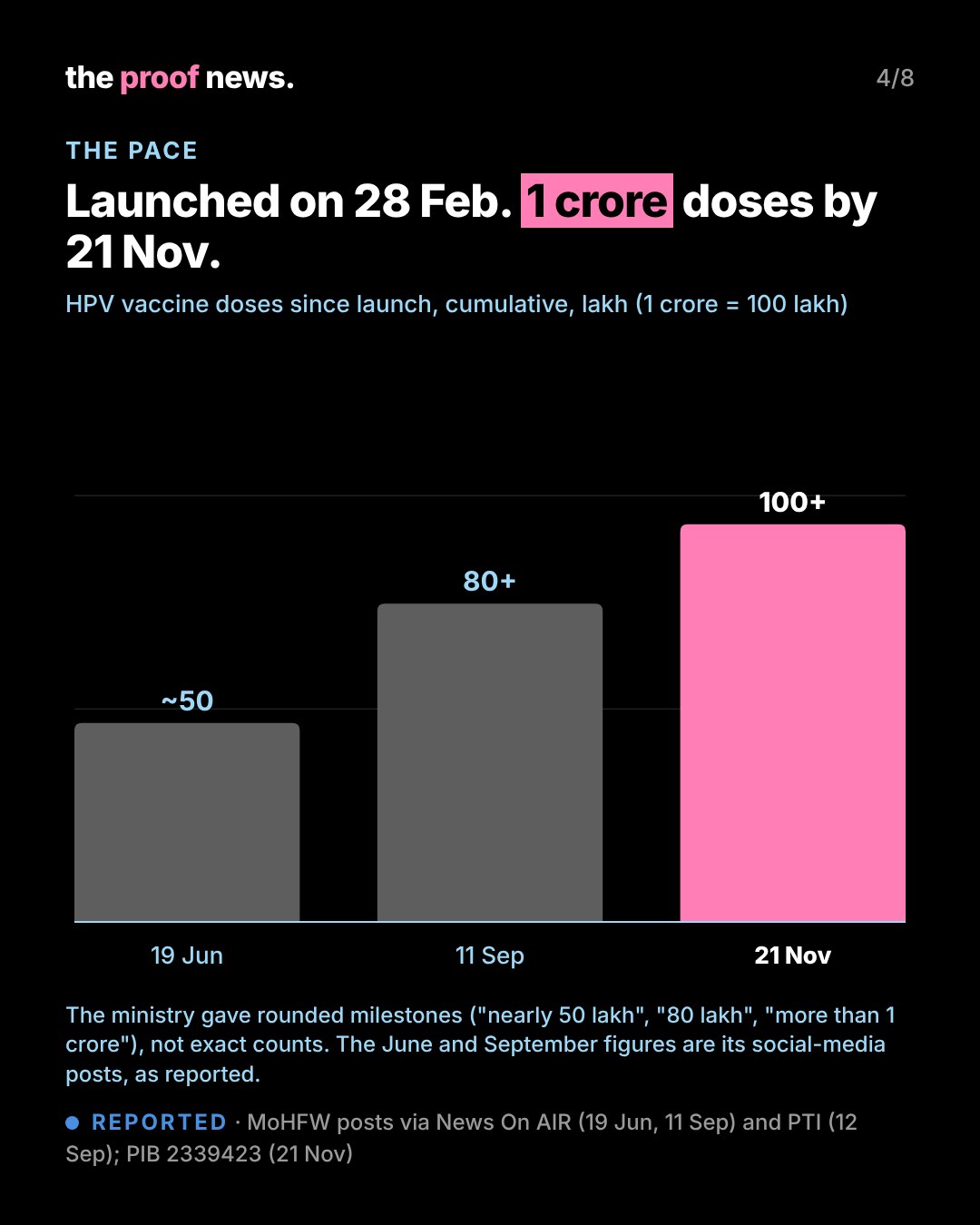
ReportedThe ministry's earlier posts, as reported by News On AIR and PTI: nearly 50 lakh doses by 19 June, with Madhya Pradesh and Gujarat at 100% and Mizoram at 93%; 80 lakh by 11 September, with Gujarat, Uttar Pradesh, Madhya Pradesh and Mizoram at 100%, and Bihar, Andhra Pradesh and Assam above 90%. In September Uttar Pradesh was at 100% with more than 22 lakh girls vaccinated; in November it is at 100% with more than 29.33 lakh. The release does not say whether state targets were revised or whether coverage above 100% is shown as 100%.
Official recordCervical cancer is the second most common cancer among women in India, with over 1,20,000 new cases and nearly 80,000 deaths a year (GLOBOCAN 2022, cited in the PIB factsheet). The factsheet says the vaccine is procured "in partnership with GAVI, the Vaccine Alliance" and cites a US$250 million Gavi partnership with India that includes support to introduce the HPV vaccine. Neither document gives the campaign's cost.
ReportedThe World Health Organization congratulated India on more than 10 million doses in a social-media post, and Prime Minister Modi, sharing a post by Union Health Minister J. P. Nadda, said it was a significant milestone in the journey towards preventive healthcare, News On AIR reported on 24 November.
CommentaryOommen C. Kurian of the Observer Research Foundation wrote on 3 March that public trust will depend on "independent adverse-event surveillance with findings reported publicly, regardless of convenience".
Verified factWe found no statement from opposition parties on the coverage figures.
Official recordWhat to watch: coverage figures for the 20 states and UTs not in the release, how state targets are set, and the next cohort of girls turning 14, who are offered the vaccine on routine immunisation days.
The proof.
Every state figure is read from the text of PIB release 2339423 and checked in check.py: 16 states and UTs listed, 12 above 80% (as in the ministry's infographic), 20 not listed. Our recomputation of the national figure: 1 crore ÷ 1.2 crore = 83.33%; 1 crore ÷ 1.15 crore (launch target) = 86.96%. The exact dose count and cohort are not published. Earlier milestones come from ministry posts as reported, and are labelled as such.
- MoHFW release, PIB 2339423, 21 Nov 2026
- PIB Research Unit factsheet: Cervical Cancer Vaccination Campaign Launched, 28 Feb 2026
- News On AIR: HPV vaccination drive crosses 50 lakh doses in three months, 19 Jun 2026
- News On AIR: India crosses mark of 80 lakh HPV vaccinations, 11 Sep 2026
- PTI via Siasat: Gujarat, UP, MP, Mizoram achieve 100 pc HPV vaccination coverage, 12 Sep 2026
- News On AIR: WHO congratulates India on over ten million doses of HPV vaccine, 24 Nov 2026
- ORF Expert Speak: Oommen C. Kurian, The Long Afterlife of a Regulatory Failure, 3 Mar 2026